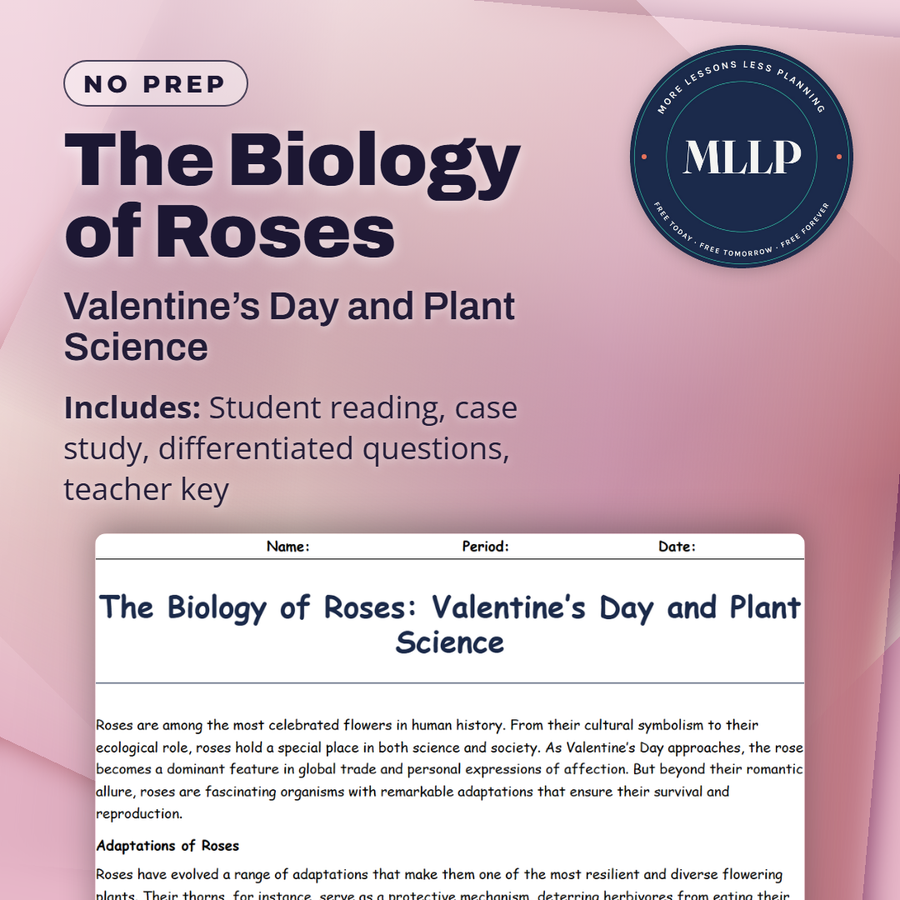
The Biology of Roses: Valentine’s Day and Plant Science
Quality reviewed September 2026
Facts verified September 9, 2026
- Subject
- Science
- Grades
- Grades 9-12
- Length
- 7-page student worksheet
- Time
- About one 50-minute class period
- Great for
- Sub plans and independent work
- Includes
- Reading passage, comprehension questions + full answer key
- Format
- Print-and-go PDF
What students do
- Connect specific rose adaptations to the organisms they attract or defend against
- Explain how cross-pollination increases genetic diversity and resilience
- Analyze environmental trade-offs in the Kenya rose industry using the case study
- Evaluate sustainable practices that balance economic and ecosystem health
What it covers
- Rose adaptations: thorns, petals, fragrance, and waxy coatings
- Pollination, genetic diversity, and reproduction
- Valentine supply chains and environmental stewardship
Start reading this worksheet
Roses are among the most celebrated flowers in human history. From their cultural symbolism to their ecological role, roses hold a special place in both science and society. As Valentine’s Day approaches, the rose becomes a dominant feature in global trade and personal expressions of affection. But beyond their romantic allure, roses are fascinating organisms with remarkable adaptations that ensure their survival and reproduction.
Adaptations of Roses
Roses have evolved a range of adaptations that make them one of the most resilient and diverse flowering plants. Their thorns, for instance, serve as a protective mechanism, deterring herbivores from eating their leaves and stems. These modified stems are sharp enough to cause discomfort to animals yet flexible enough to avoid breaking. Additionally, roses have a waxy coating on their leaves that helps retain moisture, a feature particularly useful in dry climates. Another crucial adaptation is their vibrant petals, which vary in color from deep red to pale white. These petals are not just visually stunning but are key to attracting pollinators like bees, butterflies, and hummingbirds. The bright colors combined with the alluring fragrance of roses act as a signal to pollinators, guiding them to the flower’s nectar and, consequently, its reproductive structures. Roses also produce a variety of secondary metabolites, including essential oils that create their signature scent. These oils are not only appealing to humans but also serve to repel certain pests. The intricate design of a rose’s reproductive structures ensures cross-pollination, promoting genetic diversity. This combination of defense mechanisms, attractants, and efficient pollination strategies underscores why roses have flourished across different habitats.
The Pollination Process
Pollination is the foundation of a rose's life cycle. Roses rely heavily on insects and other animals to transfer pollen from the male part of the flower (the stamen) to the female part (the carpel). When a pollinator lands on a rose, the sticky pollen grains attach to its body. As the pollinator moves to another flower, these grains are deposited on the stigma, leading to fertilization. Interestingly, some rose species have evolved to self-pollinate, ensuring reproduction even in the absence of pollinators. However, cross-pollination is more common and beneficial, as it increases the genetic diversity of the offspring, making them better equipped to survive environmental changes and diseases.
Like what you read? The full reading, the case study, and every question set are in the free download below, along with the answer key.
Why this matters
Every part of a Valentine's rose evolved for a reason that has nothing to do with romance. Thorns are defense, petals signal pollinators, and fragrance repels pests, not pleases a gift recipient. Students who think they already know roses are surprised the flower was never designed with a gift box in mind.
The Kenya case study is where the topic gets harder to sit with: thousands of workers and a damaged lake behind an industry that also produces something genuinely beautiful. Students have to hold both facts at once, which is a harder conclusion than simply picking a side.
From one teacher to another
Roses are way more interesting than romance. Students come in thinking Valentine's roses are just pretty, then discover thorns are defense mechanisms, petals are pollinator signals, and fragrance is pest repellent. The real hook is the Kenya case study, thousands of workers, beautiful flowers, and a lake getting destroyed. They have to wrestle with the fact that their Valentine gift has a real environmental cost and figure out what responsibility looks like. This worksheet does something hard: it lets roses stay beautiful while teaching students to think about where things come from.
What you get
Download
Where should I send the next one?
Everything here is free and it stays that way. Leave your email and I'll send you the new lessons as they go up. You can unsubscribe from any one of them.
Related resources
Animal Courtship Biology: Sexual Selection in the Wild
Famous Relationship Cases in Forensics: Evidence vs. Emotion in the Public Eye
Forensic Science and Domestic Violence
Forensic Science: Online Romance Scams
Government and Relationships: How Laws Have Shaped “Love” in U.S. History
Love Hormones: Oxytocin, Dopamine, and the Brain
Every lesson on this site is free to download and use. If one of them saved you a prep period, you can chip in a few bucks toward my three kids' daycare fund. That's genuinely where tips go.