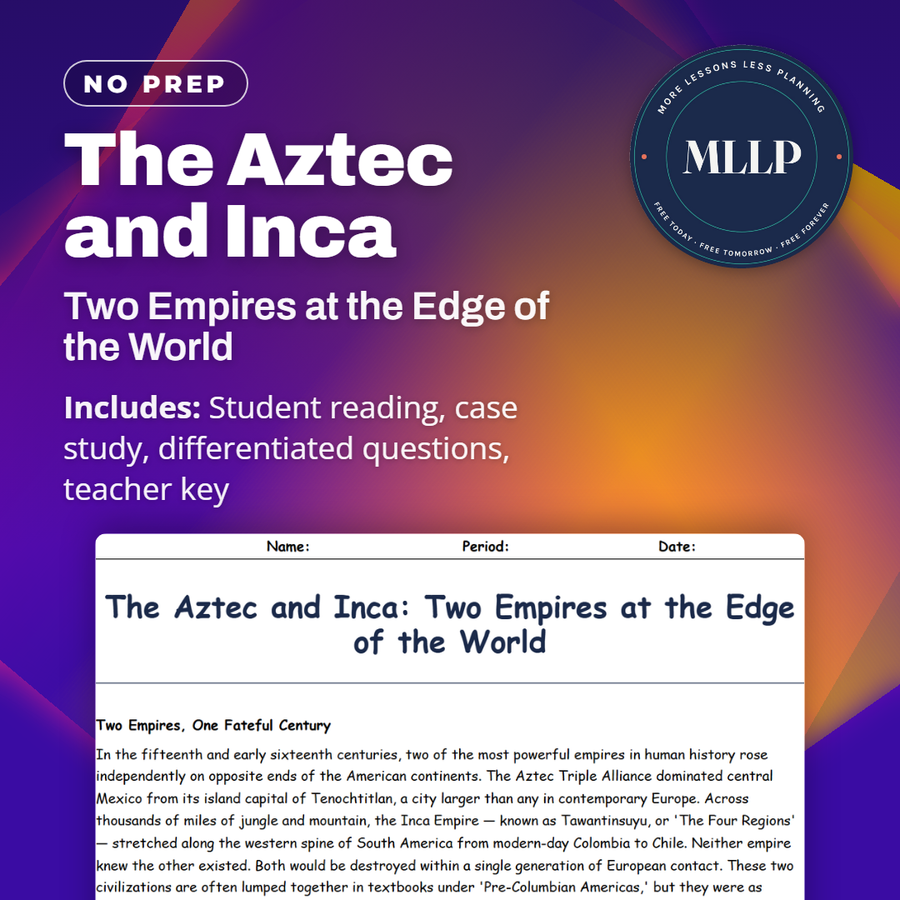
The Aztec and Inca: Two Empires at the Edge of the World
Quality reviewed September 2026
Facts verified September 21, 2026
- Subject
- Social Studies
- Grades
- Grades 9-12
- Length
- 9-page student worksheet
- Time
- About one 50-minute class period
- Great for
- Sub plans and independent work
- Includes
- Reading passage, comprehension questions + full answer key
- Format
- Print-and-go PDF
What students do
- Trace how Aztec tribute rule and Inca direct administration each held an empire together
- Isabel's storage-structure find outside Cusco sits behind a mining company's competing land claim
- Cortes's 500 men and Pizarro's 200 soldiers get set against each empire's internal divisions
- Answer why disease and internal division mattered more than Spanish weapons in both conquests
What it covers
- How the Aztec Triple Alliance and the Inca Tawantinsuyu each held their empires together
- Why smallpox and internal division did more than Spanish weapons to end both empires
- A modern land dispute in Peru that connects Inca archaeology to a living community
Start reading this worksheet
Two Empires, One Fateful Century
In the fifteenth and early sixteenth centuries, two of the most powerful empires in human history rose independently on opposite ends of the American continents. The Aztec Triple Alliance dominated central Mexico from its island capital of Tenochtitlan, a city larger than any in contemporary Europe. Across thousands of miles of jungle and mountain, the Inca Empire (known as Tawantinsuyu, or 'The Four Regions') stretched along the western spine of South America from modern-day Colombia to Chile. Neither empire knew the other existed. Both would be destroyed within a single generation of European contact. These two civilizations are often lumped together in textbooks under 'Pre-Columbian Americas,' but they were as different from each other as Rome was from China. The Aztec built their power through a web of tribute relationships, military conquest, and religious ceremony. The Inca built theirs through an unprecedented system of roads, administrative control, and labor taxation. Understanding how each empire worked (and how each fell) tells us as much about the fragility of complex societies as it does about the brutality of conquest.
The Aztec World: Tribute, War, and the Sun
The Aztec, who called themselves the Mexica, rose from obscure origins in the early fourteenth century. According to their own tradition, they were a wandering people guided by their god Huitzilopochtli to an eagle perched on a cactus in the middle of Lake Texcoco, the spot where they would build Tenochtitlan. By the mid-1400s, the Mexica had formed the Triple Alliance with the city-states of Texcoco and Tlacopan and began systematically conquering neighboring peoples. By 1519, their empire stretched across most of central Mexico and extracted tribute from hundreds of subject peoples. The Aztec worldview centered on a cosmic bargain: the gods had sacrificed themselves to create the current world, and humans owed a debt of blood that had to be repaid continuously through ritual offerings. This belief drove the institution of human sacrifice and the 'Flowery Wars', ritualized conflicts designed specifically to capture enemies for sacrifice rather than to kill them outright. Spanish accounts exaggerated the scale of sacrifice for political purposes, but archaeological evidence confirms it was a central feature of Aztec religious life. The Templo Mayor in Tenochtitlan, excavated beneath Mexico City since 1978, has yielded thousands of offering deposits, ritual objects, and human remains that are slowly rewriting the narrative of what Aztec religion actually looked like.
The Inca World: Roads, Quipus, and the Son of the Sun
The Inca Empire was the largest in pre-Columbian America, covering approximately 770,000 square miles and a population estimated between 6 and 14 million people at its height. The Sapa Inca (the emperor) was considered literally divine, the son of the sun god Inti. Unlike the Aztec, who ruled through a tribute system that left subject peoples largely autonomous, the Inca imposed direct administrative control over conquered territories. They resettled populations, imposed a labor tax called mit'a, and tied the entire empire together with over 40,000 kilometers of roads: a feat accomplished without the wheel, without draft animals larger than the llama, and without iron tools. The Inca had no writing system in the conventional sense, but they developed an extraordinary recording technology called the quipu, bundles of knotted cords that could encode numerical information and, possibly, narrative content. Quipu keepers called quipucamayocs maintained these records for the state. When Spanish administrators burned the quipus as objects of devil worship, they destroyed an enormous archive of Andean history. Researchers are still working to decode surviving quipus and recover what was lost.
Like what you read? The full reading, the case study, and every question set are in the free download below, along with the answer key.
Why this matters
Textbooks often flatten the Aztec and Inca into one paragraph under Pre Columbian civilizations, which erases how differently each one actually worked and collapsed. Isabel Quispe's case study, a Quechua archaeologist facing a two year permit review while a mining company already has equipment near her discovery, shows that the same imbalance of power that shaped the conquest five centuries ago still shows up in who gets heard when land and heritage are on the line today. Students leave this reading with a clearer sense of two distinct political systems, and a reminder that the descendants of both are still dealing with decisions being made about their land right now.
From one teacher to another
Two empires rose an ocean apart in the fifteenth century, never knew the other existed, and were both gone within a single generation of European contact. That is the frame this reading uses to compare the Aztec and Inca directly instead of treating them as one interchangeable unit. Students see how differently each held power, the Aztec through tribute relationships that left conquered cities mostly self governing, the Inca through direct administration, forced resettlement, and a labor tax called mit'a. Cortes needed about five hundred men and two years. Pizarro needed fewer than two hundred and a captured emperor, and the reading pushes past the easy superior weapons explanation into the internal political splits and epidemic disease that did most of the real damage. A case study closes the reading in the present day, with a young Quechua archaeologist facing a mining company's land claim over a site she just found.
What you get
Download
Where should I send the next one?
Everything here is free and it stays that way. Leave your email and I'll send you the new lessons as they go up. You can unsubscribe from any one of them.
Related resources
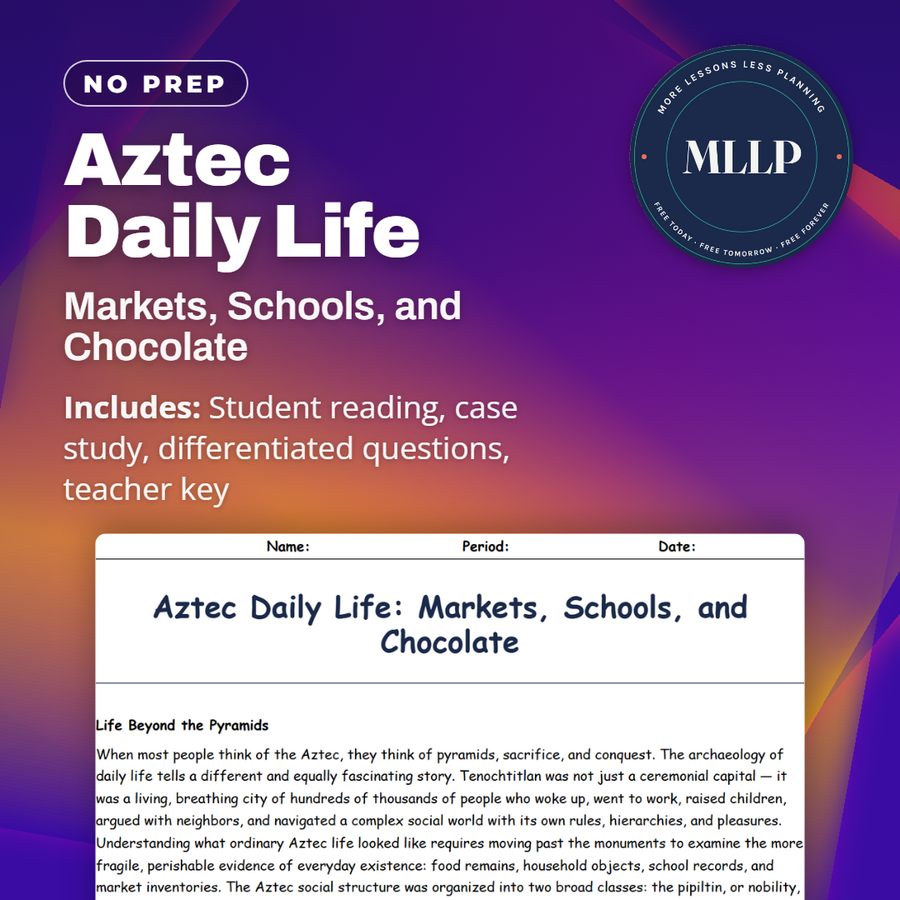
Aztec Daily Life: Markets, Schools, and Chocolate
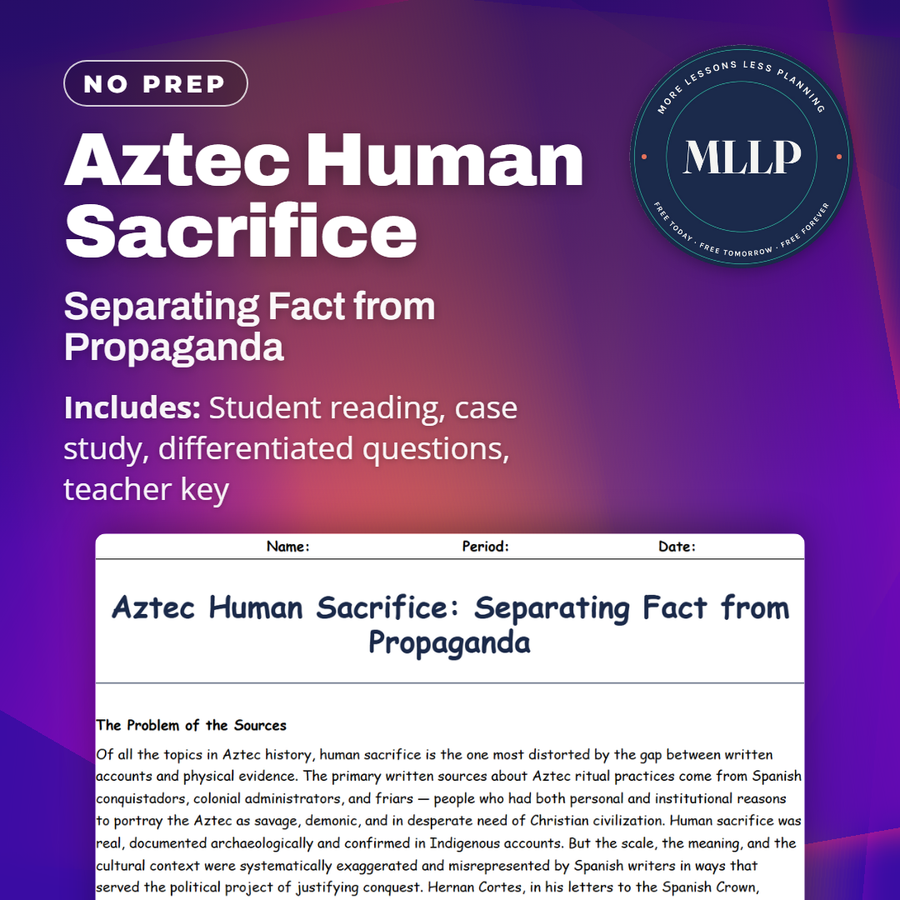
Aztec Human Sacrifice: Separating Fact from Propaganda
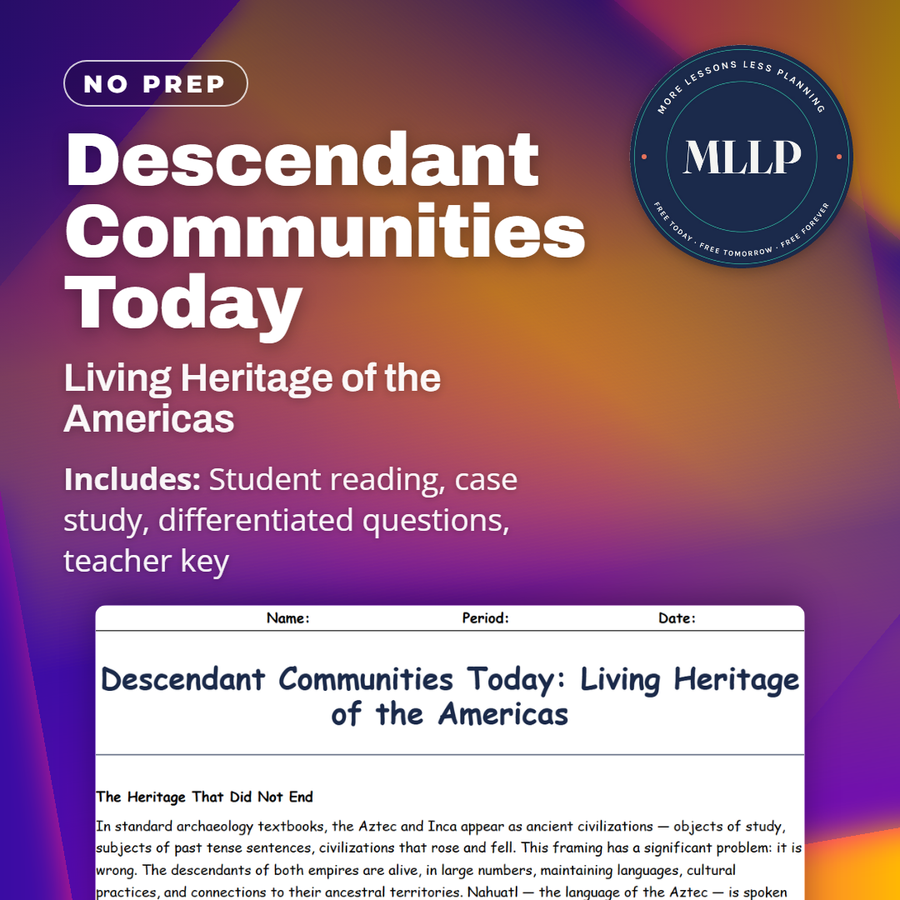
Descendant Communities Today: Living Heritage of the Americas
Inca Child Sacrifice: Capacocha and the Mountain Mummies
Machu Picchu: The Lost City That Was Never Lost
Quipu: The Inca Writing System Made of Knots
Every lesson on this site is free to download and use. If one of them saved you a prep period, you can chip in a few bucks toward my three kids' daycare fund. That's genuinely where tips go.