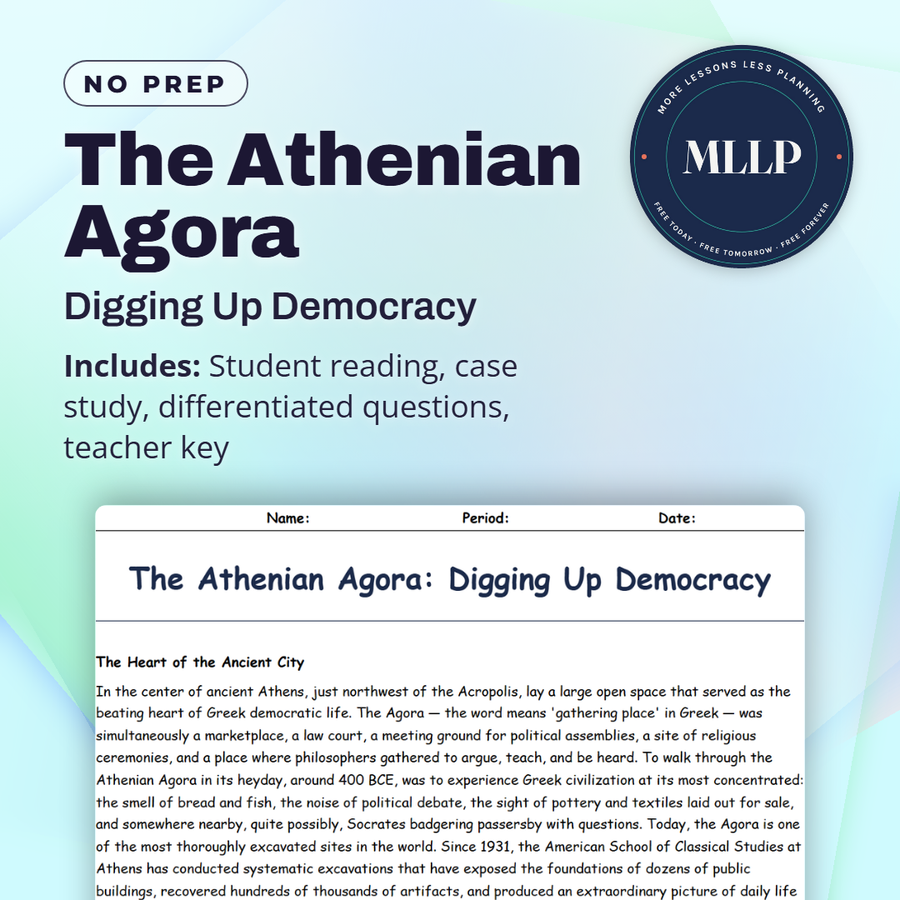
The Athenian Agora: Digging Up Democracy
Quality reviewed September 2026
Facts verified September 21, 2026
- Subject
- Social Studies
- Grades
- Grades 9-12
- Length
- 8-page student worksheet
- Time
- About one 50-minute class period
- Great for
- Sub plans and independent work
- Includes
- Reading passage, comprehension questions + full answer key
- Format
- Print-and-go PDF
What students do
- Trace how ostracism let Athenian citizens exile a politician for ten years without trial or formal charges
- Sort five terms, from agora to kleroterion, by what each one actually did in Athenian civic life
- A potter scratching a stranger's name onto a broken pot handle before an ostracism vote runs through two case study questions
- Everyday objects recovered from the Agora, from toy horses to loom weights, get checked in a multiple-choice question on what they reveal
What it covers
- Ostracism and the pottery ballots called ostraka
- The kleroterion, the bronze device Athens used to randomize jury selection
- How everyday objects at the Agora reveal ordinary Athenian life
Start reading this worksheet
The Heart of the Ancient City
In the center of ancient Athens, just northwest of the Acropolis, lay a large open space that served as the beating heart of Greek democratic life. The Agora (the word means 'gathering place' in Greek) was simultaneously a marketplace, a law court, a meeting ground for political assemblies, a site of religious ceremonies, and a place where philosophers gathered to argue, teach, and be heard. To walk through the Athenian Agora in its heyday, around 400 BCE, was to experience Greek civilization at its most concentrated: the smell of bread and fish, the noise of political debate, the sight of pottery and textiles laid out for sale, and somewhere nearby, quite possibly, Socrates badgering passersby with questions. Today, the Agora is one of the most thoroughly excavated sites in the world. Since 1931, the American School of Classical Studies at Athens has conducted systematic excavations that have exposed the foundations of dozens of public buildings, recovered hundreds of thousands of artifacts, and produced an extraordinary picture of daily life in ancient Athens. The excavations required demolishing several blocks of the modern Monastiraki neighborhood. That is a reminder that archaeology in a living city always involves difficult trade-offs between the past and the present.
Ostraka: Voting Against Someone with a Broken Pot
Among the most remarkable finds from the Agora are thousands of ostraka: pottery sherds on which citizens scratched the name of someone they wanted expelled from Athens. Ostracism was a democratic procedure unique to Athens: once a year, citizens could vote to banish a politician for ten years, without trial, without specific charges, and without the accused having any formal opportunity to defend himself. If a minimum of six thousand votes were cast and one individual received the most votes, he was exiled. The goal was to prevent any single person from accumulating enough power to become a tyrant. The ostraka recovered from the Agora and elsewhere are extraordinary historical documents. They preserve the names of real Athenian citizens, written in their own hands, including some famous names: Themistocles, the general who defeated the Persians at Salamis, was ostracized in 471 BCE. Aristides, known as 'the Just,' was ostracized in 482 BCE. One batch of ostraka found in a pit bears the same name, Themistocles, written in only a few different handwriting styles, suggesting that political organizers prepared batches of pre-filled ostraka to hand out to voters who couldn't write. Democracy, apparently, had political operatives from the very beginning.
The Stoa of Attalos and What Survives
Ancient public buildings surrounded the Agora on all sides. The most impressive survivor is the Stoa of Attalos, a long colonnade originally built by King Attalos II of Pergamon as a gift to Athens in the second century BCE. The stoa (a covered walkway with shops along one side) served as a commercial and social space where Athenians could conduct business and escape the rain. In the 1950s, the American School completely reconstructed the Stoa of Attalos using ancient materials and plans, creating a building that now houses the Agora Museum: a controversial reconstruction that echoes the debates around Evans's work at Knossos, though generally considered more faithful to the archaeological evidence. Other key structures include the Tholos (a circular building where the executive committee of the Athenian council met and ate, working in rotation around the clock to ensure constant government) and the foundations of the Metroon, the state archive where official documents were stored. The Metroon's existence confirms something important: Athens was a literate bureaucracy as well as a democracy. Laws were inscribed on stone and bronze for public display, contracts were recorded, and court decisions were documented. The written record was central to how Athenian democracy functioned.
Like what you read? The full reading, the case study, and every question set are in the free download below, along with the answer key.
Why this matters
The pre-written ostraka in this reading, ballots with the same name scratched by only a few different hands, are basically ancient campaign literature, and that detail matters because it shows organized political persuasion is not some modern invention, it is as old as democracy itself. The potter's case study is useful for the same reason: he votes based on secondhand opinion and neighborhood gossip rather than deep political knowledge, which is closer to how a lot of real voting happens than students might expect. Ostracism itself, banishment without trial or formal charges, is also worth debating directly, since it forces students to weigh a real democratic safeguard against a process that would violate basic rights in any modern court.
From one teacher to another
I use the Agora reading when I want students to see Athenian democracy as something people actually did with their hands, rather than only an idea in a textbook. Citizens voted to exile a fellow Athenian for ten years by scratching his name onto a broken pot, no trial required, and thousands of these ostraka have been recovered from the site since excavation began in 1931. The reading covers real names, Themistocles and Aristides among them, and one batch of pre-written ballots that suggests political organizers were handing out votes to citizens who could not write. A case study follows a potter who votes to exile a man he knows almost nothing about, based only on which neighbors seemed to dislike him. Students also read about the kleroterion, a bronze device Athens used to randomly assign jury duty and keep it from being bought.
What you get
Download
Where should I send the next one?
Everything here is free and it stays that way. Leave your email and I'll send you the new lessons as they go up. You can unsubscribe from any one of them.
Related resources
Alexander's Empire: Archaeology Across Three Continents
Ancient Greece: An Overview
Delphi: The Center of the Ancient World
Greek Pottery: Art That Tells Stories
Knossos and the Minoans: Europe's First Civilization
Mycenae and the Trojan War: Where Myth Meets Archaeology
Every lesson on this site is free to download and use. If one of them saved you a prep period, you can chip in a few bucks toward my three kids' daycare fund. That's genuinely where tips go.