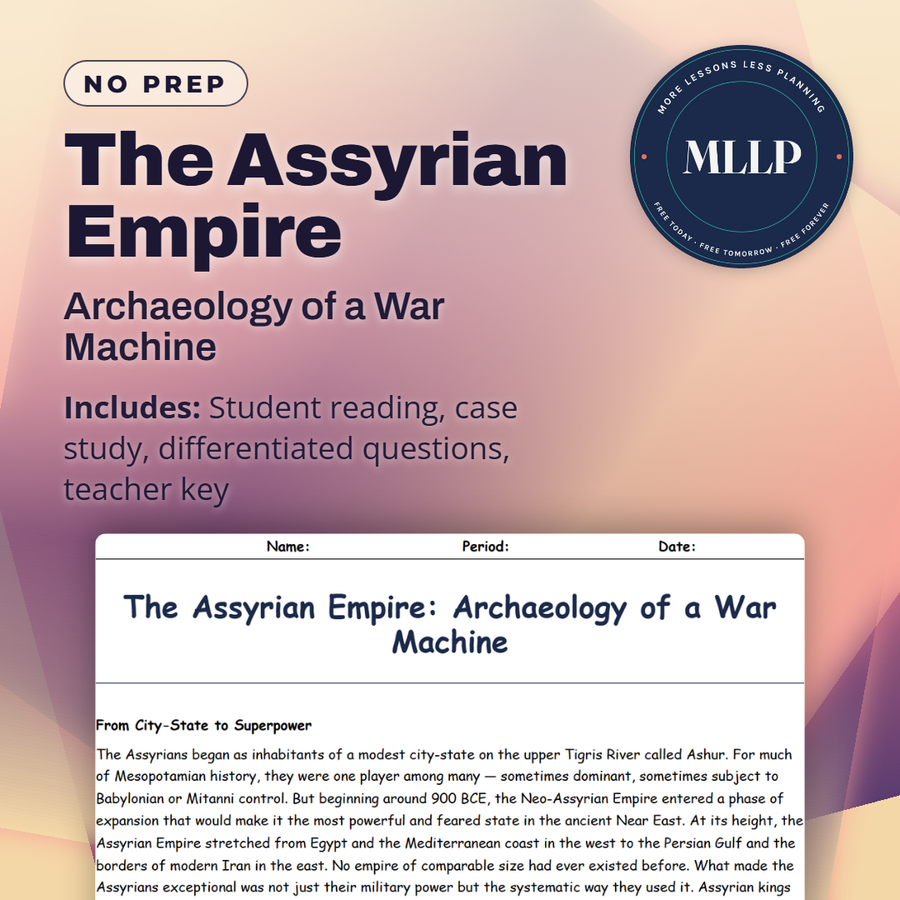
The Assyrian Empire: Archaeology of a War Machine
Quality reviewed September 2026
Facts verified September 21, 2026
- Subject
- Social Studies
- Grades
- Grades 9-12
- Length
- 8-page student worksheet
- Time
- About one 50-minute class period
- Great for
- Sub plans and independent work
- Includes
- Reading passage, comprehension questions + full answer key
- Format
- Print-and-go PDF
What students do
- The lamassu's double meaning, striding from the side and standing still from the front, gets worked out using the reading's own description
- Explain how the Library of Ashurbanipal survived the same fire that destroyed the palace built to house it
- Dr. Chen's reaction to watching Nimrud's destruction on video gets connected to what she says digital reconstruction cannot replace
- Answer questions about why calculated frightfulness worked as both a military and administrative strategy
What it covers
- Ashurbanipal's 30,000-tablet library and how it survived the fall of Nineveh
- The lamassu guardian figures at Nimrud and what they were built to communicate
- ISIS's 2015 destruction of Nimrud and what digital reconstruction cannot recover
Start reading this worksheet
From City-State to Superpower
The Assyrians began as inhabitants of a modest city-state on the upper Tigris River called Ashur. For much of Mesopotamian history, they were one player among many — sometimes dominant, sometimes subject to Babylonian or Mitanni control. But beginning around 900 BCE, the Neo-Assyrian Empire entered a phase of expansion that would make it the most powerful and feared state in the ancient Near East. At its height, the Assyrian Empire stretched from Egypt and the Mediterranean coast in the west to the Persian Gulf and the borders of modern Iran in the east. No empire of comparable size had ever existed before. What made the Assyrians exceptional was not just their military power but the systematic way they used it. Assyrian kings pioneered what historians now call 'calculated frightfulness': the deliberate use of extreme violence against enemies who resisted, combined with generous terms for those who submitted without fighting. Walls of cities that refused to surrender were lined with impaled captives. Populations of conquered cities were sometimes forcibly relocated thousands of miles from their homes, a policy designed to prevent rebellion by destroying communities' social cohesion. But cities that opened their gates without a fight received protection and could continue trading under Assyrian administration.
Nineveh and the Library of Ashurbanipal
The Assyrian Empire reached its greatest territorial extent under Ashurbanipal, who ruled from 668 to 627 BCE. Ashurbanipal was unusual among Assyrian kings in that he was also a scholar. He claimed to be able to read cuneiform tablets, which was rare for a ruler rather than a trained scribe. He used this knowledge to commission one of the ancient world's most ambitious intellectual projects: a systematic collection of every significant cuneiform text from across Mesopotamia, gathered from temples, schools, and private libraries, copied, and stored in his palace at Nineveh. The Library of Ashurbanipal contained an estimated 30,000 clay tablets covering everything from religious hymns and omens to mathematical tables, medical texts, and literary works including the Epic of Gilgamesh. Scribes were sent across the empire with explicit orders to copy tablets from existing collections — and, when collections were not surrendered voluntarily, to take them. When Nineveh fell to a coalition of Babylonians and Medes in 612 BCE, the palace burned. But the fire baked the clay tablets rather than destroying them, and British archaeologists excavating in the 1840s and 1850s found them preserved beneath the rubble. The library that had been meant to last forever turned out to have survived precisely because of the disaster that was supposed to destroy it.
Nimrud and the Lamassu
Before Nineveh, the Assyrian capital was Nimrud (ancient Kalhu), built by the king Ashurnasirpal II around 880 BCE. Nimrud was an extraordinary construction project: a walled city covering some 360 hectares, with a massive palace complex decorated with stone relief carvings depicting the king hunting, fighting, and performing religious rituals. Guarding the palace gateways were lamassu — enormous composite figures with the body of a bull or lion, the wings of an eagle, and the head of a bearded human wearing a royal crown. Each lamassu weighed approximately 16 tons and was carved from a single block of stone. The lamassu served as protective spirits for the palace, positioned so that entering officials would see a side view (showing four legs in a striding posture) and a frontal view (showing both legs stationary) — the figures appear to move or stand still depending on the angle. They also served as powerful propaganda, communicating the wealth, power, and divine favor of the Assyrian king to anyone who entered his presence. British archaeologist Austen Henry Layard shipped examples of the lamassu to the British Museum in the 1840s, where they remain among the most impressive objects in the collection.
Like what you read? The full reading, the case study, and every question set are in the free download below, along with the answer key.
Why this matters
Nimrud stood for more than 2,800 years before it was destroyed with sledgehammers, power tools, and explosives in a matter of hours in 2015, and the reading's case study scholar Dr. Chen names exactly what a photograph cannot preserve: the pigment residue, the tool marks, the physical evidence of three thousand years of history held in the stone itself. That distinction matters for students who assume a digital scan or a 3D reconstruction can replace the object it was made from. Destruction like this erases physical evidence that a screen can never hold, according to the reading's own argument. Understanding why the Assyrians built lamassu and libraries in the first place gives students a concrete stake in why archaeological preservation still matters today.
From one teacher to another
Assyrian kings pioneered a strategy historians call calculated frightfulness, brutal treatment for any city that resisted, paired with real protection for any city that surrendered without a fight. The reading traces the empire's rise from a modest city-state on the Tigris to the largest empire the ancient Near East had ever seen, then focuses on two capitals, Nineveh, where King Ashurbanipal built a 30,000-tablet library that survived precisely because the fire that destroyed his palace also baked its clay tablets, and Nimrud, where colossal lamassu guarded the palace gates for more than 2,800 years. Students also confront a more recent loss: in March 2015, ISIS destroyed Nimrud and smashed artifacts in the Mosul Museum on camera. A case study follows an Oriental Institute scholar who watches that footage in real time and has to reckon with what a digital reconstruction can and cannot replace.
What you get
Download
Where should I send the next one?
Everything here is free and it stays that way. Leave your email and I'll send you the new lessons as they go up. You can unsubscribe from any one of them.
Related resources
Babylon and the Hanging Gardens: Myth or Reality?

Cuneiform: The World's First Writing System
Gobekli Tepe: The Temple That Rewrote History
Hammurabi's Code: Justice Carved in Stone
Looting and Loss: The Destruction of Iraq's Heritage
Mesopotamia and the Fertile Crescent: Where Civilization Began
Every lesson on this site is free to download and use. If one of them saved you a prep period, you can chip in a few bucks toward my three kids' daycare fund. That's genuinely where tips go.