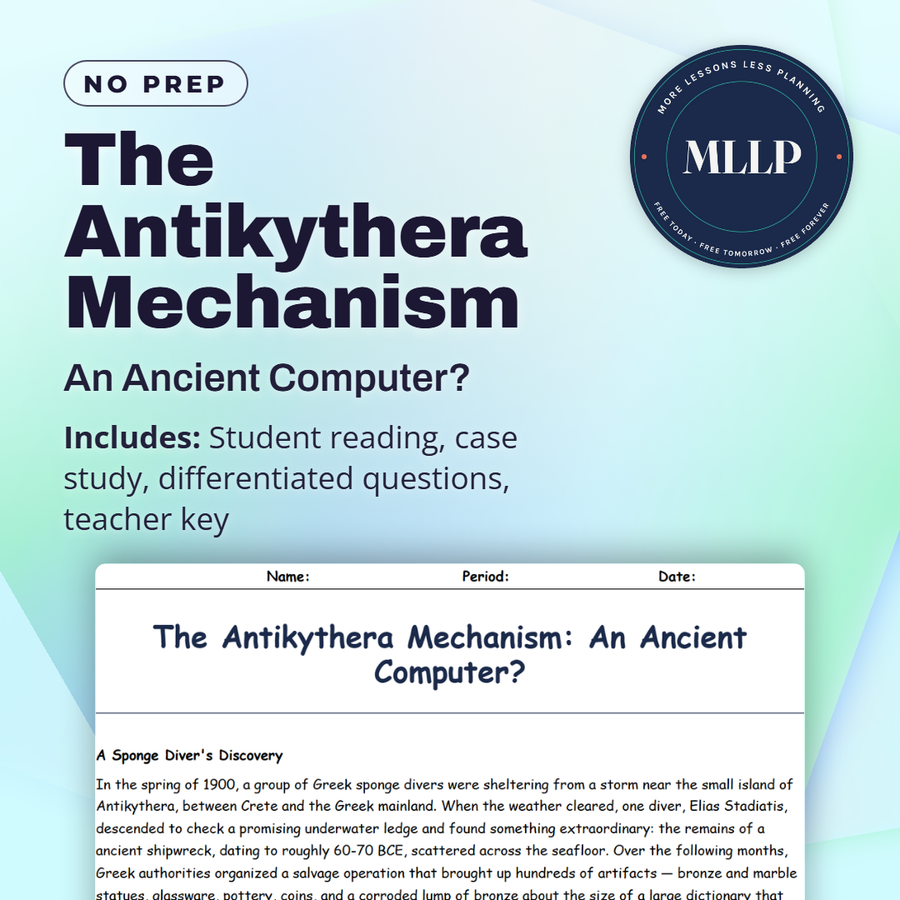
The Antikythera Mechanism: An Ancient Computer?
Quality reviewed September 2026
Facts verified September 21, 2026
- Subject
- Social Studies
- Grades
- Grades 9-12
- Length
- 9-page student worksheet
- Time
- About one 50-minute class period
- Great for
- Sub plans and independent work
- Includes
- Reading passage, comprehension questions + full answer key
- Format
- Print-and-go PDF
What students do
- Explain what the Antikythera Mechanism's 30 bronze gears were actually built to calculate
- Fill in three blanks naming the island, the historian who first analyzed the device, and the century when comparable machines reappeared
- A young sponge diver who grabbed a statue's arm and nearly ignored a corroded bronze lump opens into two case study questions
- CT scanning and over 3,500 characters of Greek inscription get checked in a multiple-choice question on how the mechanism was decoded
What it covers
- The sponge divers who discovered the Antikythera shipwreck in 1900
- How CT scanning revealed the mechanism's 30 interlocking bronze gears
- Why no comparable machine appears again for over a thousand years
Start reading this worksheet
A Sponge Diver's Discovery
In the spring of 1900, a group of Greek sponge divers were sheltering from a storm near the small island of Antikythera, between Crete and the Greek mainland. When the weather cleared, one diver, Elias Stadiatis, descended to check a promising underwater ledge and found something extraordinary: the remains of a ancient shipwreck, dating to roughly 60-70 BCE, scattered across the seafloor. Over the following months, Greek authorities organized a salvage operation that brought up hundreds of artifacts: bronze and marble statues, glassware, pottery, coins, and a corroded lump of bronze about the size of a large dictionary that nobody initially knew what to do with. That corroded lump sat in the National Museum of Athens for two years before it began to split apart, revealing the outlines of gears: bronze toothed wheels of different sizes, fitted together in a complex mechanical arrangement. Archaeologists gradually realized they were looking at something that should not exist: a sophisticated mechanical device from the ancient world, far more complex than anything else recovered from the period, capable of calculations that modern scientists are still working to fully understand.
What the Mechanism Did
The Antikythera Mechanism was an analog computing device, a mechanical calculator, designed to predict astronomical events. X-ray imaging and CT scanning conducted between the 1970s and 2020s have progressively revealed its internal complexity: at least 30 interlocking bronze gears of various sizes, arranged in a system that could track the position of the sun and moon, predict solar and lunar eclipses, display the phase of the moon, track the Metonic cycle (a 19-year period after which lunar and solar calendars realign), and calculate the dates of the ancient Olympic Games and other Panhellenic festivals. The front of the mechanism displayed a zodiac calendar and an Egyptian calendar. The back featured two large spiral dials — an upper dial tracking the 19-year Metonic cycle, with a small subsidiary dial marking the four-year Olympiad cycle, and a lower dial tracking the Saros eclipse cycle. Inscriptions on the mechanism (over 3,500 characters of Greek text, most recovered through modern imaging) served as an instruction manual explaining what each display showed. The sophistication of the gearing is extraordinary: one gear corrects for the moon's elliptical orbit using a pin-and-slot mechanism, a solution that modern engineers recognize as elegantly sophisticated.
Decades of Scientific Investigation
The Antikythera Mechanism was not fully appreciated for most of the twentieth century. The archaeologist Valerios Stais proposed in 1902 that it was an astronomical instrument, but his suggestion was dismissed. Scholars found it incredible that ancient Greeks could have built such a device. It was not until 1959 that the science historian Derek de Solla Price published the first serious analysis concluding that the mechanism was an astronomical calculator of extraordinary sophistication. His work inspired decades of further research using increasingly advanced imaging technology. In 2021, a team from University College London published a comprehensive reconstruction of the mechanism's front panel, proposing specific gear ratios that would have allowed it to track all known planetary movements, not just the sun and moon but Mercury, Venus, Mars, Jupiter, and Saturn as well. If correct, this reconstruction suggests the mechanism was capable of displaying the positions of all the known planets of the ancient world simultaneously. The research also identified inscriptions that had never previously been read, including what appears to be a reference to the Olympic Games and other festivals, confirming the mechanism's use as a practical calendar as well as an astronomical tool.
Like what you read? The full reading, the case study, and every question set are in the free download below, along with the answer key.
Why this matters
The Antikythera Mechanism sat in a museum drawer for two years before anyone noticed it was full of gears, and scholars dismissed the idea that ancient Greeks could have built something so precise for decades after that. That is worth pointing out to students who assume progress only moves forward: this device proves a level of mechanical skill that then disappeared for over a thousand years, lost rather than simply not yet invented. The diver who found it grabbed a statue's arm first and nearly left the actual breakthrough behind, which says something about how a discovery's importance is not always obvious at first sight, even to the person holding it.
From one teacher to another
In 1900, a crew of Greek sponge divers sheltering from a storm found an ancient shipwreck scattered across the seafloor, and grabbed a corroded lump of bronze almost as an afterthought next to the more obviously valuable statues. That lump turned out to be the most sophisticated surviving machine from the ancient world, a device with at least 30 bronze gears built to predict eclipses, track the moon, and calculate the dates of the Olympic Games. This worksheet covers what modern CT scanning revealed inside the corrosion, including over 3,500 characters of Greek text that worked like an instruction manual. A case study follows the diver who found it, Elias Stadiatis, who never learned what the lump he grabbed actually was before he died in an unrelated accident the following year. Students also read about the century-long gap between the mechanism's discovery and scientists taking it seriously.
What you get
Download
Where should I send the next one?
Everything here is free and it stays that way. Leave your email and I'll send you the new lessons as they go up. You can unsubscribe from any one of them.
Related resources

Alexander's Empire: Archaeology Across Three Continents
Ancient Greece: An Overview

Delphi: The Center of the Ancient World

Greek Pottery: Art That Tells Stories

Knossos and the Minoans: Europe's First Civilization
Mycenae and the Trojan War: Where Myth Meets Archaeology
Every lesson on this site is free to download and use. If one of them saved you a prep period, you can chip in a few bucks toward my three kids' daycare fund. That's genuinely where tips go.