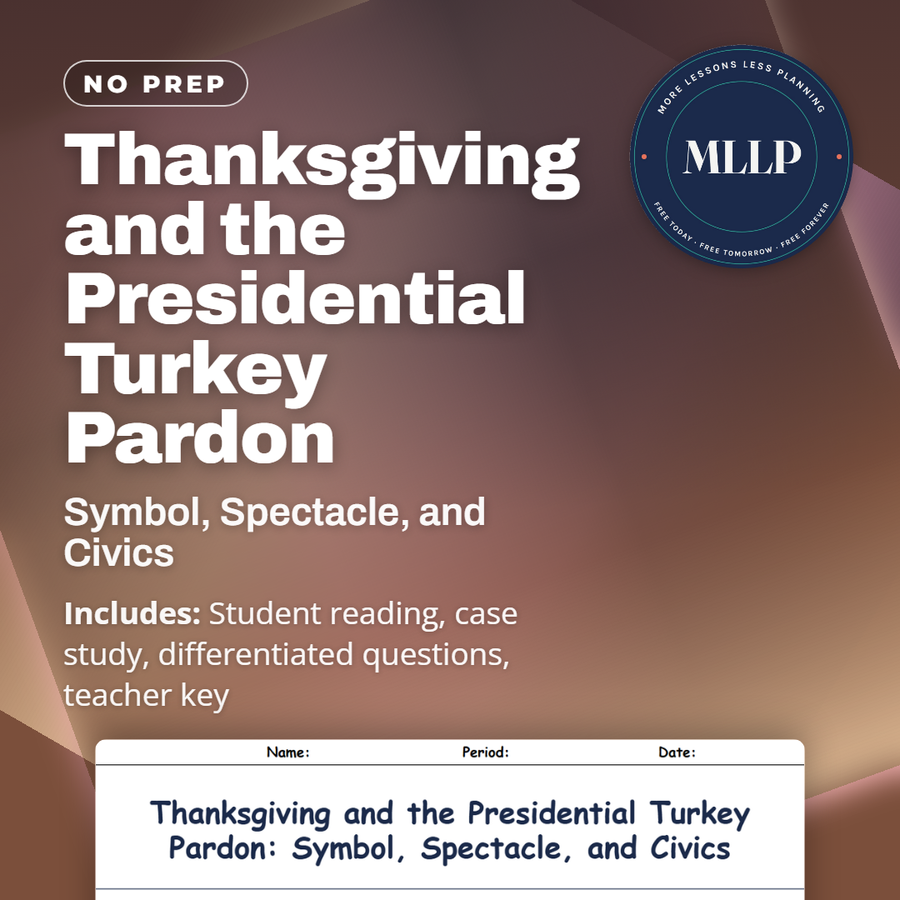
Thanksgiving and the Presidential Turkey Pardon: Symbol, Spectacle, and Civics
Quality reviewed September 2026
Facts verified September 9, 2026
- Subject
- Social Studies
- Grades
- Grades 9-12
- Length
- 8-page student worksheet
- Time
- About one 50-minute class period
- Great for
- Sub plans and independent work
- Includes
- Reading passage, comprehension questions + full answer key
- Format
- Print-and-go PDF
What students do
- Distinguish between ceremonial turkey "pardons" and constitutional criminal clemency
- Analyze how ritual communication humanizes power and reinforces cultural values
- Identify staging, media cycles, and sponsors behind a public ceremony
- Evaluate trade-offs between tradition, messaging, and animal welfare
What it covers
- Symbolic politics and soft power through ritual
- Executive clemency as constitutional tool versus ceremonial metaphor
- Media amplification and informal precedent
Start reading this worksheet
Where Did the “Pardon” Come From, and What’s Really Being Pardoned?
Every November, cameras click as the U.S. President “pardons” a turkey on the White House lawn. The bird fluffs its feathers; reporters smile; a pun-filled speech lands. But the ritual’s history is a tangle of myth, media, and evolving tradition. Presidents have been presented turkeys since the 19th century, often as gifts from farmers or civic groups. In 1963, John F. Kennedy famously spared a turkey with the remark, “We’ll just let this one grow,” and in the 1970s, some presidents sent birds to petting zoos rather than the dinner table. The first modern, explicitly labeled “presidential pardon” entered the public script under George H. W. Bush in 1989, and ever since, the event has been staged as a cheerful pre-holiday ceremony. Crucially, this is not a criminal pardon in the ordinary sense: turkeys have committed no crimes. It’s a symbolic act that borrows the language of executive clemency to celebrate abundance, national traditions, and seasonal goodwill. The difference matters for civics: an actual presidential pardon is a constitutional tool that forgives a federal offense; the turkey moment is a ceremonial custom that uses the same vocabulary to tell a cultural story.
Traditions, Narratives, and Political Theater
Why does the ritual persist? In political communication, the turkey pardon is symbolic politics: a low-stakes, high-visibility event that frames the presidency in human terms. The ritual creates an annual media cycle: the National Turkey Federation sponsors the birds, a light script is written, schoolchildren and tourists follow along, and the evening news runs a 30-second feel-good segment. For the White House, it is a rare bipartisan photo opportunity: a chance to display humor, restraint, and a nod to national unity before the intensity of year-end politics. The language of mercy and gratitude syncs with the holiday’s themes, and the harmlessness of the subject helps reset tone. But symbolic acts still do real work: they set precedents and expectations. If a president skipped the event, headlines would ask “Why?” That would be proof that the ceremony has become an informal institution, as routine as the Christmas tree lighting or the first-pitch toss in baseball. In civics terms, this is soft power: legitimacy earned by ritual and story, not by law alone.
Farming, Welfare, and the Economics Behind the Feathers
The pardoned birds are usually large, showy broad-breasted turkeys: animals bred for size, not longevity. That biology shapes their story. Even “spared” birds often struggle to live long, because selective breeding favors rapid growth over cardiovascular and skeletal resilience. The event therefore raises quiet questions about animal welfare, industrial agriculture, and our holiday food systems. On the supply side, the ceremony is excellent marketing: millions of viewers see a turkey on the lawn just as shoppers plan menus, and sponsors receive national exposure at a moment of peak demand. On the consumer side, the ritual masks the complex supply chain that moves turkeys (from hatcheries to processing plants to cold storage) to reach the table in time. Understanding the bird’s journey adds nuance: a cheerful ceremony can coexist with serious economic realities like price volatility, feed costs, and labor dynamics in meatpacking. The turkey pardon is thus both a story we tell and a window into the systems that feed the country.
Like what you read? The full reading, the case study, and every question set are in the free download below, along with the answer key.
Why this matters
The presidential turkey pardon has existed only since 1989, not since the founding of the country, though most students assume it is as old as Thanksgiving itself. A ceremony can feel timeless after only a few decades of repetition, media coverage, and expectation, which is exactly what happened here.
The pardon looks like a joke with no substance until the case study puts students backstage, among climate controlled vans, veterinarian logbooks, and chalk marks measuring camera angles on the Rose Garden lawn. Separating that ceremonial clemency from a president's actual constitutional power turns a pun filled photo op into a real civics question.
From one teacher to another
Most students think the turkey pardon is just a silly tradition. This worksheet shows how ceremonies do political work. The modern pardon didn't exist until 1989, yet it now feels timeless, proof that rituals become real through repetition, media coverage, and expectation. The case study takes students backstage: climate-controlled vans, veterinarian logbooks, rehearsed jokes, press marks chalked on the Rose Garden lawn, and a policy aide slipping in a line thanking farm workers so the light event reaches toward the serious food system. Students read the event like a primary source and ask who sponsors it, what themes matter, and which lines go viral. The answer key separates constitutional clemency (a president's legal power to forgive federal crimes) from ceremonial clemency (a metaphor). Then it asks whether that distinction matters, a civics question wrapped in a pun-filled moment.
What you get
Download
Where should I send the next one?
Everything here is free and it stays that way. Leave your email and I'll send you the new lessons as they go up. You can unsubscribe from any one of them.
Related resources
Black Friday Forensics: Shoplifting, Organized Theft, and Crowd Violence
Black Friday Smart Shopper: Economics and Personal Finance in Action
Black Friday: Are the “Deals” Actually Good for Shoppers?
Black Friday’s Economic Impact: Who Gains, Who Pays, and What It Means for the Economy
Budget a Feast: Unit Prices, Deals, and Receipts
Colonial Foodways: Indigenous Knowledge and European Adaptation
Every lesson on this site is free to download and use. If one of them saved you a prep period, you can chip in a few bucks toward my three kids' daycare fund. That's genuinely where tips go.