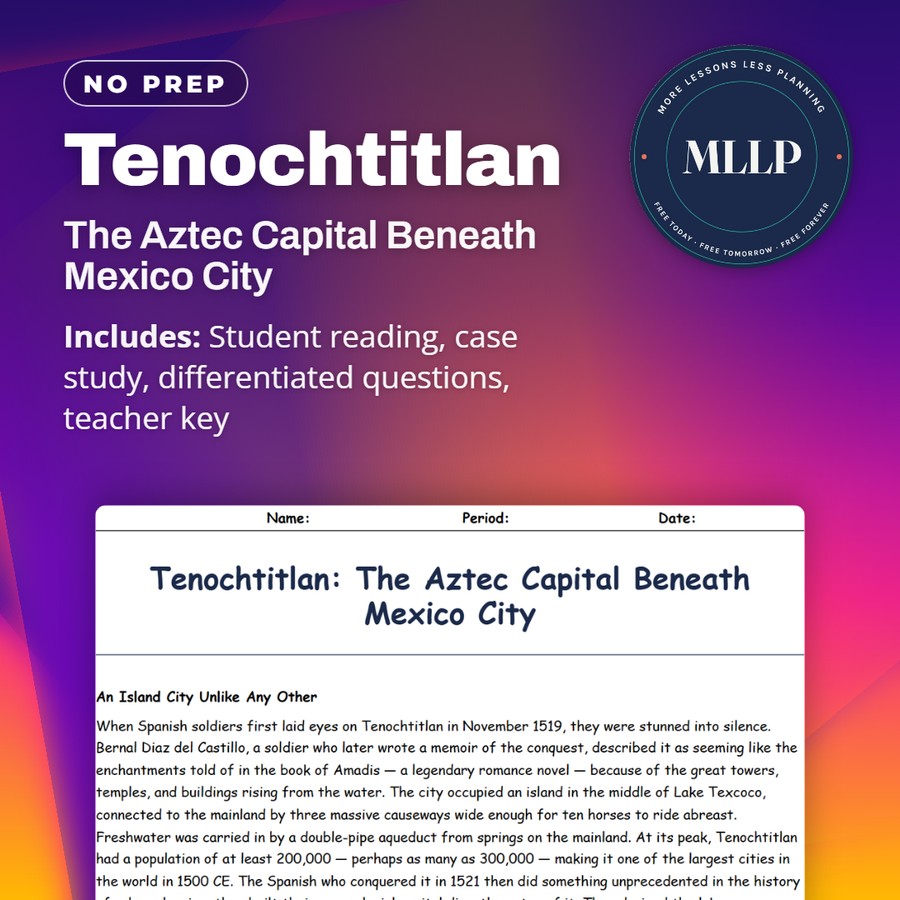
Tenochtitlan: The Aztec Capital Beneath Mexico City
Quality reviewed September 2026
Facts verified September 21, 2026
- Subject
- Social Studies
- Grades
- Grades 9-12
- Length
- 9-page student worksheet
- Time
- About one 50-minute class period
- Great for
- Sub plans and independent work
- Includes
- Reading passage, comprehension questions + full answer key
- Format
- Print-and-go PDF
What students do
- Marco's pottery shard find costs his crew five days, a real cost the reading does not hide
- Seven pyramids stacked inside the Templo Mayor get lined up against 200 years of Aztec rulers
- Write out what the 1978 Coyolxauhqui find led archaeologists to excavate next
- Match terms like tzompantli and salvage archaeology to what they mean on a real dig
What it covers
- The 1978 discovery of the Coyolxauhqui stone and the excavation it triggered
- Seven layered pyramids inside the Templo Mayor and offerings from across Mesoamerica
- Salvage archaeology under a living city of 21 million people
Start reading this worksheet
An Island City Unlike Any Other
When Spanish soldiers first laid eyes on Tenochtitlan in November 1519, they were stunned into silence. Bernal Diaz del Castillo, a soldier who later wrote a memoir of the conquest, described it as seeming like the enchantments told of in the book of Amadis (a legendary romance novel) because of the great towers, temples, and buildings rising from the water. The city occupied an island in the middle of Lake Texcoco, connected to the mainland by three massive causeways wide enough for ten horses to ride abreast. Freshwater was carried in by a double-pipe aqueduct from springs on the mainland. At its peak, Tenochtitlan had a population of at least 200,000 (perhaps as many as 300,000), making it one of the largest cities in the world in 1500 CE. The Spanish who conquered it in 1521 then did something unprecedented in the history of urban planning: they built their new colonial capital directly on top of it. They drained the lake, demolished the temples, used the rubble as fill, and laid out a European grid city over the ruins. For nearly four and a half centuries, the Aztec capital lay buried beneath the streets, plazas, and colonial buildings of Mexico City. Then, in 1978, an electrical worker's shovel struck something carved in stone.
The 1978 Discovery and What Followed
On February 21, 1978, workers from the Compania de Luz electric company were digging a trench near the Mexico City Cathedral when they hit a massive stone disc about three meters below the street. The disc measured 3.25 meters across and weighed approximately eight tons. As archaeologists were called in and the carving cleaned, it became clear that this was a representation of Coyolxauhqui, the moon goddess of Aztec mythology, depicted dismembered after being killed by the sun god Huitzilopochtli. The stone had lain at the base of the Templo Mayor, the great double pyramid that was the religious heart of Tenochtitlan. The discovery triggered one of the most significant urban archaeological projects of the twentieth century. The Mexican government, under President Jose Lopez Portillo, authorized the demolition of several city blocks of colonial buildings to expose the Templo Mayor. Excavations led by archaeologist Eduardo Matos Moctezuma began in 1978 and have continued in various phases ever since. What they found was extraordinary: not one pyramid but seven successive pyramids, each built over its predecessor as each new ruler expanded the monument. The successive layers span from approximately 1325 CE (the legendary founding of Tenochtitlan) to 1520 CE, just before the Spanish conquest.
What the Templo Mayor Contains
The Templo Mayor was dedicated to two gods: Huitzilopochtli (god of the sun and warfare) on one side, and Tlaloc (god of rain and agriculture) on the other. This dual dedication reflected the two pillars of Aztec power: military conquest and agricultural productivity. Archaeologists have discovered more than 200 offering caches buried within the pyramid structure, containing an astonishing variety of objects: coral, seashells, and crocodile bones from the Gulf Coast; jaguar remains; obsidian blades; pottery; and human skulls showing evidence of ritual processing. The offerings reveal an extensive trade and tribute network stretching across Mesoamerica. One of the most dramatic finds came from excavations in the early 2000s: the remains of numerous individuals, many showing evidence of ritual sacrifice, including skulls with cut marks, bones dyed red with hematite, and skeletal material arranged in deliberate patterns. In 2015, archaeologists discovered a large circular stone platform (a tzompantli, or skull rack) adjacent to the Templo Mayor. When fully excavated, it contained hundreds of human skulls, many embedded in a lime mortar matrix. The sheer scale of the find, and the way the skulls were arranged, confirmed Spanish descriptions of these structures while also revealing details the written accounts did not capture.
Like what you read? The full reading, the case study, and every question set are in the free download below, along with the answer key.
Why this matters
Tenochtitlan was demolished on purpose, its stone reused to build the city sitting on top of it today, so almost everything we know about it has been recovered one construction trench at a time. That makes ordinary decisions, like whether a utility crew stops digging to report a pottery shard, into real moments where history either gets preserved or gets buried again under a water main. Students who picture archaeology happening only in remote deserts should sit with the fact that some of the richest Aztec discoveries have come out of a modern subway system, found by workers who were just trying to finish a shift.
From one teacher to another
An electrical worker's shovel hit carved stone in February 1978, and that single find under a Mexico City street led to one of the biggest urban excavations of the twentieth century. Students meet the discovery through the goddess Coyolxauhqui's dismembered stone disc, then move into what archaeologists found once they started digging, seven pyramids built one over another across two centuries, more than 200 offering caches, and a skull rack confirmed in 2015 that still is not fully excavated. The reading also covers the chinampas, the raised lake bed gardens that fed a city of two hundred thousand people without wearing out the land, a system sophisticated enough that modern agricultural scientists still study it. A case study follows a present day utility worker who has to decide whether to report a pottery shard and lose five days of work, which is what archaeology under a functioning city of 21 million actually looks like.
What you get
Download
Where should I send the next one?
Everything here is free and it stays that way. Leave your email and I'll send you the new lessons as they go up. You can unsubscribe from any one of them.
Related resources
Aztec Daily Life: Markets, Schools, and Chocolate
Aztec Human Sacrifice: Separating Fact from Propaganda
Descendant Communities Today: Living Heritage of the Americas
Inca Child Sacrifice: Capacocha and the Mountain Mummies
Machu Picchu: The Lost City That Was Never Lost
Quipu: The Inca Writing System Made of Knots
Every lesson on this site is free to download and use. If one of them saved you a prep period, you can chip in a few bucks toward my three kids' daycare fund. That's genuinely where tips go.