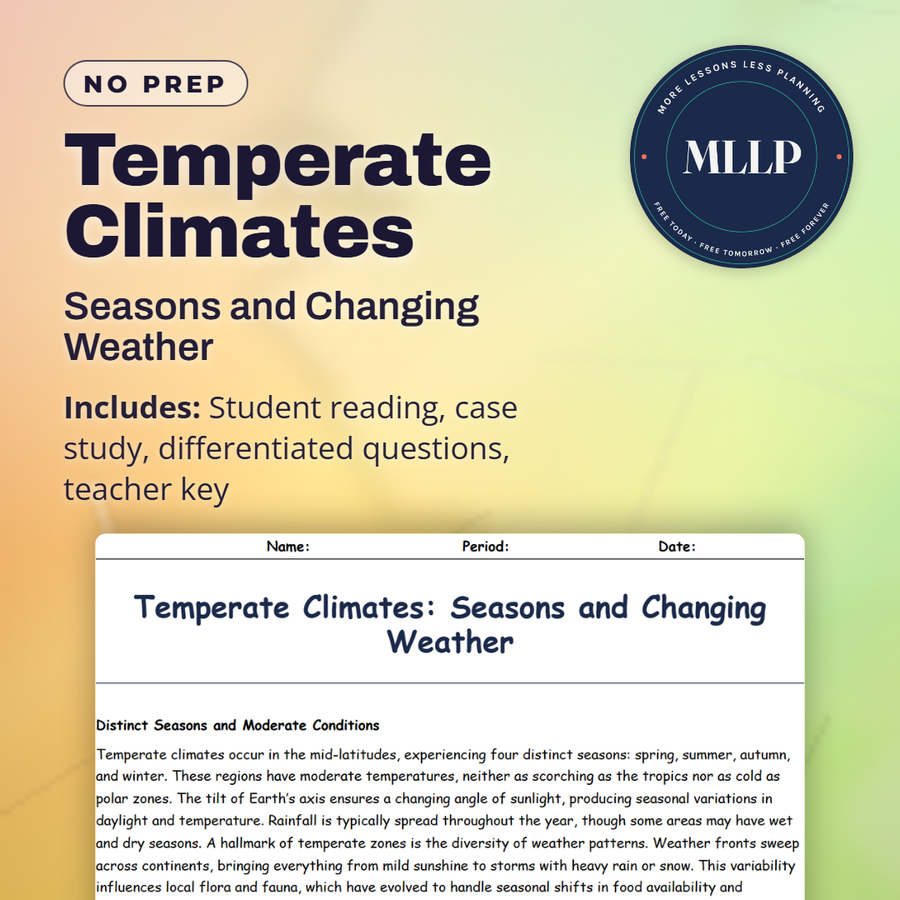
Temperate Climates: Seasons and Changing Weather
Quality reviewed September 2026
Facts verified September 14, 2026
- Subject
- Social Studies
- Grades
- Grades 9-12
- Length
- 6-page student worksheet
- Time
- About one 50-minute class period
- Great for
- Sub plans and independent work
- Includes
- Reading passage, comprehension questions + full answer key
- Format
- Print-and-go PDF
What students do
- Match terms like crop rotation, maritime climate, and monoculture to their correct definitions
- Fill in the blank sentences on continental climates, ocean influence, and Mediterranean climates
- Answer multiple choice questions on what characterizes temperate climates, what a maritime climate is like, and what Mediterranean climates typically include
- Write short answers on why temperate regions support large populations, how maritime and continental climates differ, and how farmers can sustain soil fertility without heavy chemical use
What it covers
- The four seasons of temperate climates and how they differ from maritime, continental, and Mediterranean subtypes
- Why temperate regions support dense populations and major agriculture, from wheat and corn to vineyards and olive groves
- A case study on a farming collective fixing soil depletion through crop rotation and cover crops, plus a reference table of temperate climate subtypes
Start reading this worksheet
Distinct Seasons and Moderate Conditions
Temperate climates occur in the mid-latitudes, experiencing four distinct seasons: spring, summer, autumn, and winter. These regions have moderate temperatures, neither as scorching as the tropics nor as cold as polar zones. The tilt of Earth’s axis ensures a changing angle of sunlight, producing seasonal variations in daylight and temperature. Rainfall is typically spread throughout the year, though some areas may have wet and dry seasons. A hallmark of temperate zones is the diversity of weather patterns. Weather fronts sweep across continents, bringing everything from mild sunshine to storms with heavy rain or snow. This variability influences local flora and fauna, which have evolved to handle seasonal shifts in food availability and temperature. Deciduous forests, for example, shed leaves in autumn to conserve energy during cold winters, regrowing them in spring.
Agricultural Centers and Dense Populations
Many of the world’s temperate areas, such as much of Europe, eastern North America, and parts of East Asia, boast high population densities and flourishing agriculture. Moderate climates with reliable rainfall support cereals like wheat, corn, and barley, alongside diverse fruit and vegetable crops. Technological advancements (greenhouses, irrigation systems) further enhance farming in these zones. Urban centers also thrive due to navigable rivers, temperate ports, and accessible farmland. Historically, this synergy led to trade routes and industrial growth, culminating in busy global cities. However, industrialization and intensive agriculture can strain the environment, causing pollution, habitat loss, and resource depletion. Balancing development with sustainability remains a priority.
Like what you read? The full reading, the case study, and every question set are in the free download below, along with the answer key.
Why this matters
Ask a class to describe a temperate climate and most students describe only the version they live in. This reading splits that single idea into maritime, continental, and Mediterranean subtypes, and the difference explains why one temperate region grows wheat and corn while another grows olives and grapes.
The Greenhaven Valley case study is the part that sticks. A farming collective fixes soil depletion through crop rotation and cover crops instead of heavier chemical use, giving students a concrete answer to a question climate units usually leave abstract: how do you keep farming the same land for generations without wearing it out.
From one teacher to another
I like that this one breaks temperate climates into maritime, continental, and Mediterranean instead of treating them as one category, since students often lump all four-season climates together. The Greenhaven Valley case study on crop rotation and cover crops gives a concrete example of sustainable farming that connects directly to the climate content. It works well next to a unit on climate zones or agriculture.
What you get
Download
Where should I send the next one?
Everything here is free and it stays that way. Leave your email and I'll send you the new lessons as they go up. You can unsubscribe from any one of them.
Related resources
Biomes & Ecosystems: Life Across Earth’s Habitats
Climate vs. Weather: Understanding the Difference
Convergent Boundaries: Where Plates Collide
Deserts: Survival in the Harshest Climates
Divergent Boundaries: Where Plates Pull Apart
Earth’s Layers: From Crust to Core
Every lesson on this site is free to download and use. If one of them saved you a prep period, you can chip in a few bucks toward my three kids' daycare fund. That's genuinely where tips go.