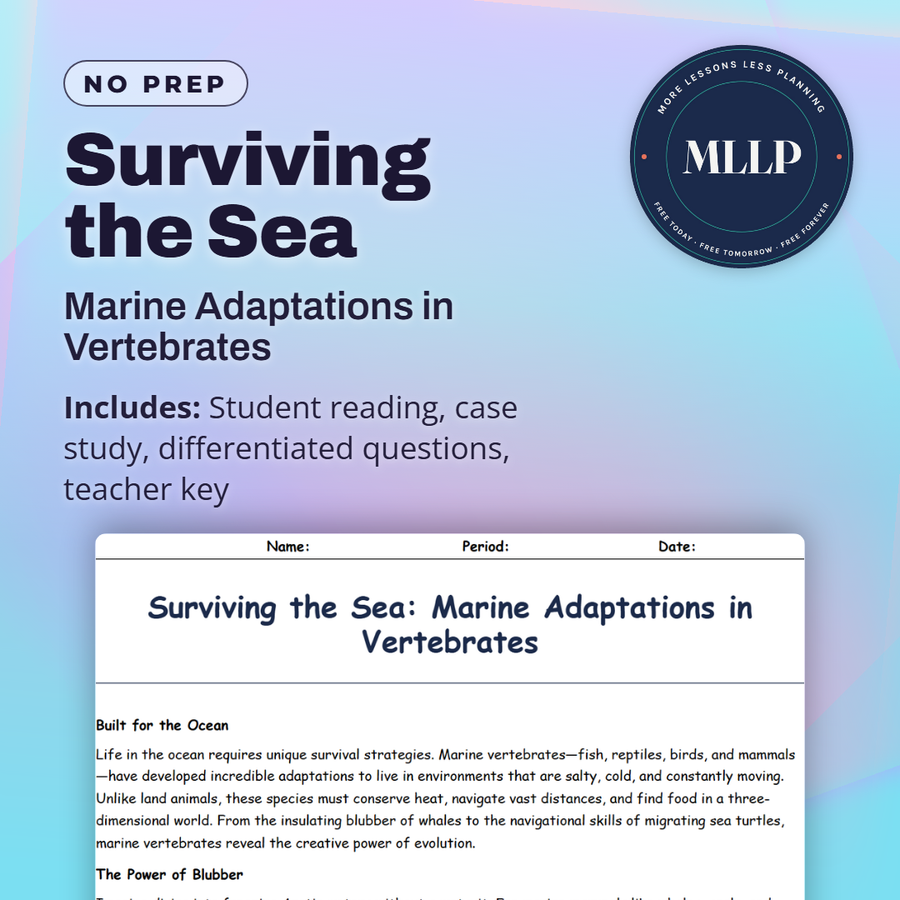
Surviving the Sea: Marine Adaptations in Vertebrates
Quality reviewed September 2026
Facts verified September 14, 2026
- Subject
- Science
- Grades
- Grades 9-12
- Length
- 6-page student worksheet
- Time
- About one 50-minute class period
- Great for
- Sub plans and independent work
- Includes
- Reading passage, comprehension questions + full answer key
- Format
- Print-and-go PDF
What students do
- Match prompts like layer of fat for warmth, whale songs, dolphin echolocation, and sea turtle nesting return to the correct description
- Fill in the blank sentences on echolocation, whale songs, and the blubber that helps mammals survive cold water
- Answer multiple choice questions on blubber's main role, how echolocation helps dolphins and whales, and why sea turtles return to their birth beaches
- Write short answers on blubber's extra functions, why migration is risky, and how communication helps marine vertebrates survive
What it covers
- How blubber insulates and stores energy for whales, seals, and walruses living in cold ocean water
- How echolocation and songs let dolphins and whales navigate, hunt, and communicate across long distances
- A case study on the gray whale's roughly 10,000 to 12,000 mile round-trip migration between Arctic feeding grounds and Baja California
Start reading this worksheet
Built for the Ocean
Life in the ocean requires unique survival strategies. Marine vertebrates (fish, reptiles, birds, and mammals) have developed incredible adaptations to live in environments that are salty, cold, and constantly moving. Unlike land animals, these species must conserve heat, navigate vast distances, and find food in a three-dimensional world. From the insulating blubber of whales to the navigational skills of migrating sea turtles, marine vertebrates reveal the creative power of evolution.
The Power of Blubber
Imagine diving into freezing Arctic waters without a wetsuit. For marine mammals like whales, seals, and walruses, blubber makes survival possible. Blubber is a thick layer of fat beneath the skin that serves as insulation against the cold, but it also works as an energy reserve and even helps with buoyancy. Polar bears, though not fully marine, rely on fat storage for similar reasons. Without this natural insulation, animals would lose body heat rapidly and risk hypothermia in icy seas.
Songs and Signals: Echolocation and Communication
One of the most fascinating adaptations in marine vertebrates is echolocation. Dolphins and some whales produce sound waves that bounce off objects, allowing them to “see” with sound. This ability is especially important in dark or murky waters where eyesight is limited. But echolocation is not the only form of communication: humpback whales sing complex songs that can travel hundreds of miles across the ocean, and seabirds use calls to navigate their colonies. Communication is essential for hunting, mating, and staying connected across the wide sea.
Like what you read? The full reading, the case study, and every question set are in the free download below, along with the answer key.
Why this matters
A gray whale's round trip between Arctic feeding grounds and the lagoons of Baja California covers 10,000 to 12,000 miles. Making that possible takes adaptations students rarely consider: blubber for insulation and stored energy, and for other marine mammals, echolocation and long-range songs for navigating and staying in contact.
I ask students why an animal would risk a migration that long instead of staying put, and most can't answer until they read what each destination offers. Feeding and breeding grounds are rarely the same place, so the risk gets weighed against a payoff the whale can't get any other way.
From one teacher to another
Marine vertebrates face a world that is salty, cold, and always moving, and this worksheet lays out the adaptations that let them handle it. Students read about blubber's role in insulation and energy storage, echolocation and whale songs used for hunting and communication, and the long migrations that connect feeding and breeding grounds. The case study follows a gray whale's journey between Arctic waters and the lagoons of Baja California.
What you get
Download
Where should I send the next one?
Everything here is free and it stays that way. Leave your email and I'll send you the new lessons as they go up. You can unsubscribe from any one of them.
Related resources
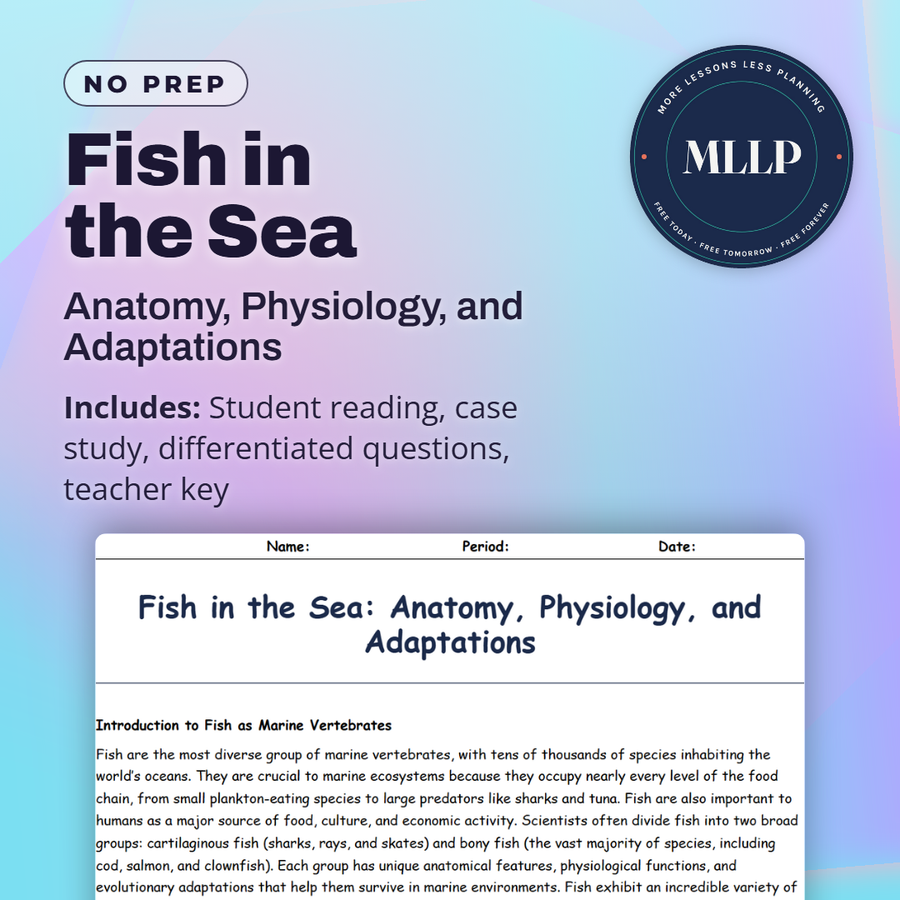
Fish in the Sea: Anatomy, Physiology, and Adaptations
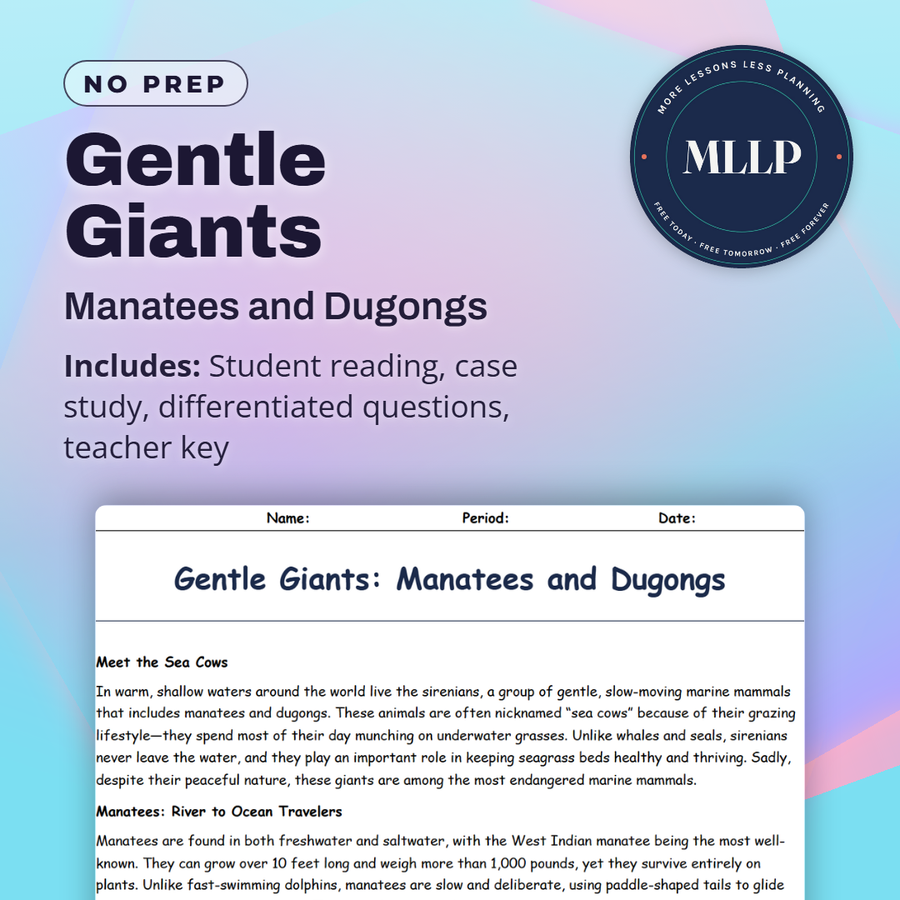
Gentle Giants: Manatees and Dugongs
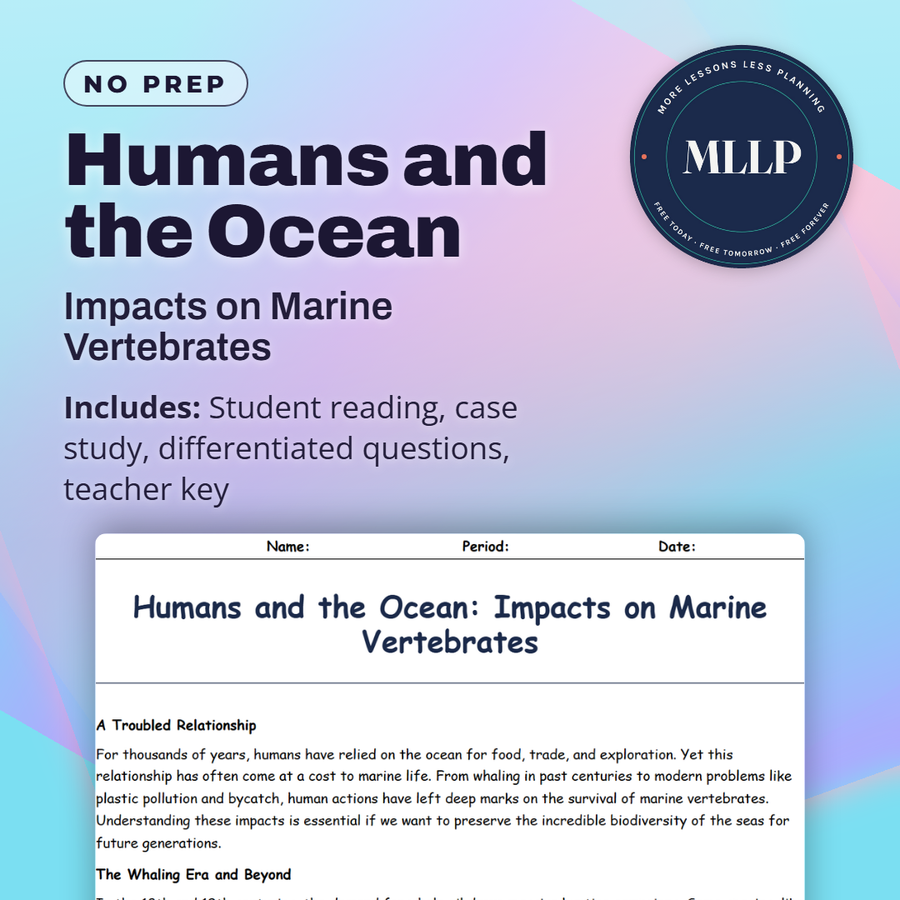
Humans and the Ocean: Impacts on Marine Vertebrates
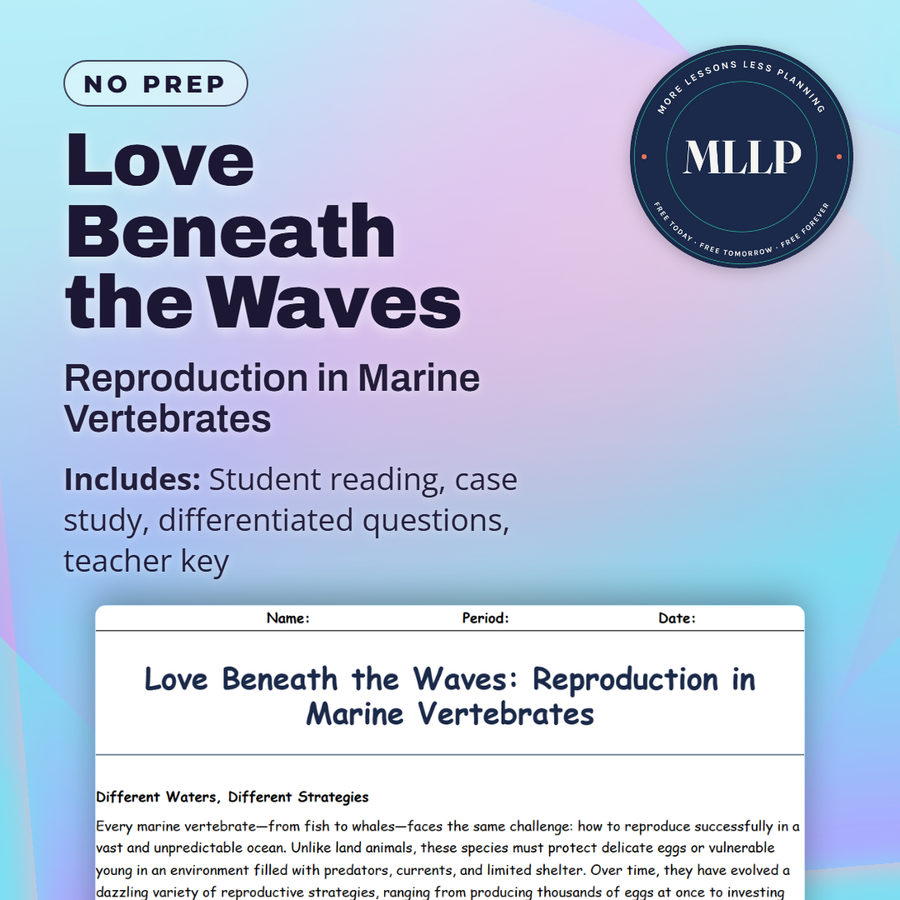
Love Beneath the Waves: Reproduction in Marine Vertebrates
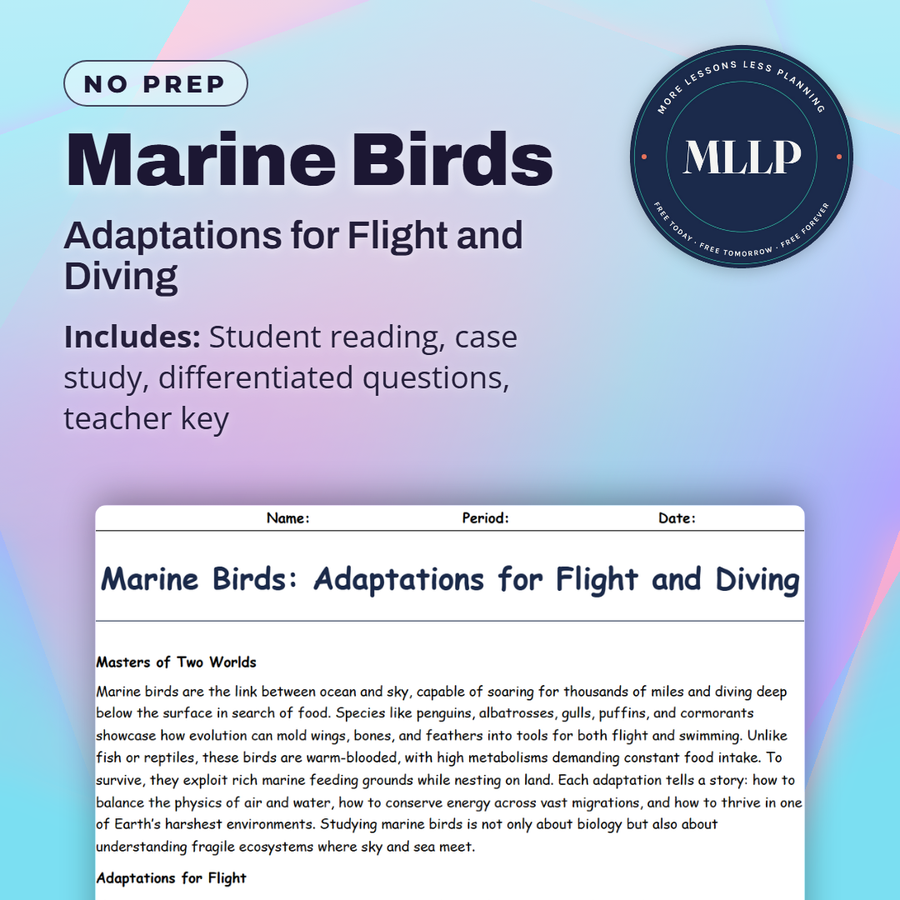
Marine Birds: Adaptations for Flight and Diving
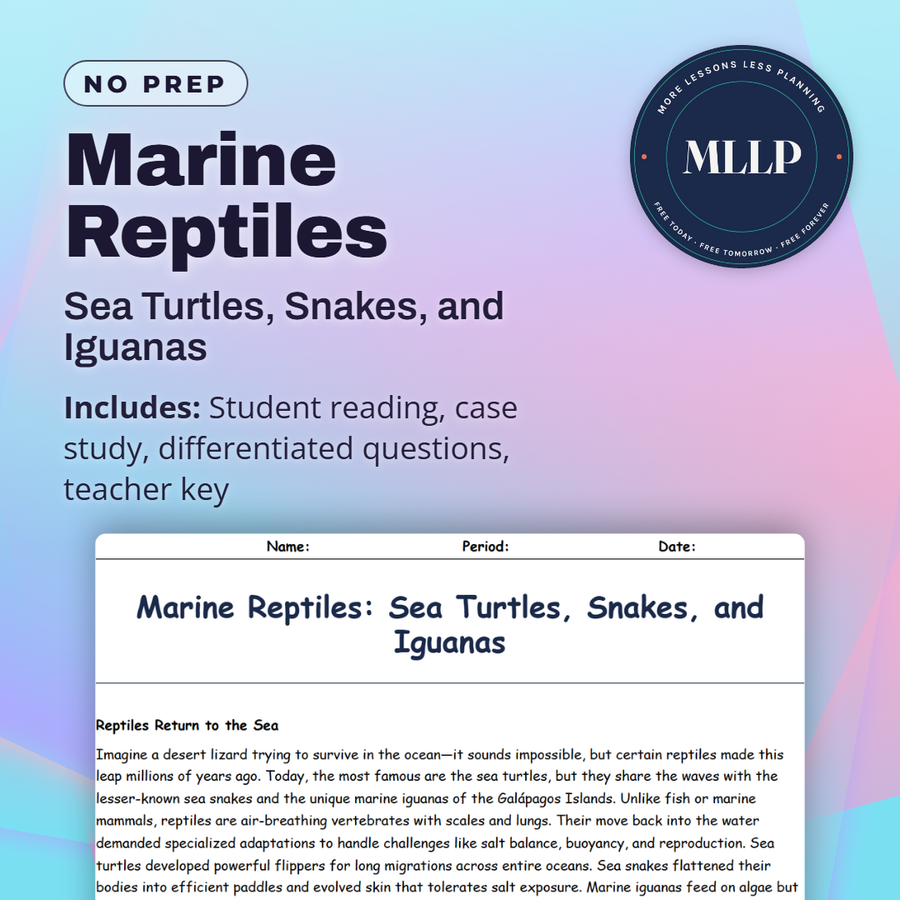
Marine Reptiles: Sea Turtles, Snakes, and Iguanas
Every lesson on this site is free to download and use. If one of them saved you a prep period, you can chip in a few bucks toward my three kids' daycare fund. That's genuinely where tips go.