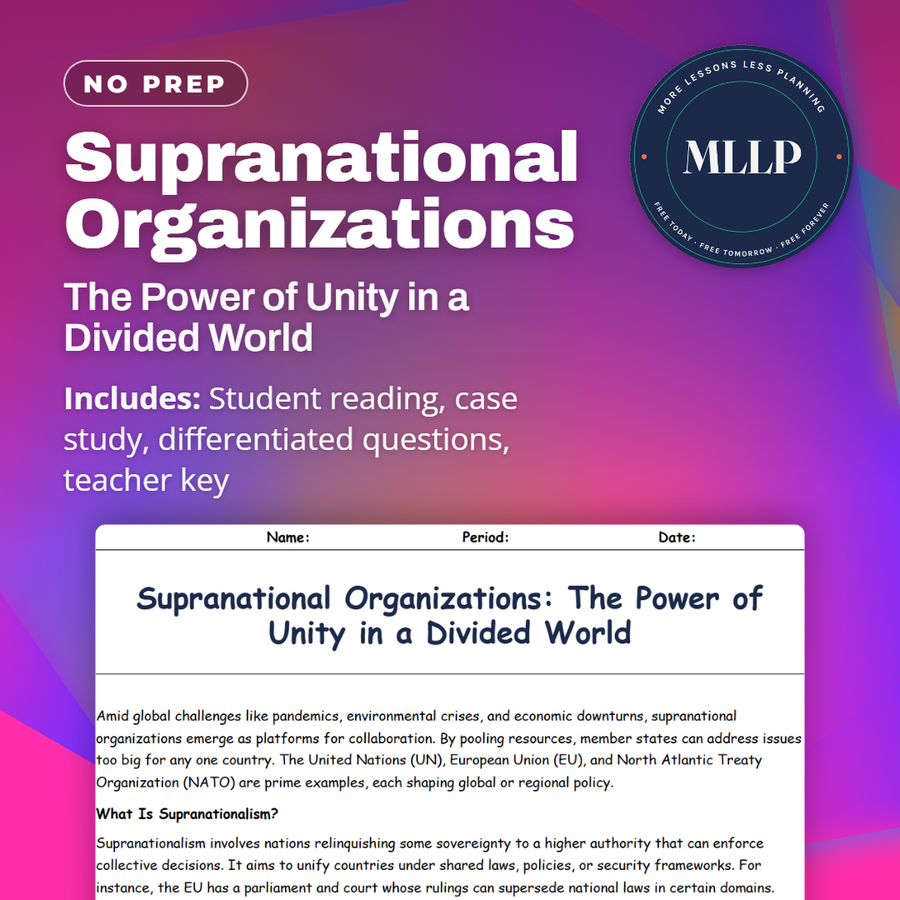
Supranational Organizations: The Power of Unity in a Divided World
Quality reviewed September 2026
Facts verified September 14, 2026
- Subject
- Social Studies
- Grades
- Grades 9-12
- Length
- 7-page student worksheet
- Time
- About one 50-minute class period
- Great for
- Sub plans and independent work
- Includes
- Reading passage, comprehension questions + full answer key
- Format
- Print-and-go PDF
What students do
- Match terms like Sovereignty, Charter, and Eurozone to their correct definitions
- Fill in the blank sentences on supranationalism, the Euro, and NATO's collective defense principle
- Answer multiple choice questions on NATO's purpose and what Brexit refers to
- Write short answers on why smaller countries might benefit from joining a supranational organization and how veto power affects UN decisions
What it covers
- Supranationalism and how the UN, EU, and NATO each shape global or regional policy
- The EU's single market and the tensions around Brexit and national sovereignty
- A case study excerpt on how the EU's single market changed everyday life for a family business
Start reading this worksheet
Amid global challenges like pandemics, environmental crises, and economic downturns, supranational organizations emerge as platforms for collaboration. By pooling resources, member states can address issues too big for any one country. The United Nations (UN), European Union (EU), and North Atlantic Treaty Organization (NATO) are prime examples, each shaping global or regional policy.
What Is Supranationalism?
Supranationalism involves nations relinquishing some sovereignty to a higher authority that can enforce collective decisions. It aims to unify countries under shared laws, policies, or security frameworks. For instance, the EU has a parliament and court whose rulings can supersede national laws in certain domains. Critics argue this weakens national autonomy, while supporters claim it fosters peace, prosperity, and collective strength. Balancing these views is a key challenge: members must abide by common regulations even as they maintain individual governance.
The United Nations: Peace and Cooperation
Formed after World War II, the UN seeks to prevent conflict and promote human rights. Its Security Council can authorize peacekeeping missions, impose sanctions, or approve military action. The UN General Assembly provides a forum where all member states have a voice, discussing global issues like climate change and economic development. Specialized agencies, such as the World Health Organization (WHO), tackle specific challenges. However, the UN faces criticism over the veto power held by permanent Security Council members, which can stall decisive action. While it has celebrated successes in humanitarian aid and conflict mediation, political deadlock remains a frequent hurdle.
Like what you read? The full reading, the case study, and every question set are in the free download below, along with the answer key.
Why this matters
Selling products across European borders sounds minor, until you realize the EU's single market removed the internal borders that used to slow it down. That case study makes supranationalism concrete, and the reading extends the idea into the UN and NATO so students see different versions of countries giving up control in exchange for something else.
The UN and NATO section is where I slow down, because students often blur sovereignty with collective defense. Explaining why a veto in the UN differs from NATO's collective defense principle is what makes Brexit and a UN vote stop sounding like background noise and start making sense as specific mechanisms at work.
From one teacher to another
This is a good one for connecting geography to current events, since the UN, EU, and NATO all come up constantly in the news. The single market case study makes the abstract idea of supranationalism concrete, showing how removing internal borders changed something as ordinary as a family business selling products across Europe. I like that the key terms table separates sovereignty from collective defense, since students often blend the two together. This pairs well with the reading on nations and states.
What you get
Download
Where should I send the next one?
Everything here is free and it stays that way. Leave your email and I'll send you the new lessons as they go up. You can unsubscribe from any one of them.
Related resources
Colonialism and Imperialism: Shaping the Modern Political Map
Drawing the Lines: Borders, Boundaries, and Political Control
Geopolitics Explained: Power, Territory, and Global Influence
How Elections Are Mapped: A Guide to Electoral Geography
Nation, State, or Nation-State? Understanding Global Political Units
Political Conflicts and Border Disputes Around the World
Every lesson on this site is free to download and use. If one of them saved you a prep period, you can chip in a few bucks toward my three kids' daycare fund. That's genuinely where tips go.