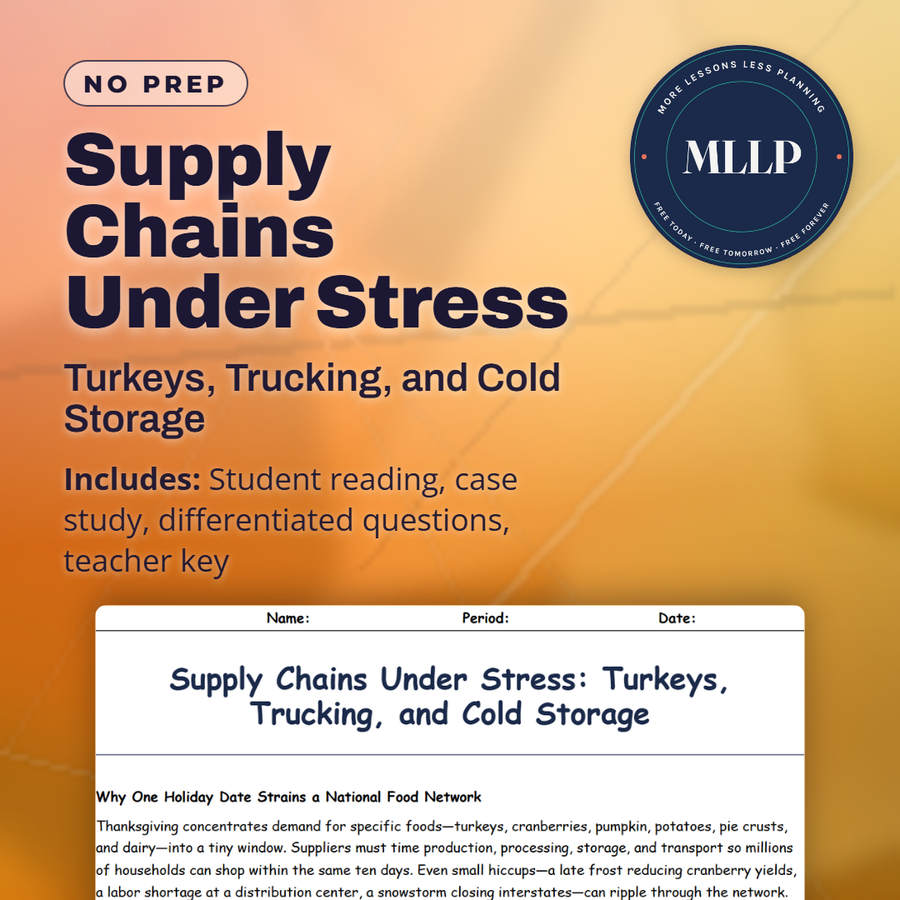
Supply Chains Under Stress: Turkeys, Trucking, and Cold Storage
Quality reviewed September 2026
Facts verified September 9, 2026
- Subject
- Social Studies
- Grades
- Grades 9-12
- Length
- 8-page student worksheet
- Time
- About one 50-minute class period
- Great for
- Sub plans and independent work
- Includes
- Reading passage, comprehension questions + full answer key
- Format
- Print-and-go PDF
What students do
- Map cold-chain risks from farm to store and propose mitigations
- Distinguish between buffer inventory and just-in-time efficiency trade-offs
- Analyze a snowstorm scenario and choose route adjustments and promotional pivots
- Design a risk-reduction budget allocation for perishable foods
What it covers
- Cold chains, cross-docking, and FIFO logistics
- Weather and labor shocks to transportation networks
- Demand forecasting and inventory positioning
Start reading this worksheet
Why One Holiday Date Strains a National Food Network
Thanksgiving concentrates demand for specific foods (turkeys, cranberries, pumpkin, potatoes, pie crusts, and dairy) into a tiny window. Suppliers must time production, processing, storage, and transport so millions of households can shop within the same ten days. Even small hiccups (a late frost reducing cranberry yields, a labor shortage at a distribution center, a snowstorm closing interstates) can ripple through the network. To handle the surge, firms rely on the cold chain (temperature-controlled storage and transport), buffer inventory (extra stock positioned in advance), and diversified routes and vendors. Still, thin margins discourage overbuilding capacity, so the system is fast but fragile. The paradox of Thanksgiving logistics is this: stability comes not from preventing all problems, but from designing options (alternate carriers, secondary warehouses, flexible cross-docking) so goods can “route around” trouble in real time. For students, this is supply-and-demand made visible: a national choreography of farms, plants, rail yards, freezers, and trucks aimed at one Thursday feast.
Turkeys: Frozen vs. Fresh and the Role of the Cold Chain
Most holiday turkeys are raised months in advance. Many are flash-frozen and stored in deep freeze to smooth production across the year, then released to retailers in the weeks before the holiday. “Fresh” turkeys (never frozen) compress the timeline: they leave plants within days of arrival at the store, with strict temperature and shelf-life constraints. That means the cold chain (from plant blast chillers to refrigerated trailers and in-store coolers) must work without interruption. A breakdown at any stage risks food safety, quality loss, and waste. To hedge, retailers may split orders among regions (Upper Midwest vs. Southeast plants), book redundant carriers, and stage drop trailers at busy stores for quick swaps. Yet any last-minute promotion can yank demand above forecast, emptying endcaps and forcing emergency deliveries. Consumers feel the system when the “right size” bird disappears; suppliers feel it as capacity hits the red line.
Cranberries, Pie, and the “Right-Now” Problem
Cranberry processors build inventory in October, but jellied sauce, fresh berries, and dried fruit move through different channels. Canned goods can ride rail to distribution centers early; fresh berries and cream for pies depend on tighter windows and refrigerated trucks. Bakeries time pie shells and pumpkin fillings to arrive just-in-time so shelves aren’t clogged two weeks too early. That leanness reduces storage costs but raises vulnerability: a missed truck appointment can mean empty shelves for a whole day of peak shopping. Retailers offset with cross-docking (rapid transfer from inbound to outbound without long storage) and pull-forward plans (releasing a little stock earlier if storms loom). Geography adds spice: an icy pass on I-80, a river barge delay, or a regional driver shortage can skew availability by state. The public sees “sold out”; logisticians see a chess board where each piece (trailer, dock door, pallet slot) must align exactly once.
Like what you read? The full reading, the case study, and every question set are in the free download below, along with the answer key.
Why this matters
Five days before Thanksgiving, a lake effect snowstorm outside Buffalo shuts the interstate needed for frozen turkeys by rail and fresh birds by refrigerated truck from Pennsylvania. The fix comes fast: reroute reefers onto open toll roads, and pull forward extra frozen birds with signage on safe thaw times, since the deadline will not wait.
This case study shows that resilience is not the same skill as forecasting. What saved the order was buffer inventory and backup carriers on retainer, not a correct guess about the weather. Treating dock doors, driver rosters, and freezer space as separate constraints turns a holiday rush into a systems problem, not a guessing game.
From one teacher to another
Thanksgiving is demand under time pressure on a network held together by frozen and refrigerated transport. The case study plunges into a lake-effect snowstorm outside Buffalo five days before the holiday. A retailer has frozen turkeys inbound by rail and "fresh" birds on refrigerated trucks from Pennsylvania, but snow shuts the interstate. The team decides fast: re-route reefers south on open toll roads even at higher cost, and pull forward extra frozen birds with signage explaining safe thaw times. Students see that resilience is optionality, not perfect forecasting. Buffering some inventory, keeping backup carriers on retainer, and the ability to swap promotions in hours all matter more than guessing the weather right. The answer key walks through each bottleneck (dock doors, driver rosters, freezer space) and how a small investment in slack or redundancy would cut risk per dollar. It turns a holiday shopping rush into a systems problem.
What you get
Download
Where should I send the next one?
Everything here is free and it stays that way. Leave your email and I'll send you the new lessons as they go up. You can unsubscribe from any one of them.
Related resources
Black Friday Forensics: Shoplifting, Organized Theft, and Crowd Violence
Black Friday Smart Shopper: Economics and Personal Finance in Action
Black Friday: Are the “Deals” Actually Good for Shoppers?
Black Friday’s Economic Impact: Who Gains, Who Pays, and What It Means for the Economy
Budget a Feast: Unit Prices, Deals, and Receipts
Colonial Foodways: Indigenous Knowledge and European Adaptation
Every lesson on this site is free to download and use. If one of them saved you a prep period, you can chip in a few bucks toward my three kids' daycare fund. That's genuinely where tips go.