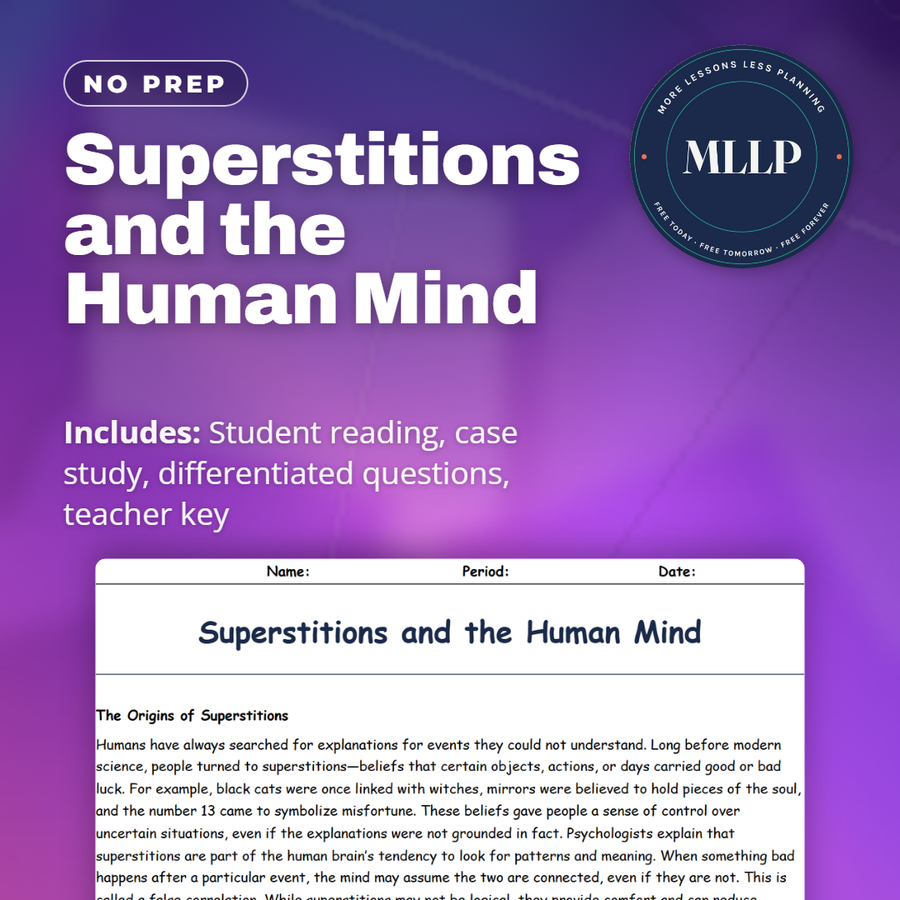
Superstitions and the Human Mind
Quality reviewed September 2026
Facts verified September 9, 2026
- Subject
- Social Studies
- Grades
- Grades 9-12
- Length
- 6-page student worksheet
- Time
- About one 50-minute class period
- Great for
- Sub plans and independent work
- Includes
- Reading passage, comprehension questions + full answer key
- Format
- Print-and-go PDF
What students do
- Identify false correlations as a foundation of superstitious thinking
- Analyze Skinner's pigeon experiment and its implications for human behavior
- Examine cultural differences in the meanings of superstitions
- Evaluate why superstitions persist despite logical reasoning
What it covers
- Pattern recognition and false correlations
- Psychology of superstition and sense of control
- Cultural traditions and lucky behaviors
Start reading this worksheet
The Origins of Superstitions
Humans have always searched for explanations for events they could not understand. Long before modern science, people turned to superstitions—beliefs that certain objects, actions, or days carried good or bad luck. For example, black cats were once linked with witches, mirrors were believed to hold pieces of the soul, and the number 13 came to symbolize misfortune. These beliefs gave people a sense of control over uncertain situations, even if the explanations were not grounded in fact. Psychologists explain that superstitions are part of the human brain’s tendency to look for patterns and meaning. When something bad happens after a particular event, the mind may assume the two are connected, even if they are not. This is called a false correlation. While superstitions may not be logical, they provide comfort and can reduce anxiety by offering simple rules to follow: avoid walking under ladders, knock on wood, or carry a lucky charm.
Why We Believe in Superstitions
Superstitions persist because they are deeply tied to emotion and culture. When people feel nervous or lack control, they are more likely to turn to superstitious behaviors. Athletes, for instance, may wear the same socks for every game, believing it helps them win. Students might bring a lucky pen to a test. These actions create a sense of confidence, even if they do not truly affect outcomes. Cultural traditions also play a major role. In some countries, certain numbers or colors symbolize luck, while in others they are considered unlucky. For example, while 13 is feared in the U.S., the number 4 is considered unlucky in parts of East Asia because it sounds similar to the word for “death.” Superstitions are therefore both personal and cultural, shaping how individuals interact with the world.
Like what you read? The full reading, the case study, and every question set are in the free download below, along with the answer key.
Why this matters
A lucky shirt does not cause a win, and a lucky pen does not cause a good grade, yet plenty of students who know that will still reach for one before a test. Skinner's pigeons explain why: fed at random intervals, each bird kept repeating whatever motion it happened to be making when food arrived.
The uncomfortable part is realizing the pigeons are not a metaphor for human behavior; they are a direct demonstration of it. Tracing a lucky shirt back to the same false correlation a hungry pigeon makes turns superstition into the pattern finding habit underneath a student's own choices.
From one teacher to another
Skinner's pigeons teach the truth: birds got food at random, but each one kept repeating whatever action they were doing when it showed up. They thought they caused the reward. Humans do the exact same thing. A lucky shirt at a successful test, a lucky pen you bring everywhere. This worksheet follows Skinner's experiment to explain why your brain finds patterns even where none exist, and why that's actually deeply human.
What you get
Download
Where should I send the next one?
Everything here is free and it stays that way. Leave your email and I'll send you the new lessons as they go up. You can unsubscribe from any one of them.
Related resources
Every lesson on this site is free to download and use. If one of them saved you a prep period, you can chip in a few bucks toward my three kids' daycare fund. That's genuinely where tips go.