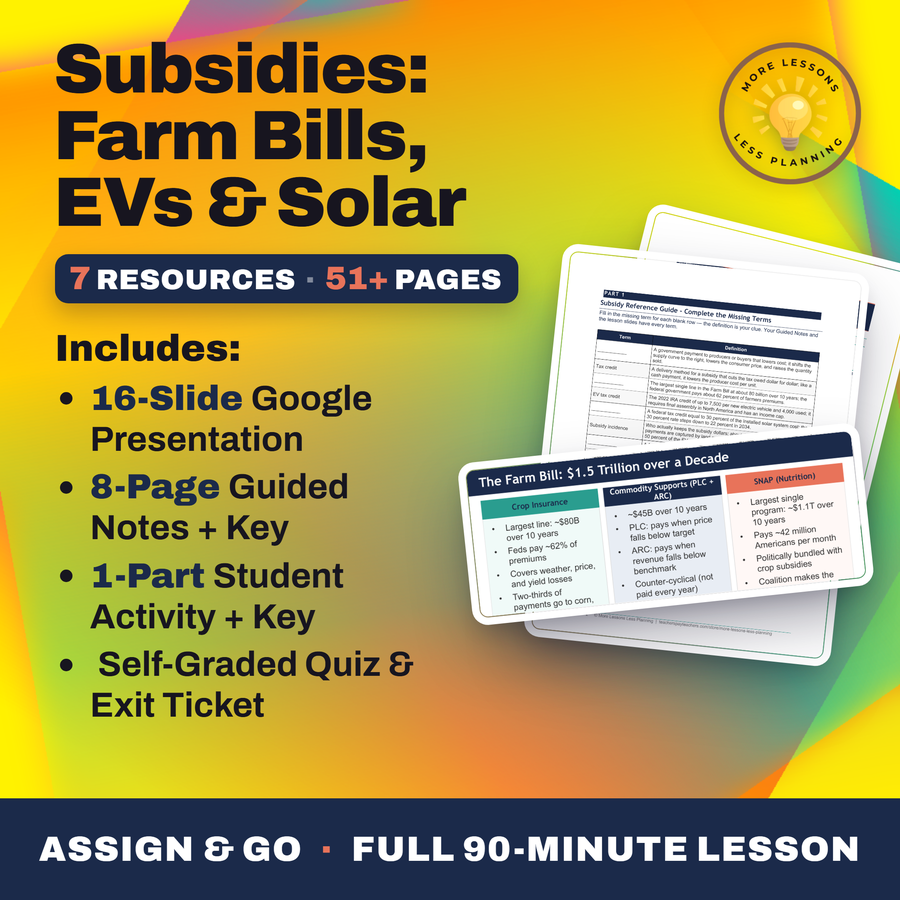

Subsidies Farm Bills, EVs & Solar
Quality reviewed September 2026
- Grades
- Grades 9-12
- Time
- About two 50-minute class periods
- Includes
- 10 ready-to-teach files
- Format
- Word (.docx) · PowerPoint (.pptx)
- Slide deck
- Guided notes
- Guided notes teacher key
- Activity + answer key
- Quiz + answer key
- Exit ticket + answer key
- Teacher guide
What students do
- Explain how a subsidy shifts the supply curve right, lowering the consumer price and raising quantity sold
- Score five real subsidy proposals, from expanding crop insurance to cutting the corn ethanol mandate, on size, winners, and political durability
- Trace how about 40% of Farm Bill payments get captured by landowners through higher land rents rather than farmers
- Write a Senate policy memo recommending which two of five subsidy proposals a committee should advance first
What it covers
- How a subsidy shifts the supply curve right, lowering price and raising quantity sold
- Three real subsidy programs, the Farm Bill's crop insurance, the EV tax credit, and the 30% solar Investment Tax Credit
- Where subsidy money actually lands, from landowners capturing Farm Bill payments through higher rents to manufacturers capturing EV credit value
- Scoring five live subsidy proposals on size, winners, and political durability before a Senate policy memo
Learning targets
- Define a subsidy and identify three major federal subsidy programs (the Farm Bill, the EV tax credit, the solar Investment Tax Credit) by their dollar size and policy goal.
- Apply supply-and-demand analysis to a subsidy: show how it shifts the supply curve right, lowers the price consumers pay, and raises the quantity bought.
- Evaluate the winners and losers of each subsidy: who collects the dollars, who pays through higher taxes or higher prices, and what market distortions the subsidy creates.
Peek inside
Definition
A government PAYMENT to producers (or buyers)
Lowers the cost of doing business
The price the consumer pays FALLS
The quantity sold RISES
Definition and Two Delivery Methods
A SUBSIDY is a government to producers (or sometimes buyers) that lowers cost.
The two main delivery methods are a CASH PAYMENT or a TAX .
Both methods lower the producer's per unit.
Both methods shift the curve to the right.
SECTION 2
1. Q1. A government payment that lowers a producer's cost, shifts the supply curve to the right, and lowers the price buyers pay is a(n) .
Why this matters
Students assume a subsidy is simply free money for whoever's at the register, but the real winner is often someone further up the supply chain. Three real programs make that visible: the Farm Bill's crop insurance, the EV tax credit's $7,500, and the 30% solar Investment Tax Credit, each traced to find where the money actually lands.
The concentration numbers change minds fastest in my room: the top 10% of farms collect 78% of federal farm payments, and manufacturers captured 30-50% of the pre-IRA EV credit through higher sticker prices. By the time students score five live proposals and write a Senate memo, they stop assuming a subsidy helps the buyer.
From one teacher to another
Students assume a subsidy just means cheaper stuff, so I make them trace exactly where the money goes on three real programs: the Farm Bill's crop insurance, the EV tax credit's $7,500 per vehicle, and the 30% solar Investment Tax Credit. The concentration numbers are what actually change their minds, the top 10% of farms collect 78% of all federal farm payments, and research on the pre-IRA EV credit found manufacturers captured 30-50% of it through higher sticker prices instead of it reaching buyers. By the end they're scoring five live proposals, from expanding crop insurance to cutting the corn ethanol mandate that's been politically untouchable since the 2007 energy law, and writing a memo that has to pick two to advance, not just describe the tradeoffs in the abstract.
Every file in this toolkit
-
Activity (Student)
Maya Castillo has students grade five subsidy ideas, more crop insurance, a bigger EV credit, a longer solar ITC, a new chip subsidy, and a corn ethanol cut, on supply shift size, who collects the money, and political durability.
-
Activity (Answer Key)
Graded answers show the top 10 percent of farms collecting 78 percent of federal payments and manufacturers keeping 30 to 50 percent of the EV credit through higher prices, then rate each proposal's odds of surviving a floor vote.
-
Exit Ticket (Student)
Opening questions define what a subsidy is, identify which direction a per-unit payment moves the supply curve, and explain why these programs stay politically durable despite the distortions they cause. Students pick one program and name its winners, payers, and one distortion.
-
Exit Ticket (Answer Key)
Lower cost with more quantity sold is the subsidy definition, a rightward move is the supply-curve direction, and concentrated benefits against scattered costs explain political durability. Full credit needs the program's size, its winners, payers, and one named distortion.
-
Guided Notes (Student)
Three real programs get priced out, crop insurance worth about $80 billion over ten years, a vehicle credit worth up to $7,500, and a 30 percent solar tax credit, then blanks trace who actually pockets the money once supply shifts right.
-
Guided Notes (Teacher Key)
Where the dollars really land gets traced, about 40 percent of farm payments ending up with landowners via pricier land rents, 30 to 50 percent of an older vehicle credit captured by manufacturers, and the top 10 percent of farms collecting 78 percent of all federal payments.
-
Quiz (Student)
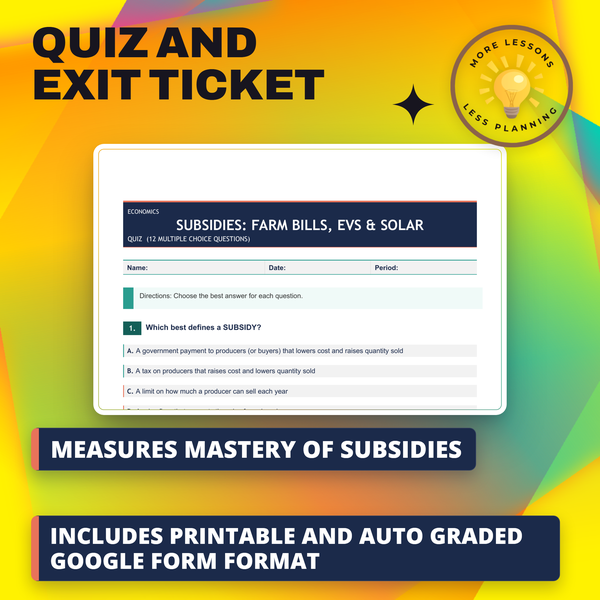
A subsidy's shift of the supply curve gets traced through three real programs, insurance for crop losses, a tax credit for electric vehicles, and a federal credit for home solar, then items ask which side of the deal actually pockets the money.
-
Quiz (Answer Key)
The top 10 percent of farms collects 78 percent of federal payments, the solar credit runs at 30 percent through 2032, and subsidy incidence shifts to manufacturers under the pre-IRA electric vehicle credit.
-
Slides
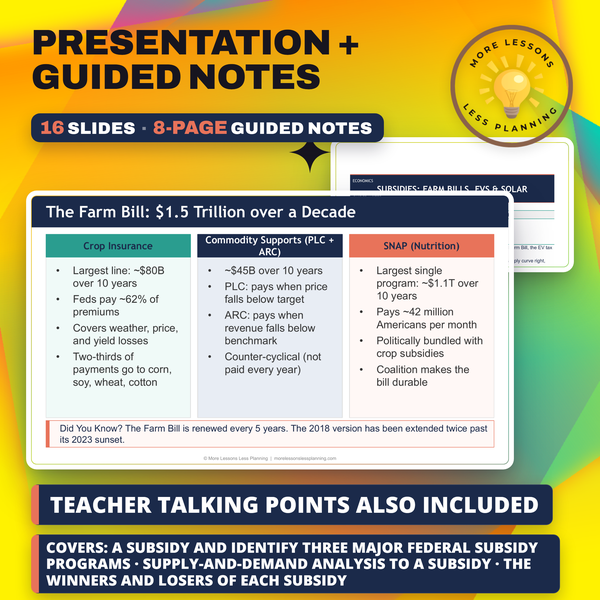
Crop insurance inside the $1.5 trillion Farm Bill gets compared against a $7,500 credit for new EVs and the 30 percent solar Investment Tax Credit, before a slide on subsidy concentration shows the top 10 percent of farms collecting 78 percent of all payments.
-
Teacher Guide
A four-faction debate splits the room between urban Democrats defending SNAP and rural Republicans defending commodity supports, with the audience voting on whose package would pass markup. One prompt weighs a $250K per-farm payment cap against preserving the Farm Bill coalition.
Download
Where should I send the next one?
Everything here is free and it stays that way. Leave your email and I'll send you the new lessons as they go up. You can unsubscribe from any one of them.
Related resources
Externalities When Markets Hurt Others
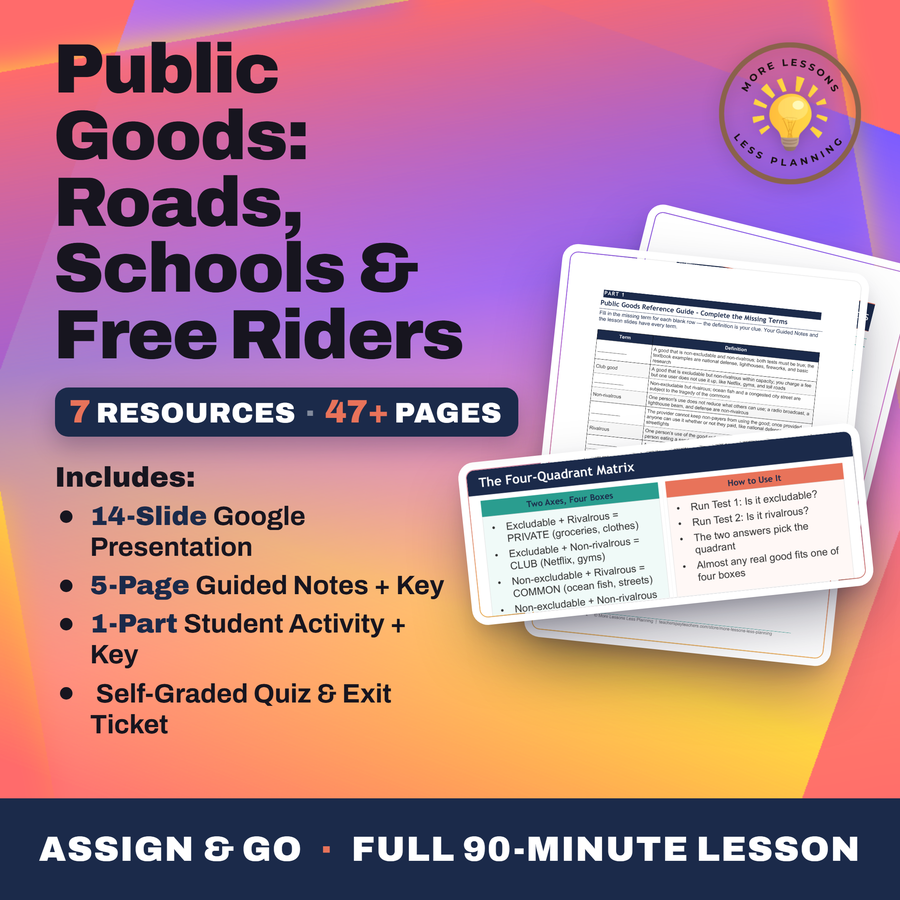
Public Goods Roads, Schools & Free Riders
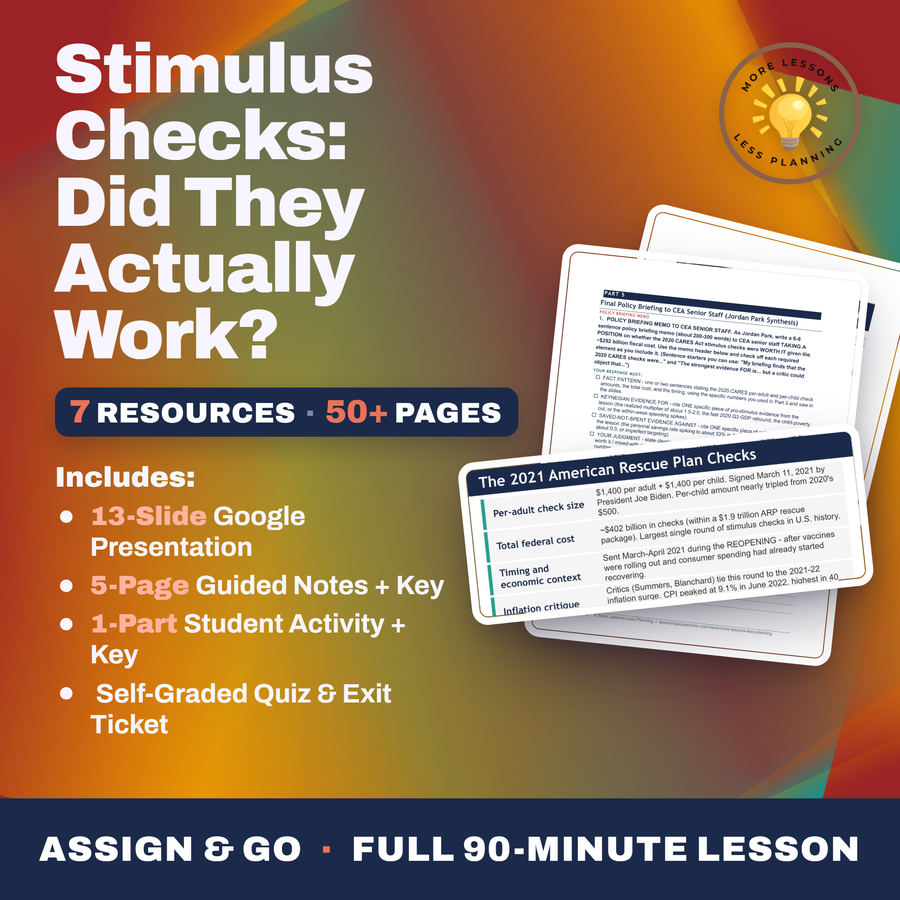
Stimulus Checks: Did They Actually Work?
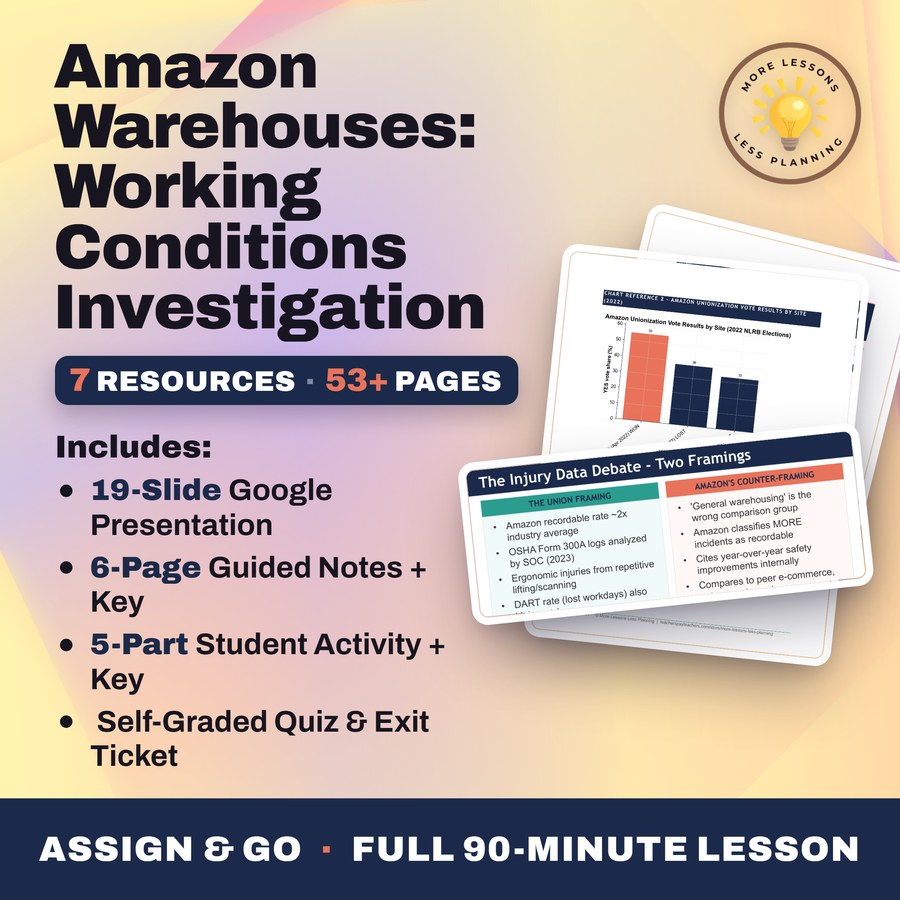
Amazon Warehouses: Working Conditions Investigation

Anti-Trust Laws and Regulation: Promoting Fair Competition

Barriers to Entry: What Keeps Competitors Out
Every lesson on this site is free to download and use. If one of them saved you a prep period, you can chip in a few bucks toward my three kids' daycare fund. That's genuinely where tips go.