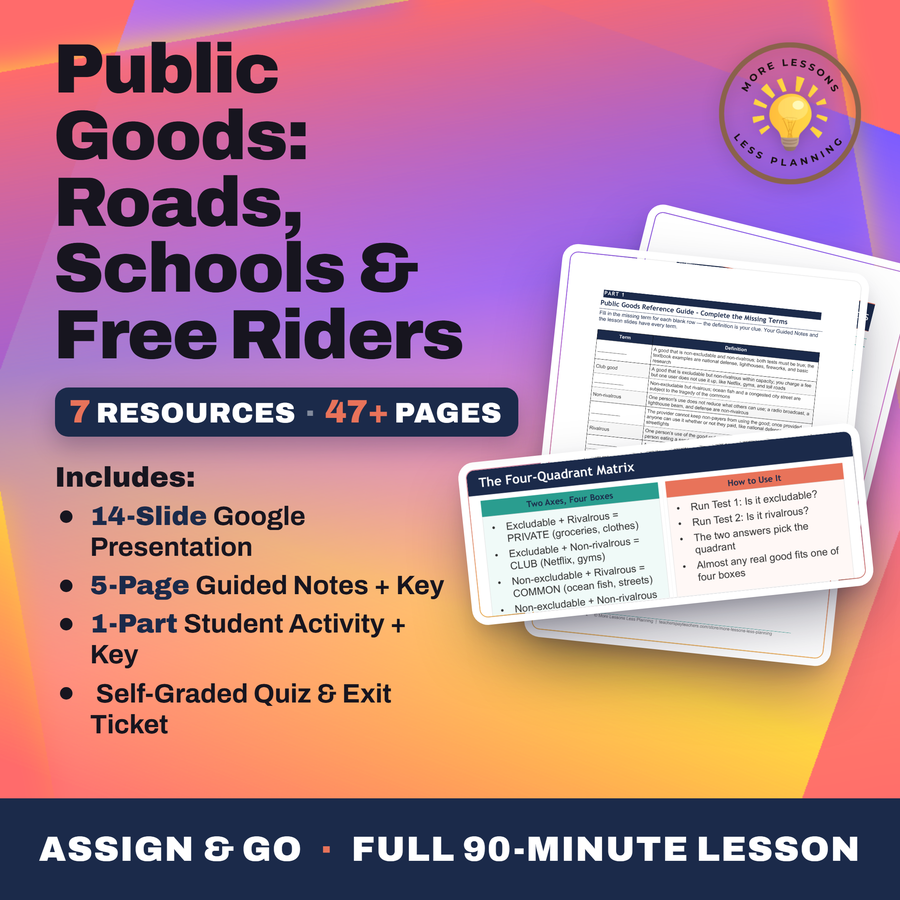
Public Goods Roads, Schools & Free Riders
Quality reviewed September 2026
- Grades
- Grades 9-12
- Time
- About two 50-minute class periods
- Includes
- 10 ready-to-teach files
- Format
- Word (.docx) · PowerPoint (.pptx)
- Slide deck
- Guided notes
- Guided notes teacher key
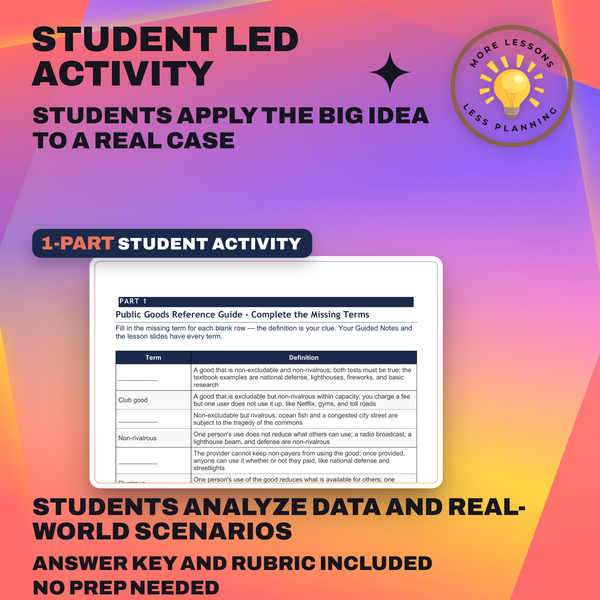
- Activity + answer key
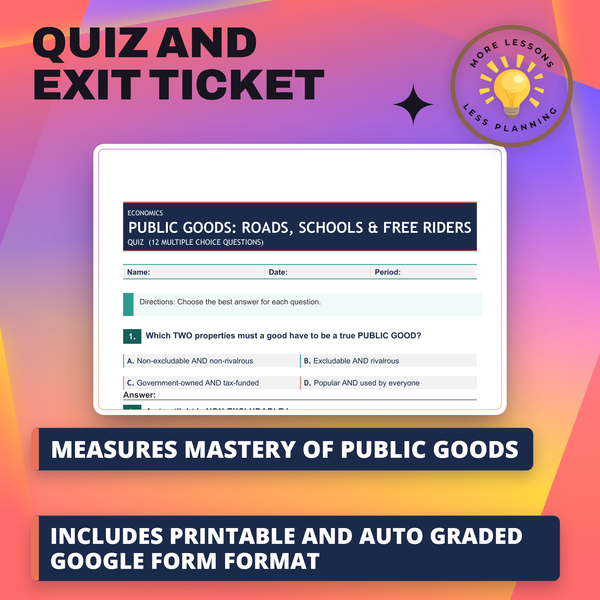
- Quiz + answer key
- Exit ticket + answer key
- Teacher guide
What students do
- Run the two tests, non-excludable and non-rivalrous, to classify a good as public, private, common, or club
- Explain the free rider problem and why voluntary payment collapses for a non-excludable good
- Work the free-rider math showing how far voluntary contributions fall short of a good's real value
- Audit a real city budget, sorting line items into public, club, common, and private goods
What it covers
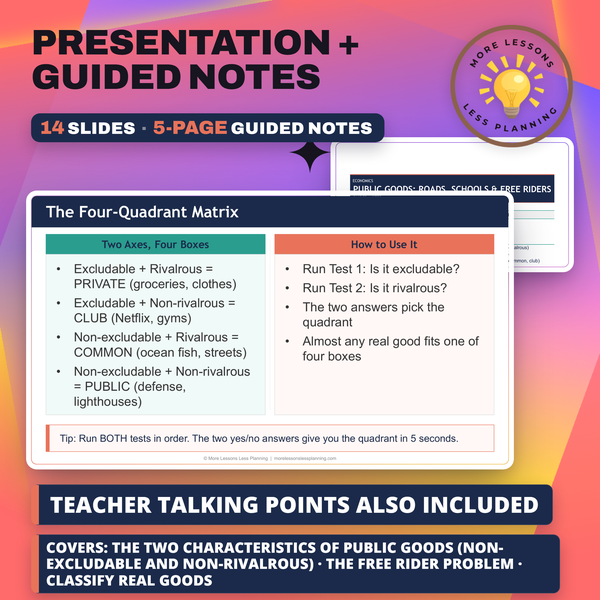
- The four-quadrant matrix that sorts real goods, groceries, Netflix, ocean fish, and national defense, into public, private, common, and club
- Why an empty interstate behaves like a public good but the same road jammed with traffic turns into a common one
- The free-rider math behind why voluntary contributions toward something like national defense fall far short of what it's actually worth
- Real dollar figures on what U.S. defense and public schools cost every year, and why a compulsory tax is the standard fix
Learning targets
- Identify the two characteristics of public goods (non-excludable and non-rivalrous)
- Explain the free rider problem and why markets underprovide public goods
- Classify real goods using the rivalry-excludability matrix (public, private, common, club)
Peek inside
1. Q1. A good that passes BOTH tests - you cannot keep non-payers out AND one person's use does not reduce what is left for others, like the U.S. military or a coastal lighthouse beam - is a .
Why this matters
A city park sits empty most mornings, then fills past capacity by Saturday, and somewhere in that shift a public good turns into a common one. Students trace that same slide inside a real $850 million city budget, testing whether you can keep a non-payer out and whether one person's use eats into what is left.
Watching one line item fail one test and pass the other is what reorganizes how students think about government spending. Once they work the free-rider math and see how far voluntary giving falls short of what something like national defense is worth, a compulsory tax stops sounding like overreach.
From one teacher to another
Dr. Maya Chen is a city budget analyst who has to sort an $850 million proposed budget into what actually belongs on the tax rolls, and students take on her exact audit. Before anything gets a label, every good has to pass two separate tests, whether you can keep a non-payer out and whether one person's use eats into what's left for someone else, and I make them run both tests every time instead of guessing off a gut feeling. The four-quadrant matrix is where it clicks for most kids, since something like a toll road or a crowded city park doesn't sit still in one category, an empty road reads as public but the same road jammed with traffic starts to look a lot more like a fish stock everyone's competing over. The free-rider math is the part that closes the loop, because once they see how far voluntary contributions fall below what a good's actually worth, the case for a compulsory tax stops being abstract.
Every file in this toolkit
-
Activity (Student)
Dr. Maya Chen's card sort has students run the excludability and rivalry tests on national defense, a lighthouse beam, ocean fish stocks, and a July 4th park that turns from empty to packed, then decide whether each is public, private, common, or a club good.
-
Activity (Answer Key)
Card verdicts in this key land national defense and a lighthouse as public goods, ocean fish stocks and a rush-hour street as common goods needing quotas or congestion pricing, and public schools as a borderline case funded by about $800 billion a year.
-
Exit Ticket (Student)
The ticket's questions name the two tests a good must pass to count as public, ask students to define a free rider, and identify which item on the list is a club good instead of a public one. A public good gets defined with both tests, and the underprovision problem gets explained.
-
Exit Ticket (Answer Key)
Non-excludable and non-rivalrous together make up the public-good test, benefiting without paying is what the term names, and Netflix is the club-good example on the list. Both tests, one example, and the underprovision explanation earn full credit here.
-
Guided Notes (Student)
Whether a non-payer can be excluded and whether one user's turn crowds out another get tested on goods like ocean fish and fireworks, then a free-rider example runs for a thousand people valuing a good at $50 a year, landing between $5,000 and $15,000 short of $50,000.
-
Guided Notes (Teacher Key)
The four-quadrant matrix gets completed and both fixes get priced, national defense at about $850 billion a year and public schools at about $800 billion, both funded through compulsory taxes instead of the voluntary payments that collapse under free riders.
-
Quiz (Student)
A streetlight, Netflix, ocean fish, and a congested city street each get tested against the excludable and rivalrous questions, while a clean air scenario works the underprovision gap in dollars.
-
Quiz (Answer Key)
A streetlight and national defense sort as public goods, ocean fish counts as a common good, and Netflix works as a club good. Compulsory taxes then get named as the standard fix for the underprovision problem voluntary giving creates.
-
Slides
National defense costing about $850 billion a year gets sorted using the excludability and rivalry tests before the underprovision math shows a thousand people worth $50,000 in total defense value collecting only $5,000 to $15,000 in voluntary pledges.
-
Teacher Guide
A fishing simulation drops thirty paper fish into a bowl for four or five boats to divide across ten rounds, and most classes wipe out the stock before discussing a quota or license fee. One question asks why Maine lobstermen manage a shared resource without government rules.
Download
Where should I send the next one?
Everything here is free and it stays that way. Leave your email and I'll send you the new lessons as they go up. You can unsubscribe from any one of them.
Related resources
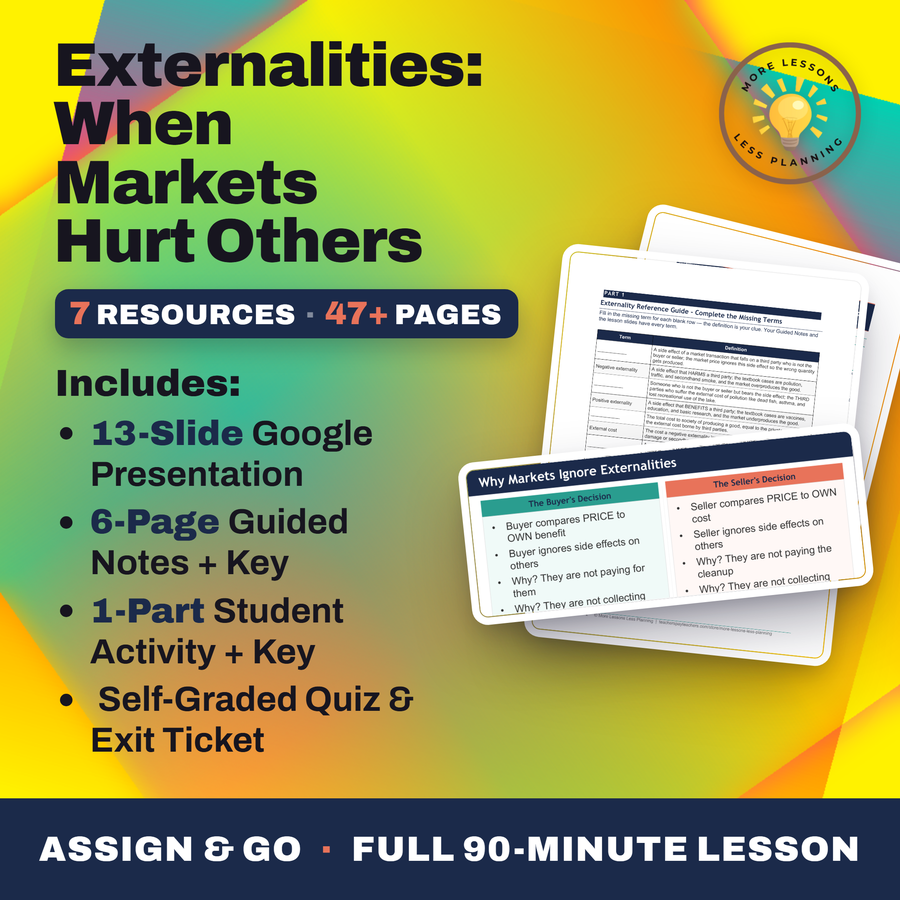
Externalities When Markets Hurt Others
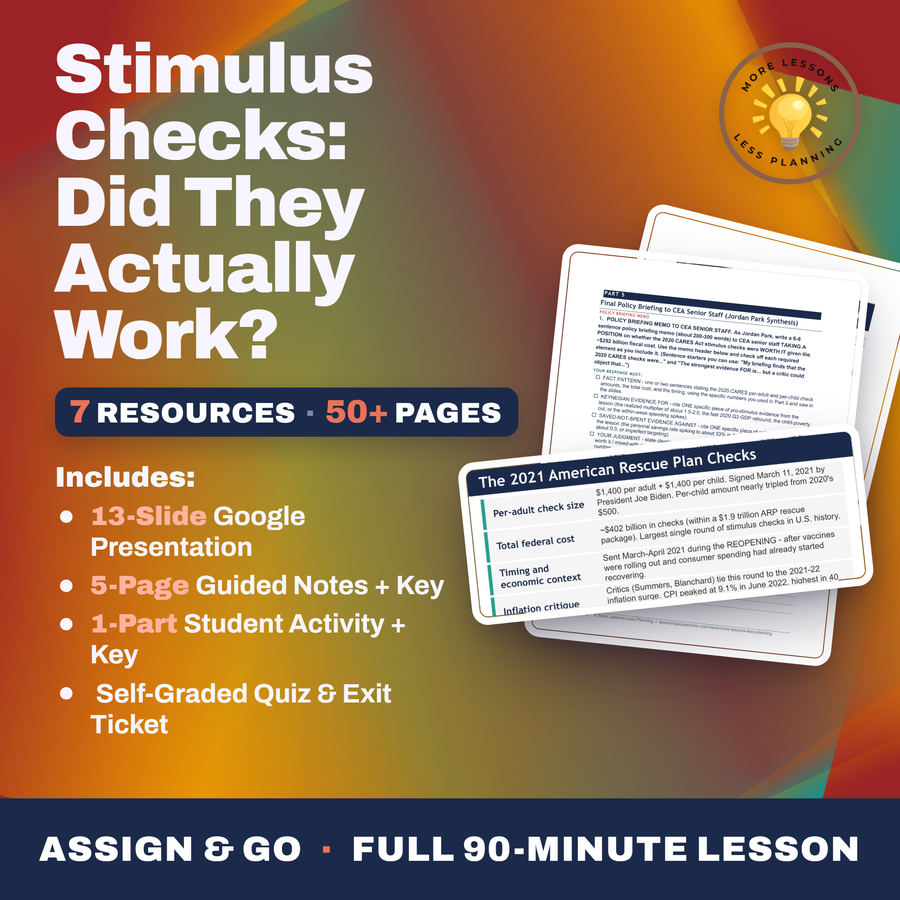
Stimulus Checks: Did They Actually Work?
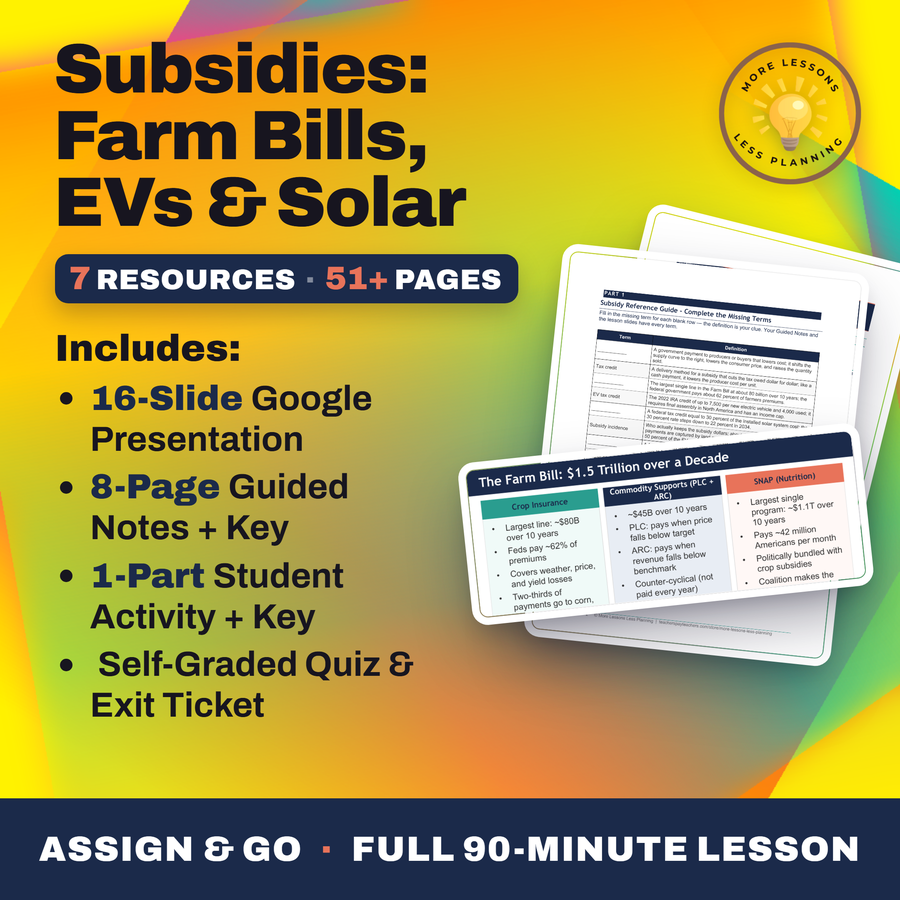
Subsidies Farm Bills, EVs & Solar
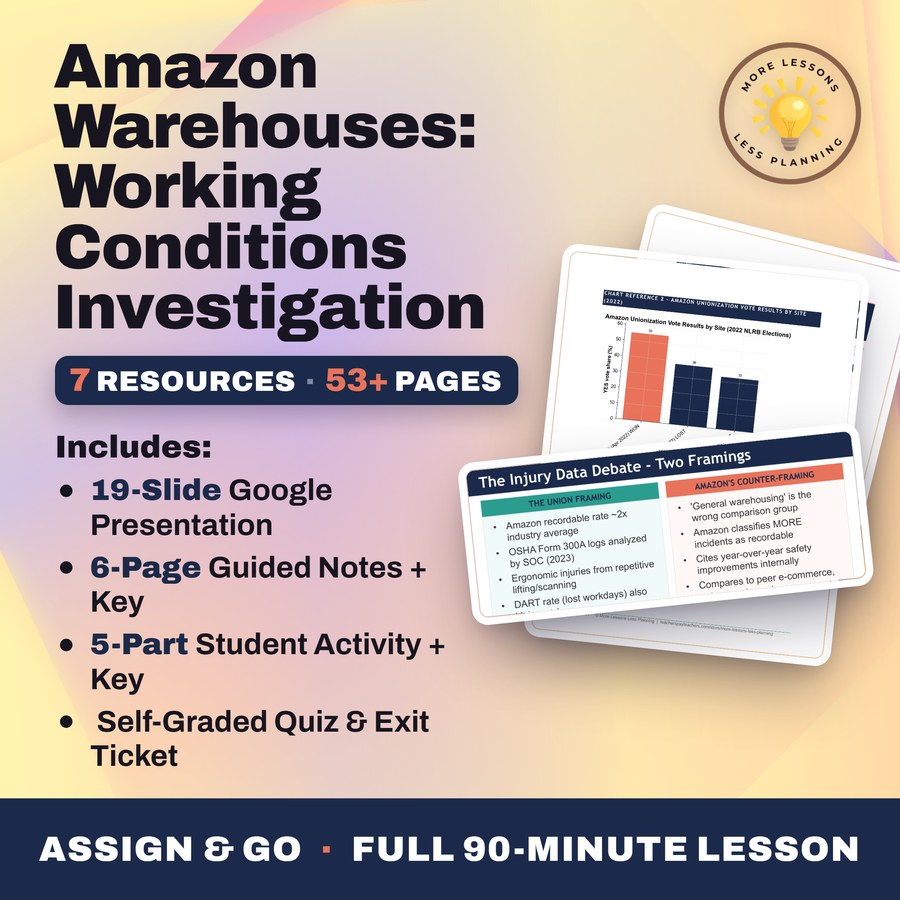
Amazon Warehouses: Working Conditions Investigation
Anti-Trust Laws and Regulation: Promoting Fair Competition
Barriers to Entry: What Keeps Competitors Out
Every lesson on this site is free to download and use. If one of them saved you a prep period, you can chip in a few bucks toward my three kids' daycare fund. That's genuinely where tips go.