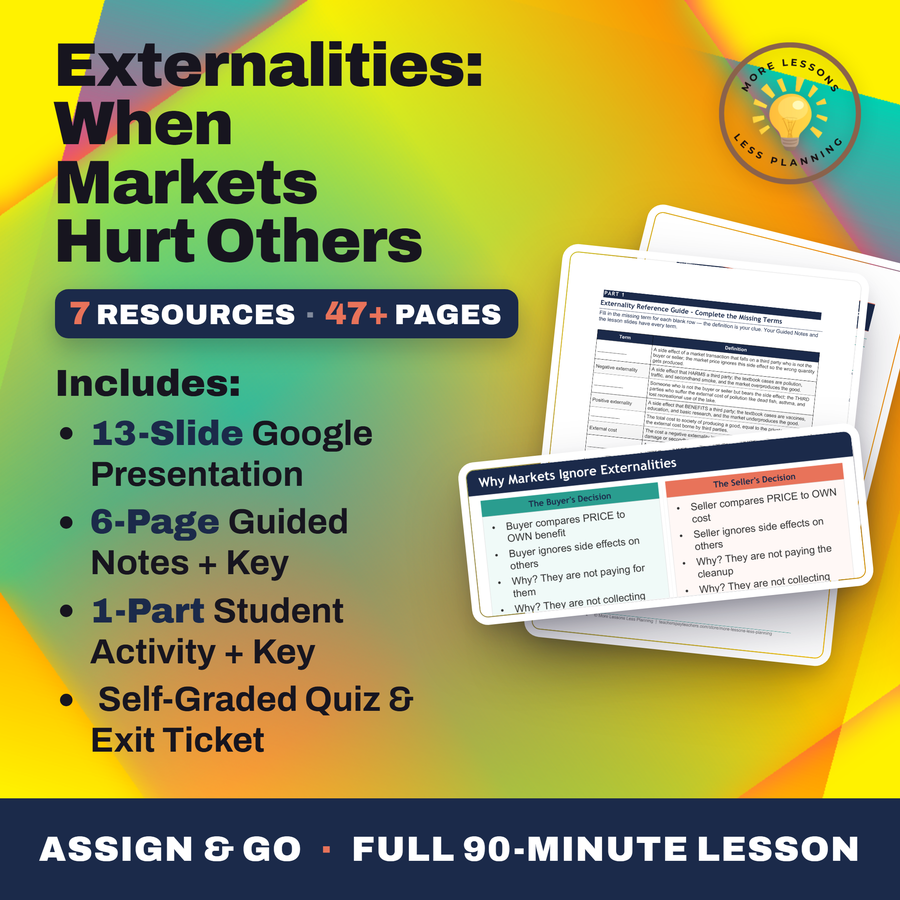
Externalities When Markets Hurt Others
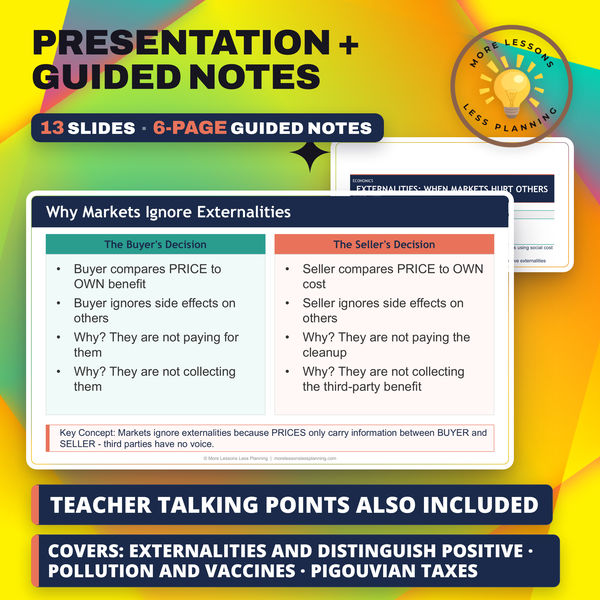
- Slide deck
- Guided notes
- Guided notes teacher key
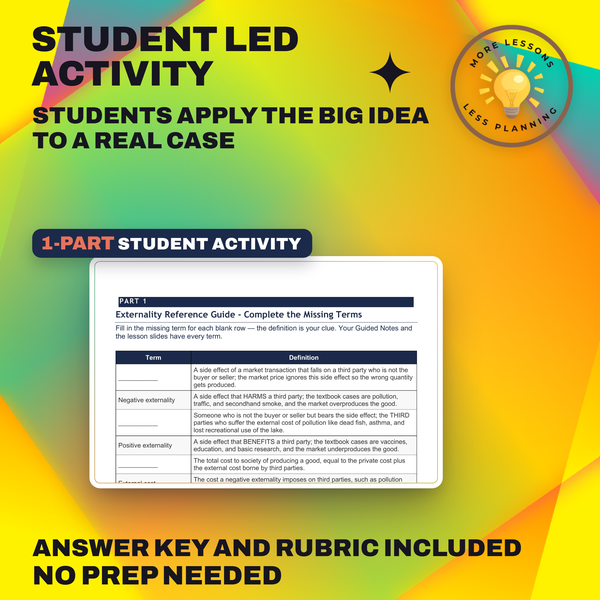
- Activity + answer key
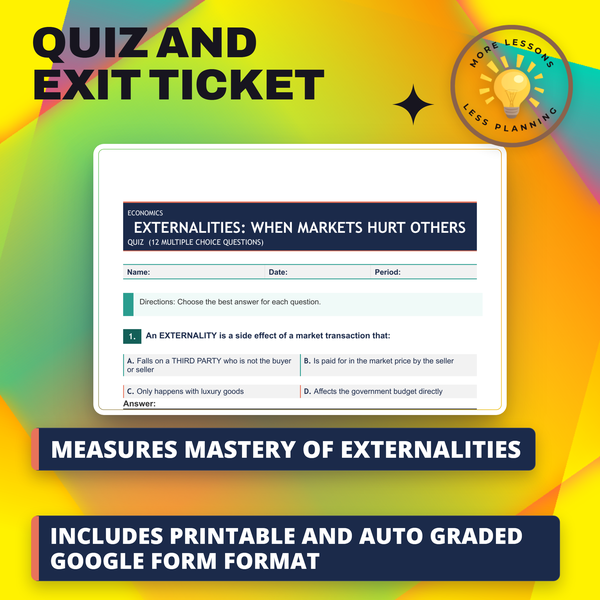
- Quiz + answer key
- Exit ticket + answer key
- Teacher guide
Where should I send the next one?
Everything here is free and it stays that way. Leave your email and I'll send you the new lessons as they go up. You can unsubscribe from any one of them.
Every file in this toolkit
Related resources
Big Tech Antitrust - Google Apple Amazon Meta
Credit Scores: The Number That Runs Your Life
Economic Systems - Capitalism vs Socialism vs Mixed
Factors of Production - Land, Labor, Capital, and Entrepreneurship
Interest Rates: The Fed's Main Tool
Law of Demand - Why Price Matters
What students do
- Diagnose whether a real-world case, factory pollution, secondhand smoke, or vaccination, is a positive or negative externality
- Calculate the gap between private cost and social cost, or private benefit and social benefit, for a given case
- Diagram why a negative externality causes overproduction and a positive externality causes underproduction on a supply-demand graph
- Prescribe a Pigouvian tax or subsidy with a defensible dollar amount for a real policy case
What it covers
- Why a factory dumping waste into a river is the textbook negative externality, and a vaccinated person protecting neighbors is the textbook positive one
- How carbon taxes, used in about 30 countries, and the U.S. Vaccines for Children subsidy work as real Pigouvian fixes
- The Coase theorem, and why private negotiation can fix an externality only when property rights are clear and transaction costs are low
Learning targets
- Define externalities and distinguish POSITIVE from NEGATIVE externalities using social cost vs private cost
- Identify pollution and vaccines as the textbook cases of negative and positive externalities and explain why markets ignore them
- Evaluate Pigouvian TAXES (on negative externalities) and Pigouvian SUBSIDIES (on positive externalities) as the standard policy fix
From one teacher to another
Every case in the activity hands students one real situation, like a factory dumping waste into the river next to a neighborhood, and asks them to work out in real dollars how much more it costs everyone else than it costs the company doing it, before anyone's allowed to slap the word externality on it. That cost gap is the idea the whole lesson circles back to, so a diagnosis alone doesn't finish the job, students still have to back up their answer with an actual Pigouvian fix, a tax or a subsidy, and put a real number on it that they can defend. I added the Coase theorem at the end on purpose, because private negotiation can fix some of these without any tax at all, and I don't want students thinking a government fix is the only lever on the shelf.
Every lesson on this site is free to download and use. If one of them saved you a prep period, you can chip in a few bucks toward my three kids' daycare fund. That's genuinely where tips go.