Stimulus Checks: Did They Actually Work?
Quality reviewed September 2026
- Grades
- Grades 9-12
- Time
- About two 50-minute class periods
- Includes
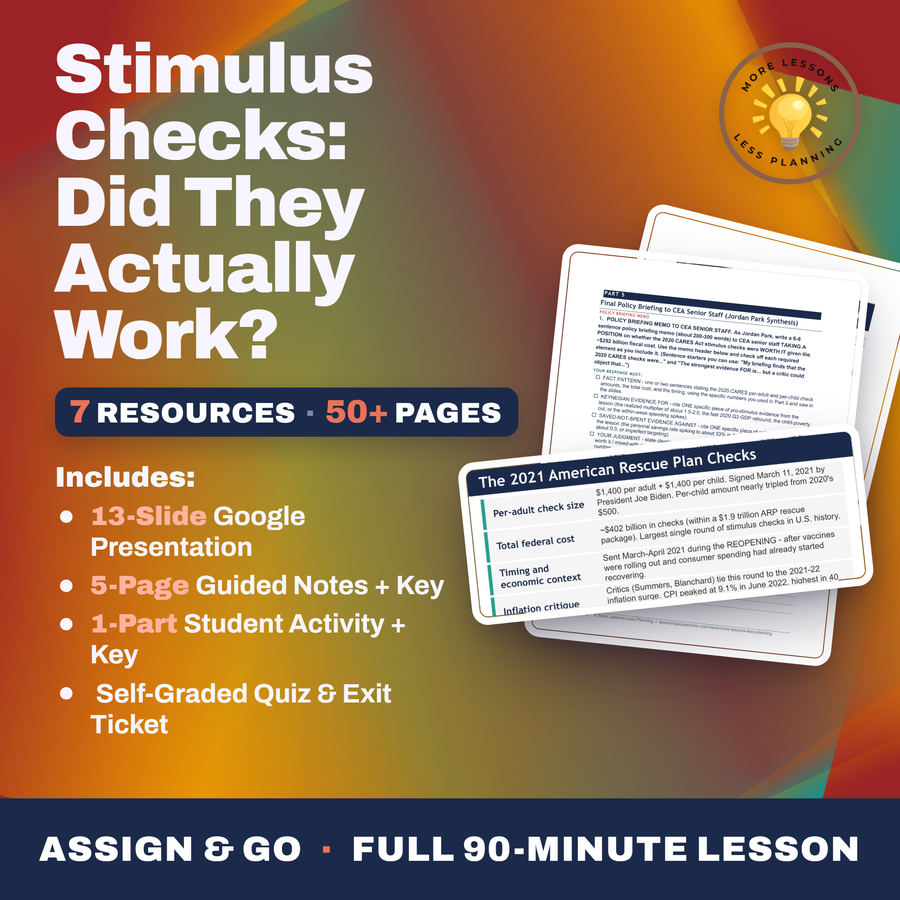
- 11 ready-to-teach files
- Format
- Word (.docx) · PowerPoint (.pptx)
- Slide deck
- Guided notes
- Guided notes teacher key
- Activity + answer key
- Quiz + answer key
- Exit ticket + answer key
- Teacher guide
- Teacher presentation notes
What students do
- Calculate the spending multiplier at three MPC values using Multiplier = 1 / (1 - MPC)
- Project the aggregate-demand impact of the 2021 American Rescue Plan's $402 billion in checks under three MPC scenarios
- Read a chart showing $1,000 in stimulus rippling through five rounds of spending at MPC = 0.6
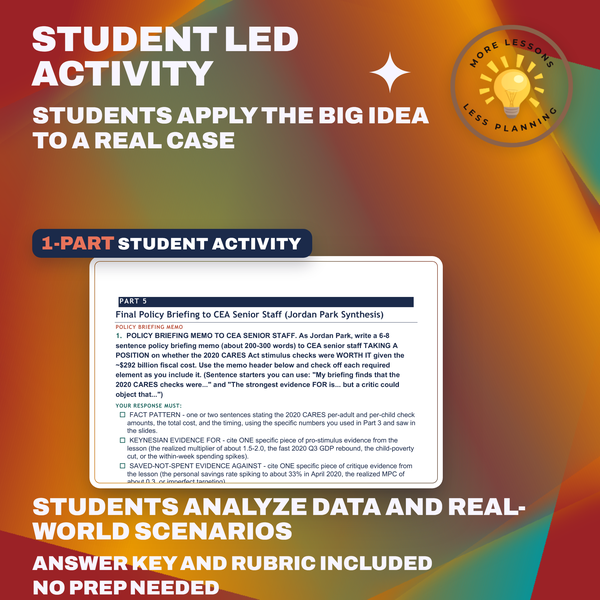
- Write a CEA policy memo taking a position on whether the 2020 CARES Act checks were worth their $292 billion cost
What it covers
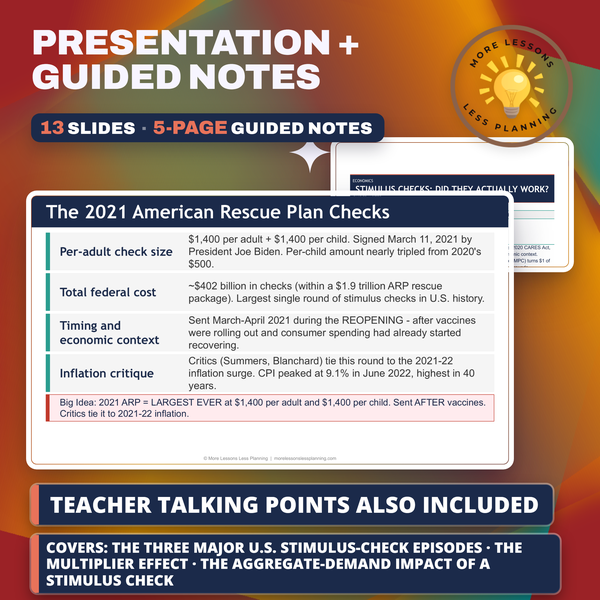
- The 2008 Bush rebate, 2020 CARES Act, and 2021 American Rescue Plan compared by per-adult amount and total cost
- The Keynesian defense, including the 2020 Q3 GDP snapback and the child poverty rate cut roughly in half
- The saved-not-spent critique, including the personal savings rate spiking to 33% in April 2020
- Why the realized MPC on the 2020 checks was closer to 0.3 than the textbook 0.6 benchmark
Learning targets
- Identify the three major U.S. stimulus-check episodes (2008 Bush rebate, 2020 CARES Act, 2021 American Rescue Plan) by size, eligibility, total federal cost, and economic context.
- Explain the MULTIPLIER EFFECT - how marginal propensity to consume (MPC) turns $1 of federal stimulus into more than $1 of total economic activity across spending rounds.
- Calculate the aggregate-demand impact of a stimulus check at given MPC values using the multiplier formula 1 / (1 - MPC), and predict how saving versus spending changes the result.
- Evaluate the two-sided 'did stimulus work' debate - the Keynesian multiplier defense vs the saved-not-spent + 2021-22 inflation critique - and judge which side the evidence supports.
Peek inside
Direct cash payment from the federal government to households.
Goal: BOOST aggregate demand (C) when consumers cut spending.
Different from unemployment insurance - not tied to job loss.
Eligibility usually phases out above a household income threshold.
Key Concept: A stimulus check is FISCAL POLICY - cash from the federal government to consumers to raise aggregate demand in a recession.
The Goal of a Stimulus Check
A stimulus check is a direct payment from the federal government to households.
The goal is to BOOST aggregate when consumers cut spending.
Stimulus checks are different from unemployment insurance because they are not tied to loss.
Eligibility usually phases out above a household threshold.
1. A direct cash payment the federal government sends straight to households to boost consumer spending and aggregate demand during a downturn is a .
Why this matters
Ask whether a $1,000 check mailed straight to a family's account actually boosted the economy, and most students just guess. This lesson makes them compute it instead, using the 2021 American Rescue Plan's $402 billion in checks to project the effect on demand under three different assumptions about how much of it actually got spent.
Both sides of the debate are true at once: the personal savings rate spiked to 33% in April 2020, real evidence people banked the money, while the same checks are tied to cutting child poverty roughly in half. The closing memo forces students to hold both facts and land on an actual position.
From one teacher to another
Every one of my students either got a stimulus check or watched their family get one, so I don't need to sell them on why this matters, I just need them to do the math instead of repeating a talking point. They compute the multiplier at three different MPC values, 1 divided by 1 minus MPC, before projecting what the 2021 American Rescue Plan's $402 billion actually bought in aggregate demand, and the answer changes a lot depending on whether people spent or saved it. That's exactly the tension I want them sitting in: the savings rate spiked to 33% in April 2020, real evidence people saved a good chunk of that money, but the same checks are tied to cutting child poverty roughly in half, so the final policy memo forces them to weigh both facts and take an actual position instead of hedging.
Every file in this toolkit
-
Activity (Student)
Jordan Park works for the CEA, and you work out the multiplier under three MPC assumptions, project how much demand a $402 billion check round could add under each one, tally what a family of four collected across three stimulus rounds, then judge whether the 2020 checks paid for themselves.
-
Activity (Answer Key)
Every multiplier value from MPC 0.4 to 0.8 gets solved and applied to the $402 billion ARP total, the $10,800 combined family total gets itemized round by round, and the five-round spending chart gets verified against the 60 percent rule. The CEA memo rules on whether the checks paid for themselves.
-
Exit Ticket (Student)
Questions compute the multiplier at an MPC of 0.6, compare the size and timing of the 2020 CARES checks against the 2021 ARP checks, and weigh the strongest evidence for and against the later round working. The closing paragraph judges whether the earlier round of checks earned its cost.
-
Exit Ticket (Answer Key)
A multiplier of 2.5 comes from MPC equals 0.6, $1,200 sent in April 2020 against $1,400 sent in March 2021 marks the two-round comparison, and a poverty rate cut nearly in half stacks against fueling the later price surge as the competing evidence. Scoring weighs both sides plus a judgment.
-
Guided Notes (Student)
Three stimulus rounds, $600 in 2008, $1,200 in 2020, and $1,400 in 2021, get compared by size and cost before students compute the multiplier, one over one minus MPC, at an MPC of 0.6. A round-by-round chart traces how a $1,000 check ripples through spending at that rate.
-
Guided Notes (Teacher Key)
MPC at 0.6 producing a multiplier of 2.5 and a running total of $2,500 from one $1,000 check stand worked out beside the savings rate spiking to 33 percent in April 2020. Both sides of the Keynesian defense and the saved-not-spent critique carry their citations attached.
-
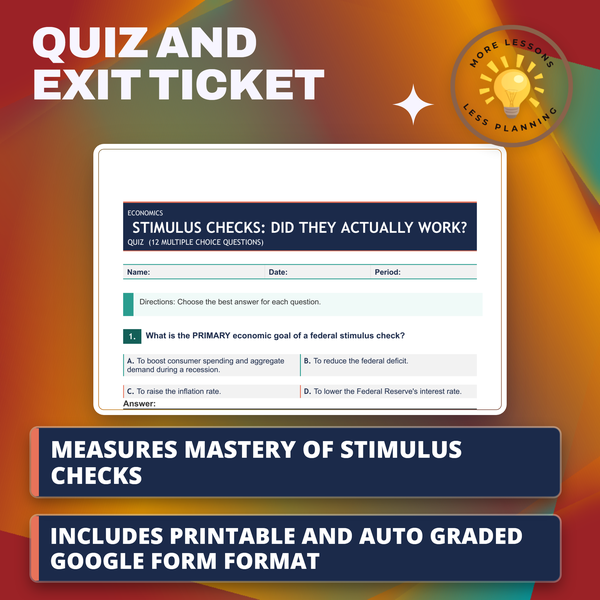
Quiz (Student)
Three items ask for the exact per-adult amount under the Bush rebate, the CARES Act, and the American Rescue Plan, then run the multiplier formula against several different MPC values.
-
Quiz (Answer Key)
$600, $1,200, and $1,400 mark the three check amounts, a multiplier of 2.5 at an MPC of 0.6 follows, and the 2021 round, paired with the expanded Child Tax Credit, gets credited with roughly halving child poverty.
-
Slides
Check amounts climb across the deck, $600 in 2008, $1,200 in 2020, $1,400 in 2021, before the multiplier formula turns MPC into a real number, 2.5 at an MPC of 0.6. A savings rate spiking to 33 percent is set against child poverty cut from 9.7 to 5.2 percent on the closing slides.
-
Teacher Guide
A CEA briefing memo closes the rubric, while discussion prompts weigh the 33 percent April 2020 savings spike against child poverty cut roughly in half by the same checks.
-
Teacher Presentation Notes
A per-adult check size climbs from $600 in 2008 to $1,200 in 2020 to $1,400 in 2021, while the total cost rises from about $152 billion to roughly $402 billion. One chart pairs an 8.4 percent GDP drop in one quarter with a 7.9 percent bounce the next.
Download
Where should I send the next one?
Everything here is free and it stays that way. Leave your email and I'll send you the new lessons as they go up. You can unsubscribe from any one of them.
Related resources
Externalities When Markets Hurt Others
Public Goods Roads, Schools & Free Riders
Subsidies Farm Bills, EVs & Solar
Amazon Warehouses: Working Conditions Investigation
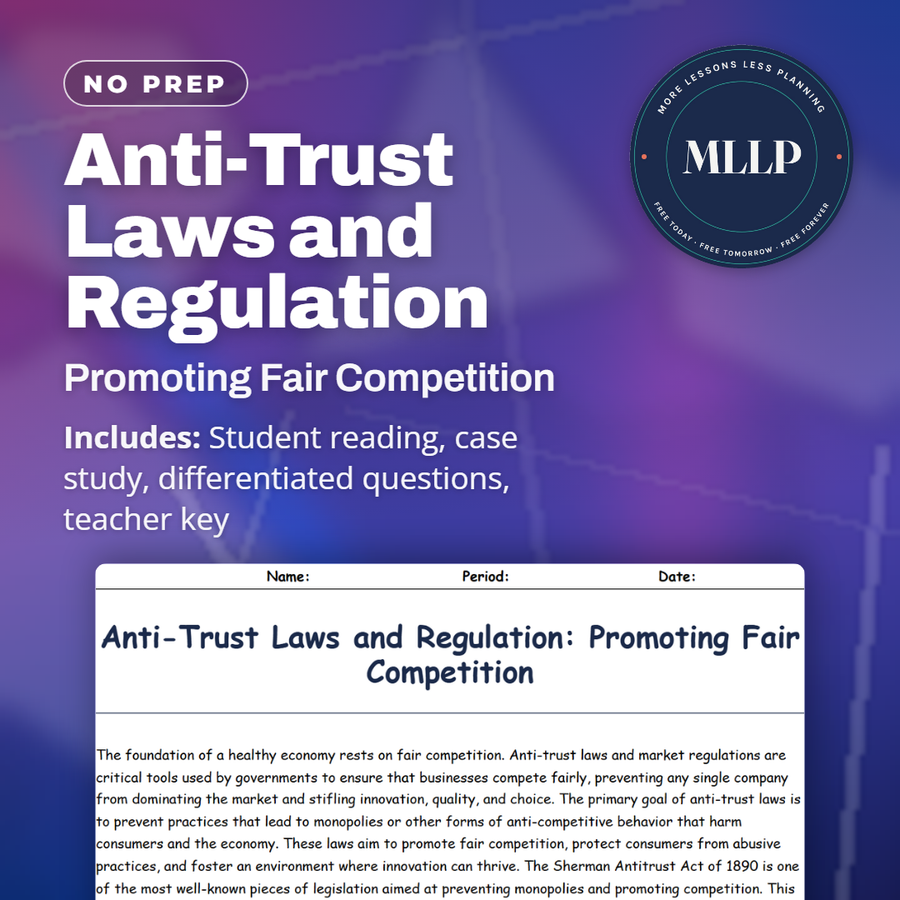
Anti-Trust Laws and Regulation: Promoting Fair Competition

Barriers to Entry: What Keeps Competitors Out
Every lesson on this site is free to download and use. If one of them saved you a prep period, you can chip in a few bucks toward my three kids' daycare fund. That's genuinely where tips go.