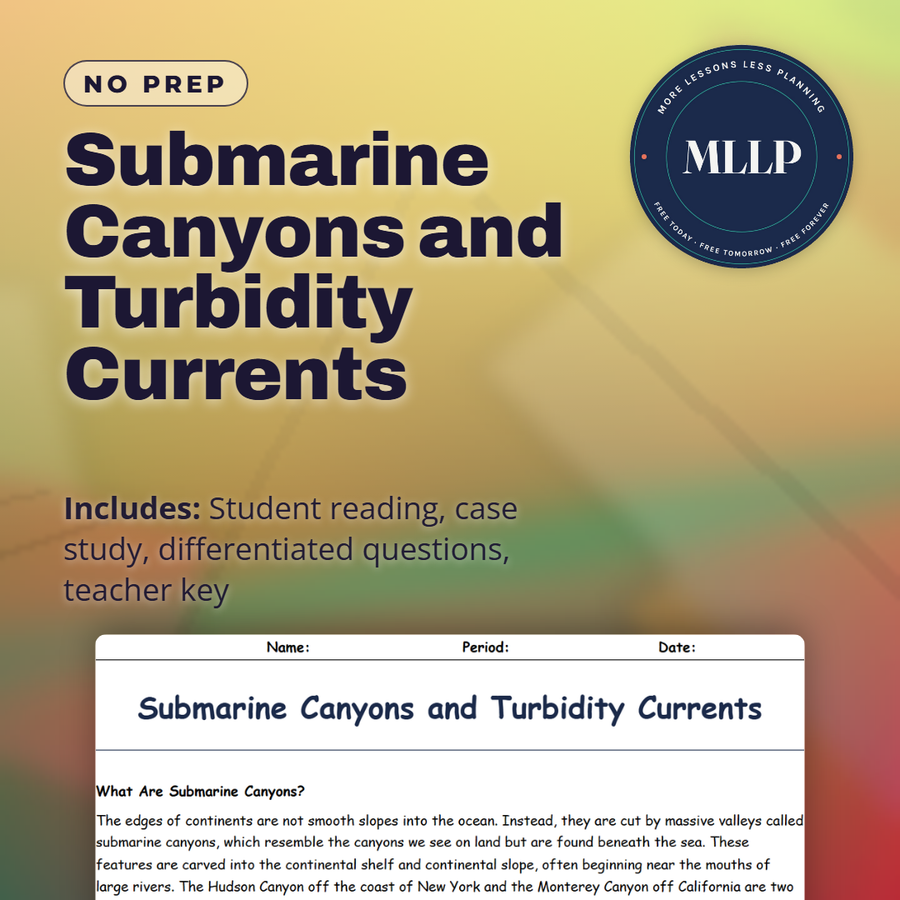
Submarine Canyons and Turbidity Currents
Quality reviewed September 2026
Facts verified September 14, 2026
- Subject
- Science
- Grades
- Grades 9-12
- Length
- 6-page student worksheet
- Time
- About one 50-minute class period
- Great for
- Sub plans and independent work
- Includes
- Reading passage, comprehension questions + full answer key
- Format
- Print-and-go PDF
What students do
- Match terms like Submarine canyon, Turbidity current, Turbidites, Grand Banks event, and Continental rise to their correct definitions
- Fill in the blank sentences on turbidity currents, the Grand Banks earthquake, and the deposits called turbidites
- Answer multiple choice questions on what a turbidity current is, what evidence revealed the 1929 event, and what feature forms from canyon sediment
- Write short answers on why submarine canyons matter for sediment transport, how turbidity currents affect human infrastructure, and why canyons are valuable for marine ecosystems, using the case study on the 1929 Grand Banks earthquake
What it covers
- What submarine canyons are and how they funnel sediment from continents into the deep ocean
- Turbidity currents and the layered turbidite deposits they leave behind on abyssal plains
- A case study on the 1929 Grand Banks earthquake, its turbidity current, and the cables it destroyed
Start reading this worksheet
What Are Submarine Canyons?
The edges of continents are not smooth slopes into the ocean. Instead, they are cut by massive valleys called submarine canyons, which resemble the canyons we see on land but are found beneath the sea. These features are carved into the continental shelf and continental slope, often beginning near the mouths of large rivers. The Hudson Canyon off the coast of New York and the Monterey Canyon off California are two well-known examples. Submarine canyons act like underwater highways, funneling sediments from the continent into the deep ocean. Over time, these sediments build up at the base of the slope to form the continental rise. The presence of these canyons shows how erosion and transport processes are just as active beneath the sea as they are on land.
Turbidity Currents: Underwater Avalanches
One of the most powerful forces shaping submarine canyons is the turbidity current. A turbidity current is a fast-moving flow of water mixed with sand, mud, and silt that rushes down the slope of a canyon, similar to an underwater avalanche. Triggered by storms, earthquakes, or sudden sediment buildup, these currents can travel at incredible speeds, eroding canyon walls and transporting enormous amounts of material into the deep sea. When turbidity currents slow down, the sediments they carry settle in layers on the abyssal plains. These deposits, called turbidites, provide scientists with a record of past underwater landslides and even major earthquakes. Because turbidity currents can also damage underwater communication cables, they are important not just for geology but also for modern infrastructure.
Like what you read? The full reading, the case study, and every question set are in the free download below, along with the answer key.
Why this matters
In 1929, the Grand Banks earthquake triggered a turbidity current that raced down a submarine canyon and snapped transatlantic cables one after another. Engineers timed each break to work out how fast the flow traveled, turning a communications failure into early evidence for how these canyons move sediment off the continental shelf.
Students picture the seafloor as flat and still, so a canyon carved by fast underwater flows surprises them. The layered turbidite deposits on the abyssal plain prove something violent happened long after the water calmed. This case study also produced a tsunami, tying an event on land to undersea causes they cannot see.
From one teacher to another
Submarine canyons cut through the continental shelf and slope like underwater versions of the canyons carved on land, and this worksheet explains how they form and what moves through them. It covers turbidity currents, fast-moving flows of sediment and water that race down canyon walls and leave behind layered deposits called turbidites. The case study on the 1929 Grand Banks earthquake shows how a single turbidity current snapped transatlantic cables and triggered a deadly tsunami.
What you get
Download
Where should I send the next one?
Everything here is free and it stays that way. Leave your email and I'll send you the new lessons as they go up. You can unsubscribe from any one of them.
Related resources
Continental Drift and Seafloor Spreading Made Simple
Continental Margins: Active vs. Passive Boundaries
Earth’s Layers and Plate Tectonics Explained
Geological Hazards: Tsunamis, Undersea Earthquakes, and Landslides
Hydrothermal Vents and Their Ecosystems
Marine Geology and Natural Resources
Every lesson on this site is free to download and use. If one of them saved you a prep period, you can chip in a few bucks toward my three kids' daycare fund. That's genuinely where tips go.