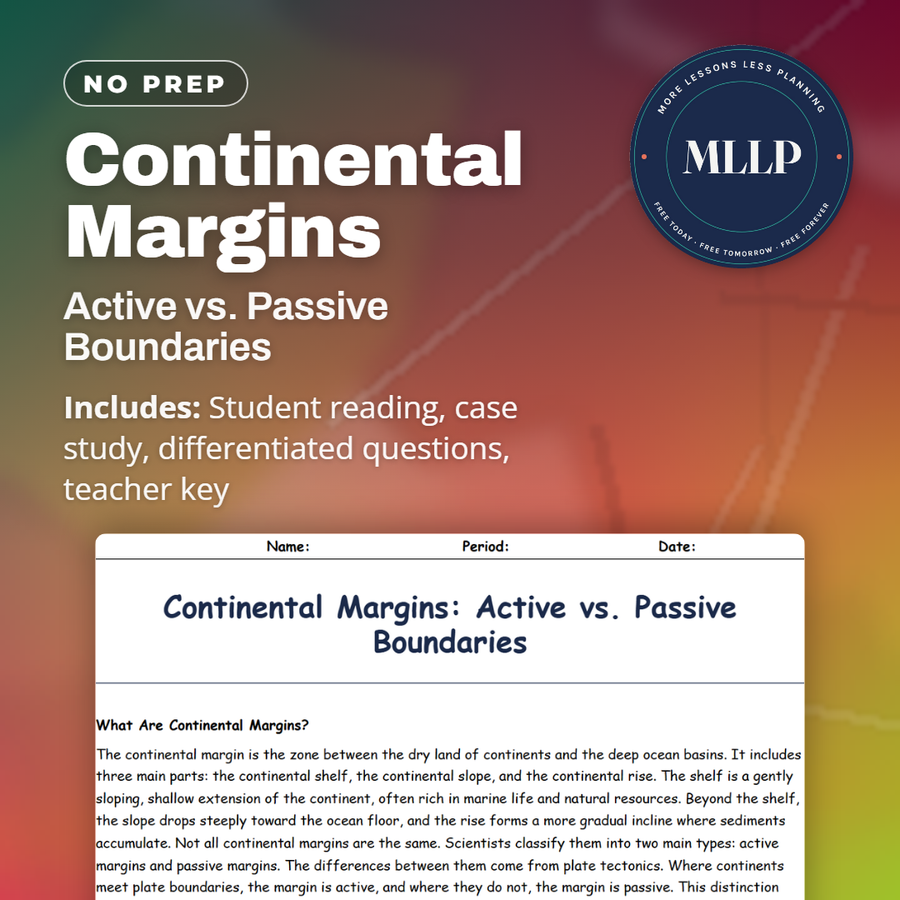
Continental Margins: Active vs. Passive Boundaries
Quality reviewed September 2026
Facts verified September 14, 2026
- Subject
- Science
- Grades
- Grades 9-12
- Length
- 6-page student worksheet
- Time
- About one 50-minute class period
- Great for
- Sub plans and independent work
- Includes
- Reading passage, comprehension questions + full answer key
- Format
- Print-and-go PDF
What students do
- Match terms like Active margin, Passive margin, Cascadia Subduction, San Andreas Fault, and Continental rise to their correct definitions
- Fill in the blank sentences on which margin type sits at plate boundaries and which has a wide, resource-rich continental shelf
- Answer multiple choice questions on which shelf type is wider, what boundary type shapes active margins, and which U.S. coast is a passive margin
- Write short answers on why active margins are narrower than passive margins, how passive margins support economic activity, and how East Coast and West Coast hazards compare, using the case study on the Cascadia Subduction Zone
What it covers
- The three parts of a continental margin and the difference between active and passive types
- How plate tectonics shapes active margins like the U.S. West Coast, with frequent earthquakes and narrow shelves
- A case study on the U.S. West Coast, including the San Andreas Fault and the Cascadia Subduction Zone
Start reading this worksheet
What Are Continental Margins?
The continental margin is the zone between the dry land of continents and the deep ocean basins. It includes three main parts: the continental shelf, the continental slope, and the continental rise. The shelf is a gently sloping, shallow extension of the continent, often rich in marine life and natural resources. Beyond the shelf, the slope drops steeply toward the ocean floor, and the rise forms a more gradual incline where sediments accumulate. Not all continental margins are the same. Scientists classify them into two main types: active margins and passive margins. The differences between them come from plate tectonics. Where continents meet plate boundaries, the margin is active, and where they do not, the margin is passive. This distinction affects the geology, resources, and hazards of each region.
Active Continental Margins
An active margin occurs where a continent’s edge meets an oceanic plate boundary, typically at a convergent boundary. These areas are geologically active, with frequent earthquakes, volcanic eruptions, and mountain building. The continental shelf in active margins is usually narrow because the crust is constantly being reshaped. Examples of active margins include the west coasts of North and South America. In places like Chile, the oceanic Nazca Plate is subducting beneath the South American Plate, creating the Andes Mountains and the Peru-Chile Trench. Similarly, off the coast of California, the San Andreas Fault marks the sliding boundary between the Pacific and North American Plates. These regions are prone to seismic hazards but also host valuable mineral deposits.
Like what you read? The full reading, the case study, and every question set are in the free download below, along with the answer key.
Why this matters
The East Coast and West Coast of the United States sit on the same continent but face different risks, and the difference comes down to what kind of margin each one is. Active margins like the West Coast sit where plates collide, causing frequent earthquakes and a narrow shelf, while passive margins carry a wide, resource-rich shelf with little seismic activity.
The San Andreas Fault and Cascadia Subduction Zone case study turns that comparison into named hazards instead of a general east versus west rule. Explaining why the West Coast counts as an active margin turns out to be the harder half of the comparison, and students who can do that usually work out the East Coast's passive-margin logic on their own, without me spelling it out.
From one teacher to another
Continental margins are the transition zones between dry land and the deep ocean floor, and not all of them behave the same way. This worksheet compares active margins, where plates collide and earthquakes are common, to passive margins, where wide shelves support fisheries and little seismic activity occurs. The case study on the U.S. West Coast looks at the San Andreas Fault and the Cascadia Subduction Zone to show what an active margin looks like in practice.
What you get
Download
Where should I send the next one?
Everything here is free and it stays that way. Leave your email and I'll send you the new lessons as they go up. You can unsubscribe from any one of them.
Related resources
Continental Drift and Seafloor Spreading Made Simple
Earth’s Layers and Plate Tectonics Explained
Geological Hazards: Tsunamis, Undersea Earthquakes, and Landslides
Hydrothermal Vents and Their Ecosystems
Marine Geology and Natural Resources
Marine Sediments: Terrigenous, Biogenous, Hydrogenous, and Cosmogenous
Every lesson on this site is free to download and use. If one of them saved you a prep period, you can chip in a few bucks toward my three kids' daycare fund. That's genuinely where tips go.