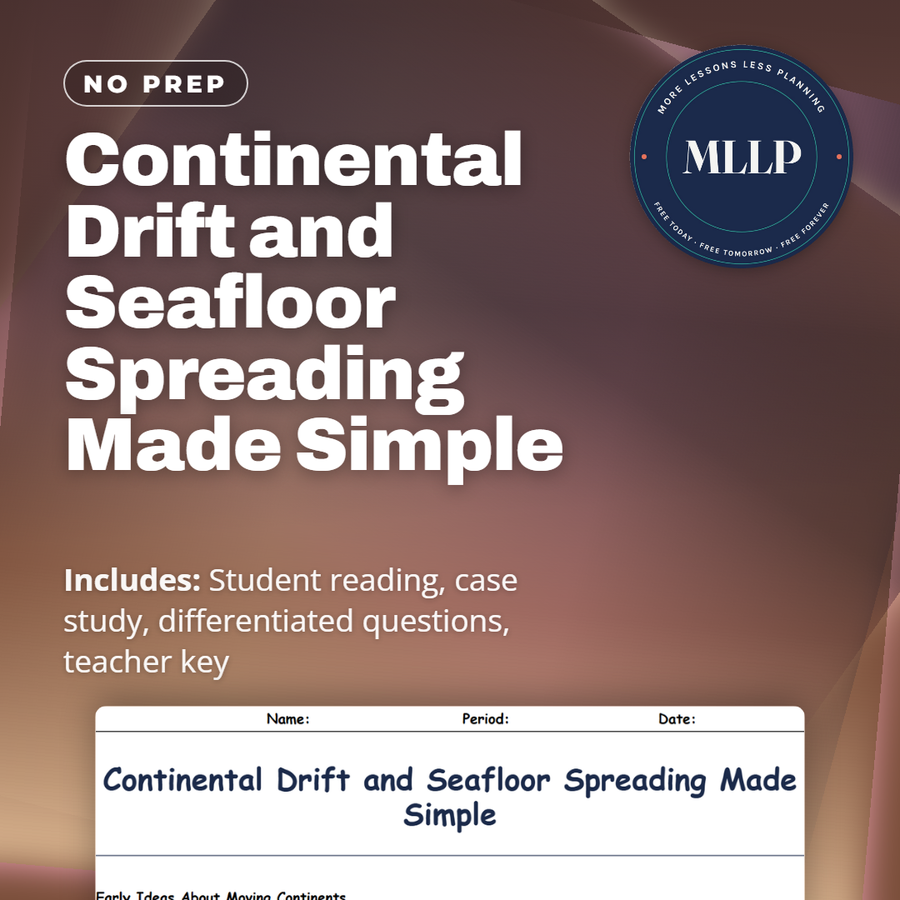
Continental Drift and Seafloor Spreading Made Simple
Quality reviewed September 2026
Facts verified September 14, 2026
- Subject
- Science
- Grades
- Grades 9-12
- Length
- 6-page student worksheet
- Time
- About one 50-minute class period
- Great for
- Sub plans and independent work
- Includes
- Reading passage, comprehension questions + full answer key
- Format
- Print-and-go PDF
What students do
- Match terms like Continental Drift, Pangaea, Seafloor Spreading, Mid-Atlantic Ridge, and Plate Tectonics to their correct definitions
- Fill in the blank sentences on the evidence Wegener used, where new crust forms, and what causes magnetic stripes on the seafloor
- Answer multiple choice questions on who proposed continental drift, what evidence confirmed seafloor spreading, and how fast the Atlantic Ocean widens each year
- Write short answers on why Wegener's theory was first rejected, how seafloor spreading explained continental movement, and why the Mid-Atlantic Ridge matters for plate tectonics, using the case study on the ridge itself
What it covers
- How Alfred Wegener's continental drift theory was first proposed and initially rejected for lack of a mechanism
- The discovery of seafloor spreading through sonar mapping and magnetic stripe patterns on the ocean floor
- A case study on the Mid-Atlantic Ridge, where measurable seafloor spreading pushes continents apart each year
Start reading this worksheet
Early Ideas About Moving Continents
In the early 20th century, a German scientist named Alfred Wegener proposed a bold idea: the continents were not fixed in place but had once been joined together in a supercontinent he called Pangaea. Over millions of years, they slowly drifted apart to their current locations. This became known as the theory of continental drift. At first, Wegener’s idea was controversial. He provided evidence such as the close fit between the coastlines of South America and Africa, fossil records showing the same species on continents separated by oceans, and similarities in rock formations across different continents. However, scientists at the time criticized Wegener because he could not explain the force that moved the continents. Without a clear mechanism, his theory remained debated for decades. Today, we know Wegener was correct—though incomplete. His work laid the foundation for the modern understanding of plate tectonics, which combines continental drift with new discoveries about the ocean floor. This shift in scientific thinking shows how evidence can challenge accepted beliefs and lead to breakthroughs in knowledge.
Discovery of Seafloor Spreading
In the 1950s and 1960s, scientists studying the ocean floor uncovered new evidence that solved the mystery of how continents move. Using sonar mapping, they discovered long underwater mountain ranges called mid-ocean ridges, such as the Mid-Atlantic Ridge. At these ridges, molten rock from the mantle rises, cools, and forms new oceanic crust. This process is known as seafloor spreading. Magnetic patterns on the seafloor provided further proof. When magma solidifies, iron minerals inside align with Earth’s magnetic field. Over millions of years, Earth’s magnetic poles have reversed many times. Scientists found symmetrical patterns of these magnetic stripes on both sides of mid-ocean ridges, confirming that new crust forms and pushes older crust outward. This discovery explained the driving force behind continental drift. Continents are carried along like passengers on conveyor belts of moving oceanic crust. Together, continental drift and seafloor spreading merged into the comprehensive plate tectonic theory we accept today.
Like what you read? The full reading, the case study, and every question set are in the free download below, along with the answer key.
Why this matters
Alfred Wegener noticed the coastlines of South America and Africa fit together and matching fossils turned up on both sides of the Atlantic, and he was dismissed anyway because he could not explain how continents would move. Sonar mapping and the magnetic stripes it revealed decades later supplied the missing mechanism: seafloor spreading.
It takes most students a minute to accept that a correct idea sat rejected for decades simply because no one had found the mechanism yet. The Mid-Atlantic Ridge case study supplies real numbers instead: measurable proof of how fast the Atlantic Ocean is still widening today.
From one teacher to another
Alfred Wegener's idea that continents once fit together like puzzle pieces was dismissed for decades until seafloor mapping proved him right. This worksheet walks through the evidence, from matching coastlines and fossils to the magnetic stripes that revealed seafloor spreading at mid-ocean ridges. The case study on the Mid-Atlantic Ridge gives students real measurements to work with, including how fast the Atlantic Ocean widens each year.
What you get
Download
Where should I send the next one?
Everything here is free and it stays that way. Leave your email and I'll send you the new lessons as they go up. You can unsubscribe from any one of them.
Related resources
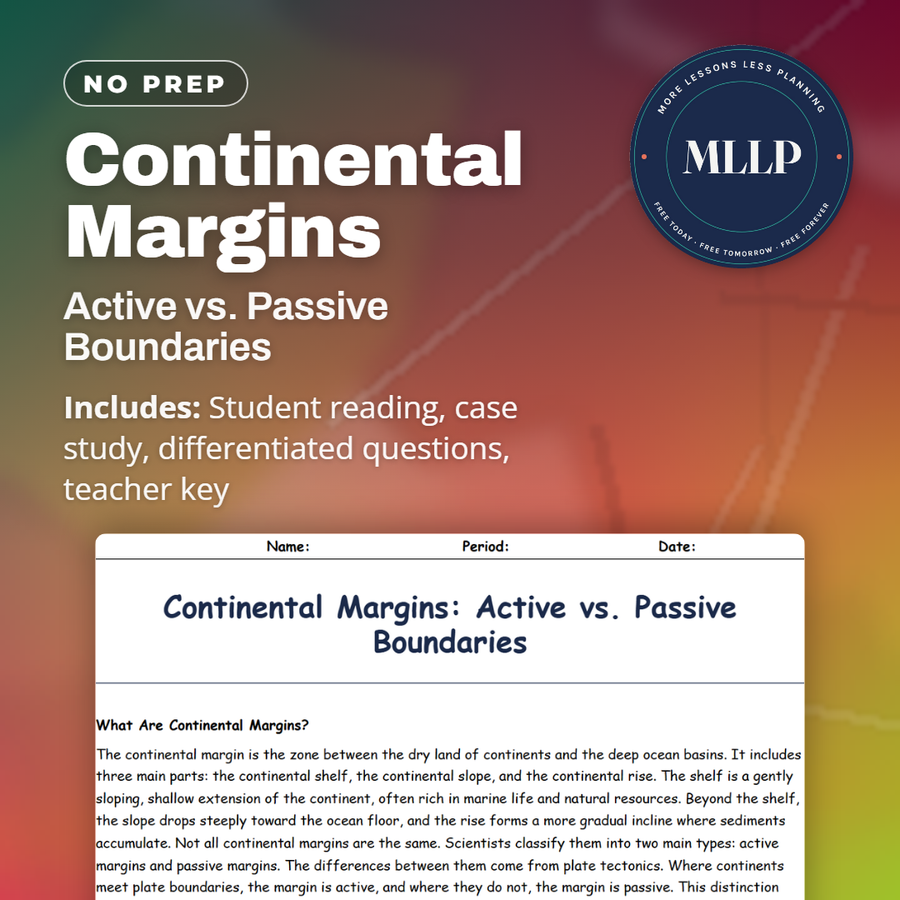
Continental Margins: Active vs. Passive Boundaries
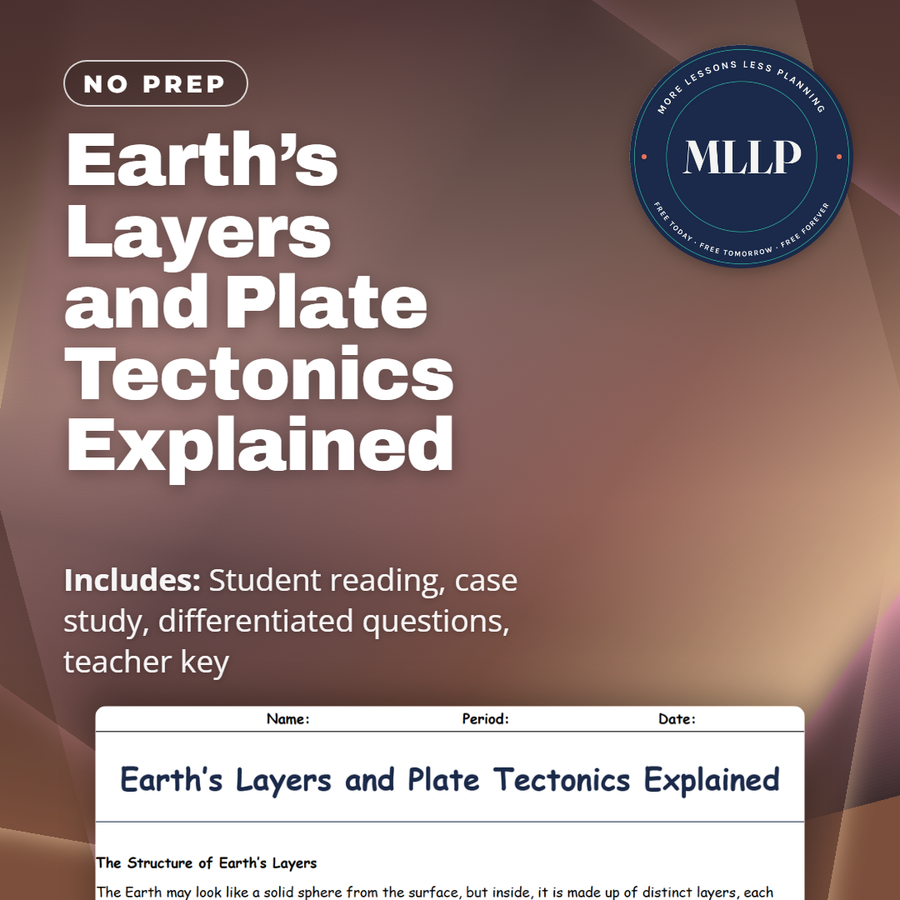
Earth’s Layers and Plate Tectonics Explained
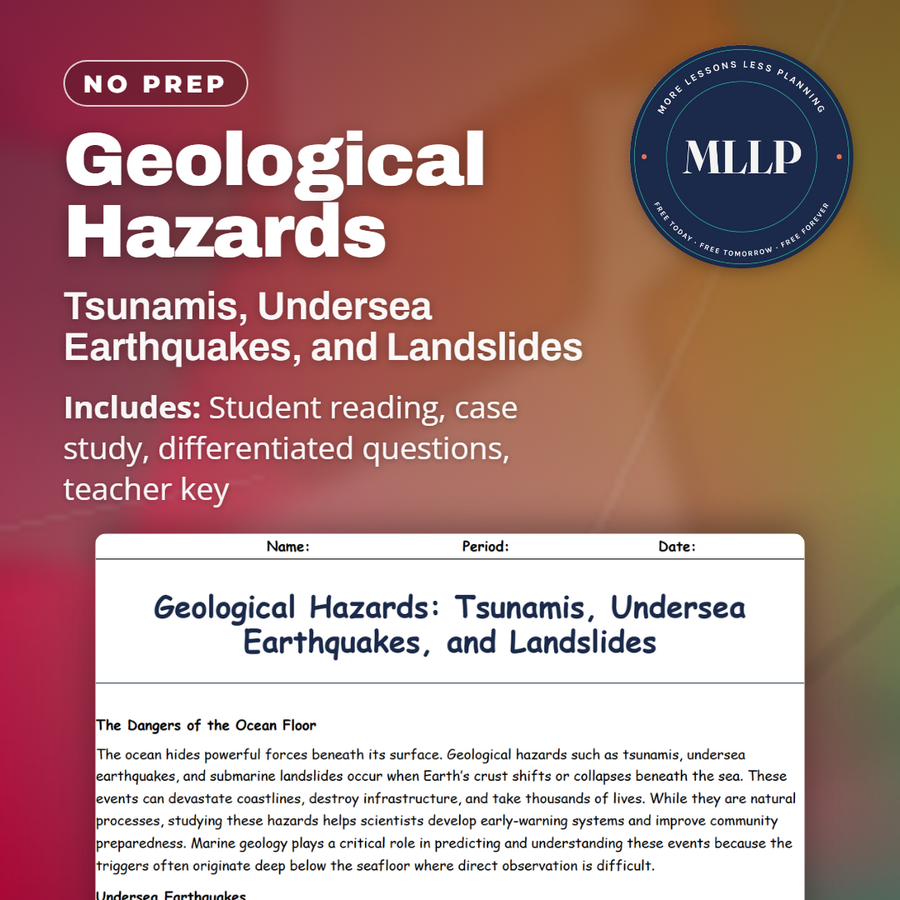
Geological Hazards: Tsunamis, Undersea Earthquakes, and Landslides
Hydrothermal Vents and Their Ecosystems
Marine Geology and Natural Resources
Marine Sediments: Terrigenous, Biogenous, Hydrogenous, and Cosmogenous
Every lesson on this site is free to download and use. If one of them saved you a prep period, you can chip in a few bucks toward my three kids' daycare fund. That's genuinely where tips go.