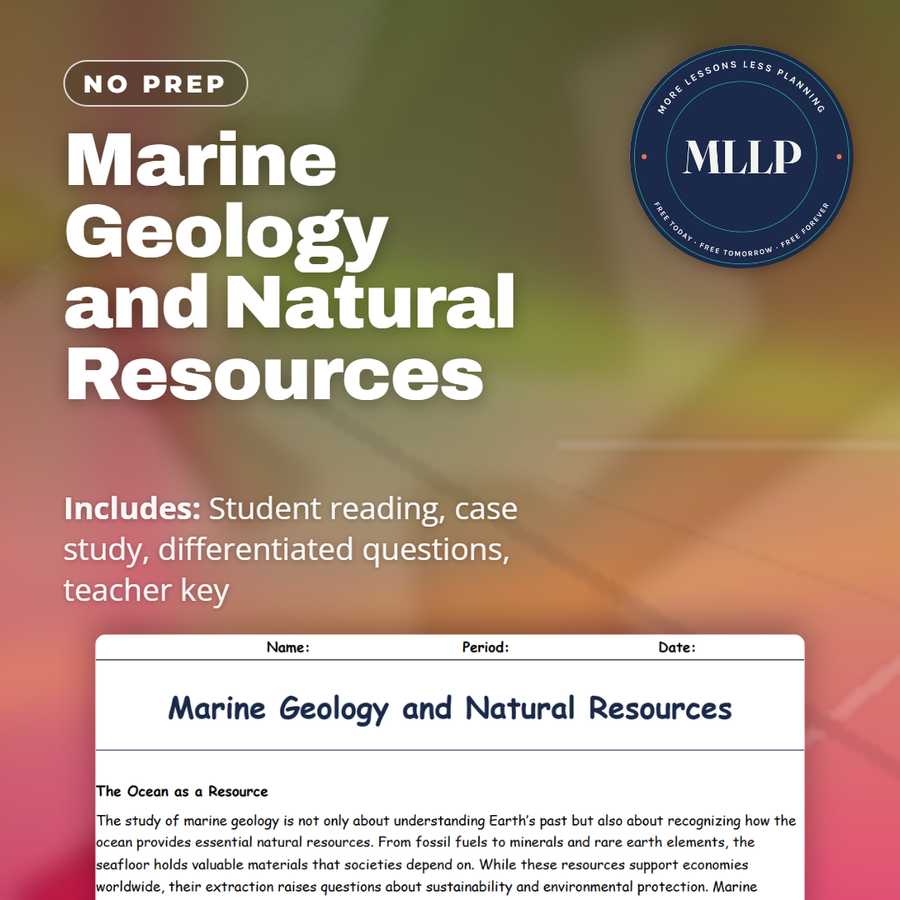
Marine Geology and Natural Resources
Quality reviewed September 2026
Facts verified September 14, 2026
- Subject
- Science
- Grades
- Grades 9-12
- Length
- 6-page student worksheet
- Time
- About one 50-minute class period
- Great for
- Sub plans and independent work
- Includes
- Reading passage, comprehension questions + full answer key
- Format
- Print-and-go PDF
What students do
- Match terms like Oil and gas, Manganese nodules, Hydrothermal deposits, Deepwater Horizon, and Offshore wind energy to their correct definitions
- Fill in the blank sentences on the Deepwater Horizon disaster, manganese nodules, and the geology needed for offshore renewable energy sites
- Answer multiple choice questions on what manganese nodules contain, what caused the Deepwater Horizon disaster, and why hydrothermal vent deposits are valuable
- Write short answers on the risks oil spills pose to marine ecosystems, why rare earth elements from the seafloor matter for technology, and how marine geology balances resource use with protection, using the case study on the Deepwater Horizon spill
What it covers
- How oil and gas form beneath the continental shelf and how marine geologists locate them
- Mineral resources like manganese nodules and hydrothermal deposits, and the environmental tradeoffs of mining them
- A case study on the 2010 Deepwater Horizon oil spill and its impact on offshore drilling safety
Start reading this worksheet
The Ocean as a Resource
The study of marine geology is not only about understanding Earth’s past but also about recognizing how the ocean provides essential natural resources. From fossil fuels to minerals and rare earth elements, the seafloor holds valuable materials that societies depend on. While these resources support economies worldwide, their extraction raises questions about sustainability and environmental protection. Marine geology helps us locate, evaluate, and responsibly manage these resources.
Oil and Gas Beneath the Seafloor
One of the most important resources obtained from the ocean is oil and natural gas. These fossil fuels form when organic material is buried under layers of sediment, heated, and compressed over millions of years. In many places, such as the Gulf of Mexico and the North Sea, oil and gas reservoirs lie beneath the continental shelf. Marine geologists use techniques such as seismic surveys and drilling to locate these reserves. Offshore drilling platforms then extract the fuels, which are transported by pipelines or tankers. While vital for energy production, oil and gas drilling comes with risks such as oil spills, which can harm marine ecosystems. The 2010 Deepwater Horizon disaster is a stark reminder of these dangers.
Minerals and Rare Earth Elements
Beyond fossil fuels, the seafloor holds vast quantities of minerals. Manganese nodules, rich in copper, cobalt, and nickel, lie scattered across abyssal plains. Hydrothermal vent deposits contain valuable metals such as zinc, silver, and gold. These materials are important for electronics, renewable energy technologies, and modern industry. The challenge is that mining these deposits could destroy fragile deep-sea ecosystems. Because hydrothermal vents host unique life forms, scientists debate whether the benefits of mining outweigh the risks. Marine geology provides critical data to guide these decisions by studying how deposits form and how ecosystems might recover.
Like what you read? The full reading, the case study, and every question set are in the free download below, along with the answer key.
Why this matters
Modern technology depends on rare earth elements, and some of the richest untapped deposits sit inside manganese nodules scattered across the deep abyssal plains. This reading covers how marine geologists locate resources like these, plus the oil and gas reservoirs beneath the continental shelf.
The Deepwater Horizon case study earns its place in a geology unit as much as a pollution unit, since the same rock and pressure that make oil valuable also make it dangerous to extract. I use the 2010 disaster to show students that pulling anything from the seafloor is a geology problem before it becomes an environmental one.
From one teacher to another
The seafloor holds resources that power modern life, from oil and gas reservoirs beneath the continental shelf to manganese nodules scattered across abyssal plains. This worksheet covers how marine geologists locate these resources and why extracting them, especially from fragile hydrothermal vent deposits, raises real environmental tradeoffs. The case study on the 2010 Deepwater Horizon spill shows what can go wrong with offshore drilling and why the disaster highlighted the need for strict safety regulations.
What you get
Download
Where should I send the next one?
Everything here is free and it stays that way. Leave your email and I'll send you the new lessons as they go up. You can unsubscribe from any one of them.
Related resources
Continental Drift and Seafloor Spreading Made Simple
Continental Margins: Active vs. Passive Boundaries
Earth’s Layers and Plate Tectonics Explained
Geological Hazards: Tsunamis, Undersea Earthquakes, and Landslides
Hydrothermal Vents and Their Ecosystems
Marine Sediments: Terrigenous, Biogenous, Hydrogenous, and Cosmogenous
Every lesson on this site is free to download and use. If one of them saved you a prep period, you can chip in a few bucks toward my three kids' daycare fund. That's genuinely where tips go.