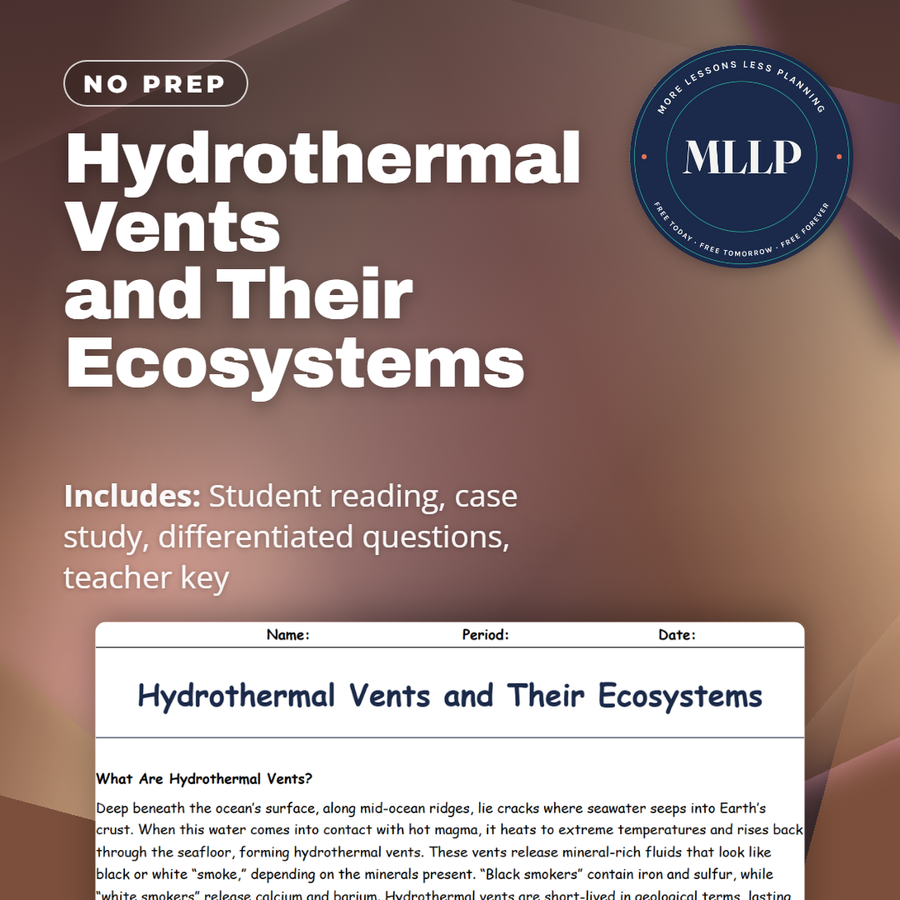
Hydrothermal Vents and Their Ecosystems
Quality reviewed September 2026
Facts verified September 14, 2026
- Subject
- Science
- Grades
- Grades 9-12
- Length
- 6-page student worksheet
- Time
- About one 50-minute class period
- Great for
- Sub plans and independent work
- Includes
- Reading passage, comprehension questions + full answer key
- Format
- Print-and-go PDF
What students do
- Match terms like Black smoker, White smoker, Chemosynthesis, Galápagos Rift, and Tubeworm symbiosis to their correct definitions
- Fill in the blank sentences on where hydrothermal vents form, what powers vent life instead of sunlight, and which expedition first discovered vent communities
- Answer multiple choice questions on what energy source drives vent ecosystems, which vent type releases iron and sulfur, and what year vent communities were first discovered
- Write short answers on how vents influence seawater chemistry, why scientists connect vents to the origin of life, and what makes vent ecosystems unique, using the case study on the Galápagos Rift discovery
What it covers
- What hydrothermal vents are and how black smokers and white smokers differ
- How chemosynthesis allows tubeworms, clams, crabs, and shrimp to survive without sunlight
- A case study on the 1977 discovery of hydrothermal vent ecosystems at the Galápagos Rift
Start reading this worksheet
What Are Hydrothermal Vents?
Deep beneath the ocean’s surface, along mid-ocean ridges, lie cracks where seawater seeps into Earth’s crust. When this water comes into contact with hot magma, it heats to extreme temperatures and rises back through the seafloor, forming hydrothermal vents. These vents release mineral-rich fluids that look like black or white “smoke,” depending on the minerals present. “Black smokers” contain iron and sulfur, while “white smokers” release calcium and barium. Hydrothermal vents are short-lived in geological terms, lasting decades to centuries, but they play an important role in shaping the ocean floor. The minerals they deposit can form massive sulfide structures and even influence the chemistry of seawater. More importantly, they support ecosystems unlike any other on Earth.
Life Without Sunlight
Unlike most ecosystems on Earth that depend on sunlight, hydrothermal vent communities survive in complete darkness. Here, life relies on a process called chemosynthesis, where bacteria use chemicals such as hydrogen sulfide to produce energy instead of sunlight. These bacteria form the foundation of the vent food web, providing energy for organisms like giant tubeworms, clams, crabs, and shrimp. The discovery of these ecosystems in the late 1970s stunned scientists. Before then, biologists believed life could not thrive in such extreme conditions. Yet vent organisms survive under crushing pressure, near-boiling water, and toxic chemicals. This discovery expanded our understanding of the adaptability of life and even inspired ideas about life on other planets and moons.
Like what you read? The full reading, the case study, and every question set are in the free download below, along with the answer key.
Why this matters
Until 1977, every scientist studying life on Earth worked from one non-negotiable rule: no sunlight, no ecosystem. Then scientists found tubeworms, clams, crabs, and shrimp thriving around hydrothermal vents on the Galapagos Rift, feeding on bacteria that build energy from chemicals in the vent fluid instead of sunlight.
This is one of the few readings where a single discovery overturns a rule students think is fixed. Once they accept that life does not need sunlight, I ask why scientists connect that same chemistry to the origin of life on Earth, and the discussion stops being about strange deep sea animals and starts being about how life could start at all.
From one teacher to another
Hydrothermal vents form where seawater meets magma along mid-ocean ridges, releasing mineral-rich fluids that support life in total darkness. This worksheet explains chemosynthesis, the process bacteria use to convert chemicals into energy, and how it supports giant tubeworms, clams, crabs, and shrimp at vent sites. The case study on the 1977 Galápagos Rift discovery covers how scientists first found these ecosystems and why the find changed ideas about where life can exist.
What you get
Download
Where should I send the next one?
Everything here is free and it stays that way. Leave your email and I'll send you the new lessons as they go up. You can unsubscribe from any one of them.
Related resources
Continental Drift and Seafloor Spreading Made Simple
Continental Margins: Active vs. Passive Boundaries
Earth’s Layers and Plate Tectonics Explained
Geological Hazards: Tsunamis, Undersea Earthquakes, and Landslides
Marine Geology and Natural Resources
Marine Sediments: Terrigenous, Biogenous, Hydrogenous, and Cosmogenous
Every lesson on this site is free to download and use. If one of them saved you a prep period, you can chip in a few bucks toward my three kids' daycare fund. That's genuinely where tips go.