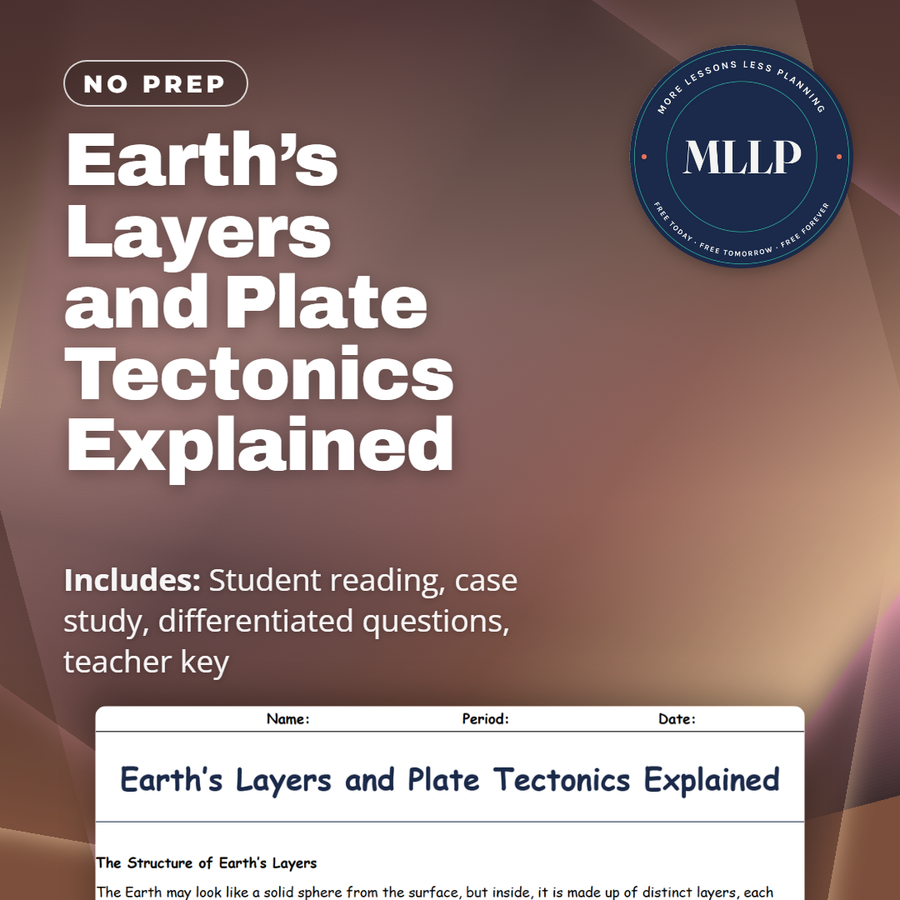
Earth’s Layers and Plate Tectonics Explained
Quality reviewed September 2026
Facts verified September 14, 2026
- Subject
- Science
- Grades
- Grades 9-12
- Length
- 6-page student worksheet
- Time
- About one 50-minute class period
- Great for
- Sub plans and independent work
- Includes
- Reading passage, comprehension questions + full answer key
- Format
- Print-and-go PDF
What students do
- Match terms like Lithosphere, Pangaea, Subduction zone, Inner Core, and Ring of Fire to their correct definitions
- Fill in the blank sentences on convection currents, volcanic activity in the Ring of Fire, and the ancient supercontinent Pangaea
- Answer multiple choice questions on which layer generates Earth's magnetic field, what happens at divergent boundaries, and what caused the Fukushima disaster
- Write short answers on how convection currents drive plate tectonics, why studying plate tectonics helps predict natural disasters, and how divergent and convergent boundaries shape Earth's surface differently, using the case study on the Ring of Fire
What it covers
- The structure of Earth's layers, from the crust and mantle to the outer and inner core
- How plate tectonics and the three types of plate boundaries reshape Earth's surface over time
- A case study on the Pacific Ring of Fire, including the 2011 Tōhoku earthquake and tsunami
Start reading this worksheet
The Structure of Earth’s Layers
The Earth may look like a solid sphere from the surface, but inside, it is made up of distinct layers, each with its own properties. Starting from the outside, the crust is the thin, rocky shell where we live. It is divided into continental crust, which is thick and less dense, and oceanic crust, which is thinner but denser. Beneath the crust lies the mantle, a much thicker layer made of semi-solid rock that flows slowly over time. This flow is crucial because it drives the movement of tectonic plates. Deeper still, the outer core is liquid iron and nickel, and its movement generates Earth’s magnetic field. At the very center, the inner core is solid, made mostly of iron under extreme pressure and temperature. Understanding these layers is not just about memorizing their names—it explains how the Earth is dynamic and constantly changing. Heat from the core rises through the mantle in convection currents, which slowly push and pull the crust above. These movements explain why continents drift, mountains rise, and earthquakes occur. Without this knowledge, we would not be able to understand the powerful geological forces that shape both the land and ocean floors.
Plate Tectonics and Movement
The theory of plate tectonics is one of the most important scientific breakthroughs in geology. It tells us that the Earth’s outer shell, or lithosphere, is broken into pieces called plates. These plates “float” on the softer layer beneath them, the asthenosphere. Where plates meet, dramatic geological events take place. At divergent boundaries, plates move apart, and molten rock rises to form new crust, such as at the Mid-Atlantic Ridge. At convergent boundaries, plates collide, creating mountains or deep-sea trenches. At transform boundaries, plates slide past one another, often causing earthquakes. The movement of tectonic plates explains why continents have shifted over millions of years, a process once known as continental drift. It also explains why ocean basins are constantly renewing themselves. The ocean floor is not permanent; instead, it is created at ridges and destroyed at subduction zones. This recycling of crust is what keeps Earth’s surface so dynamic.
Like what you read? The full reading, the case study, and every question set are in the free download below, along with the answer key.
Why this matters
In 2011, movement along a fault beneath the Pacific triggered the earthquake and tsunami behind the Fukushima disaster, tracing directly back to convection currents deep inside the planet. Earth's four layers are not just a diagram to label: heat moving through the mantle drives every one of the three plate boundary types covered here.
Most students treat an earthquake as random bad luck, not a predictable outcome of a particular kind of plate boundary. The Ring of Fire case study gives them a way to explain why that region absorbed that disaster, and why scientists can flag danger zones before the ground ever moves.
From one teacher to another
This reading breaks down Earth's four layers, from the crust down to the solid inner core, and explains how heat moving through the mantle drives plate tectonics. It covers the three types of plate boundaries and how their collisions, separations, and slides create mountains, ridges, and earthquakes. The case study on the Pacific Ring of Fire ties the science to a real disaster, the 2011 Tōhoku earthquake and tsunami, showing how plate movement affects millions of people.
What you get
Download
Where should I send the next one?
Everything here is free and it stays that way. Leave your email and I'll send you the new lessons as they go up. You can unsubscribe from any one of them.
Related resources
Continental Drift and Seafloor Spreading Made Simple
Continental Margins: Active vs. Passive Boundaries
Geological Hazards: Tsunamis, Undersea Earthquakes, and Landslides
Hydrothermal Vents and Their Ecosystems
Marine Geology and Natural Resources
Marine Sediments: Terrigenous, Biogenous, Hydrogenous, and Cosmogenous
Every lesson on this site is free to download and use. If one of them saved you a prep period, you can chip in a few bucks toward my three kids' daycare fund. That's genuinely where tips go.