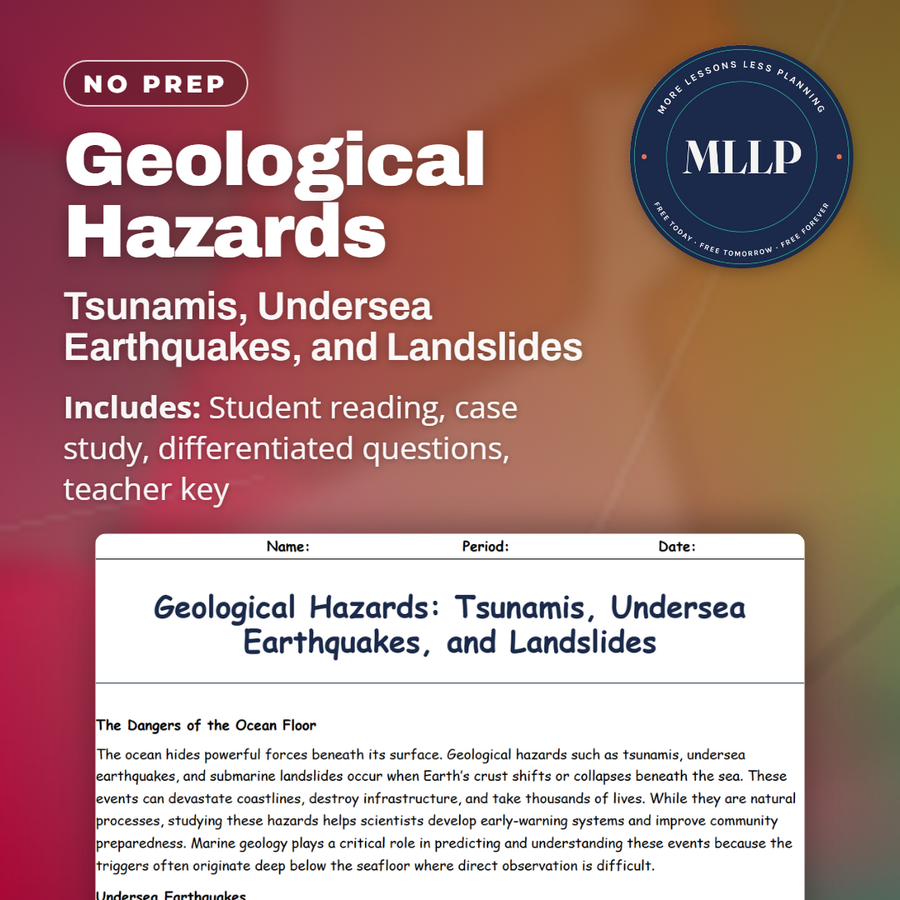
Geological Hazards: Tsunamis, Undersea Earthquakes, and Landslides
Quality reviewed September 2026
Facts verified September 14, 2026
- Subject
- Science
- Grades
- Grades 9-12
- Length
- 6-page student worksheet
- Time
- About one 50-minute class period
- Great for
- Sub plans and independent work
- Includes
- Reading passage, comprehension questions + full answer key
- Format
- Print-and-go PDF
What students do
- Match terms like Undersea earthquake, Tsunami, Submarine landslide, 2004 Indian Ocean event, and Grand Banks 1929 to their correct definitions
- Fill in the blank sentences on what a tsunami is, where the 2004 Indian Ocean earthquake occurred, and what triggers submarine landslides
- Answer multiple choice questions on what causes tsunamis, which boundary type produces the most powerful undersea earthquakes, and what disaster inspired global tsunami warning systems
- Write short answers on why tsunami waves are so destructive, how submarine landslides disrupt human activity beyond causing tsunamis, and what role marine geology plays in reducing hazard impacts, using the case study on the 2004 Indian Ocean earthquake and tsunami
What it covers
- How undersea earthquakes form at plate boundaries and can trigger destructive tsunamis
- How submarine landslides, like the 1929 Grand Banks event, can also generate tsunamis and damage infrastructure
- A case study on the 2004 Indian Ocean earthquake and tsunami and the warning systems it inspired
Start reading this worksheet
The Dangers of the Ocean Floor
The ocean hides powerful forces beneath its surface. Geological hazards such as tsunamis, undersea earthquakes, and submarine landslides occur when Earth’s crust shifts or collapses beneath the sea. These events can devastate coastlines, destroy infrastructure, and take thousands of lives. While they are natural processes, studying these hazards helps scientists develop early-warning systems and improve community preparedness. Marine geology plays a critical role in predicting and understanding these events because the triggers often originate deep below the seafloor where direct observation is difficult.
Undersea Earthquakes
Most undersea earthquakes occur along plate boundaries, where tectonic plates collide, slide, or pull apart. When stress builds up and releases suddenly, seismic waves spread through the ocean crust. If the seafloor shifts vertically, it can displace massive volumes of water, generating a tsunami. Not all undersea earthquakes create tsunamis, but even without them, earthquakes can disrupt seafloor ecosystems, damage undersea cables, and trigger landslides. The most powerful earthquakes occur at subduction zones, where one plate dives beneath another.
Tsunamis
A tsunami is a series of long, powerful waves caused by sudden water displacement. Unlike ordinary waves, which are driven by wind, tsunamis can travel across entire oceans at jetliner speeds. As they approach shallow coastal areas, their energy compresses, causing wave heights to increase dramatically. Tsunamis can be caused by earthquakes, volcanic eruptions, or landslides. Early warning systems, which rely on seismic sensors and ocean buoys, are crucial for saving lives. Even with warning, evacuation requires rapid response because the time between an earthquake and tsunami landfall may be only minutes.
Like what you read? The full reading, the case study, and every question set are in the free download below, along with the answer key.
Why this matters
An earthquake on the seafloor can displace enough water to send a wave racing across an ocean basin, and a collapsing underwater landslide, like the 1929 Grand Banks event, can trigger the same kind of wave through a different mechanism. Undersea earthquakes, tsunamis, and submarine landslides work as one connected hazard, not three separate topics.
A tsunami reads as just a big wave until the 2004 Indian Ocean case study, since that disaster led directly to the warning systems that exist today. Seeing how a single geological event thousands of miles away reshaped global disaster policy convinces students the geology and the human consequences belong together.
From one teacher to another
Powerful forces move beneath the ocean floor, and this worksheet looks at undersea earthquakes, tsunamis, and submarine landslides as connected hazards. It explains how a seafloor earthquake can displace enough water to send a tsunami racing across an ocean, and how collapsing sediment on a continental slope can do the same. The case study on the 2004 Indian Ocean earthquake and tsunami shows the real scale of these hazards and how the disaster led to new international warning systems.
What you get
Download
Where should I send the next one?
Everything here is free and it stays that way. Leave your email and I'll send you the new lessons as they go up. You can unsubscribe from any one of them.
Related resources
Continental Drift and Seafloor Spreading Made Simple
Continental Margins: Active vs. Passive Boundaries
Earth’s Layers and Plate Tectonics Explained
Hydrothermal Vents and Their Ecosystems
Marine Geology and Natural Resources
Marine Sediments: Terrigenous, Biogenous, Hydrogenous, and Cosmogenous
Every lesson on this site is free to download and use. If one of them saved you a prep period, you can chip in a few bucks toward my three kids' daycare fund. That's genuinely where tips go.