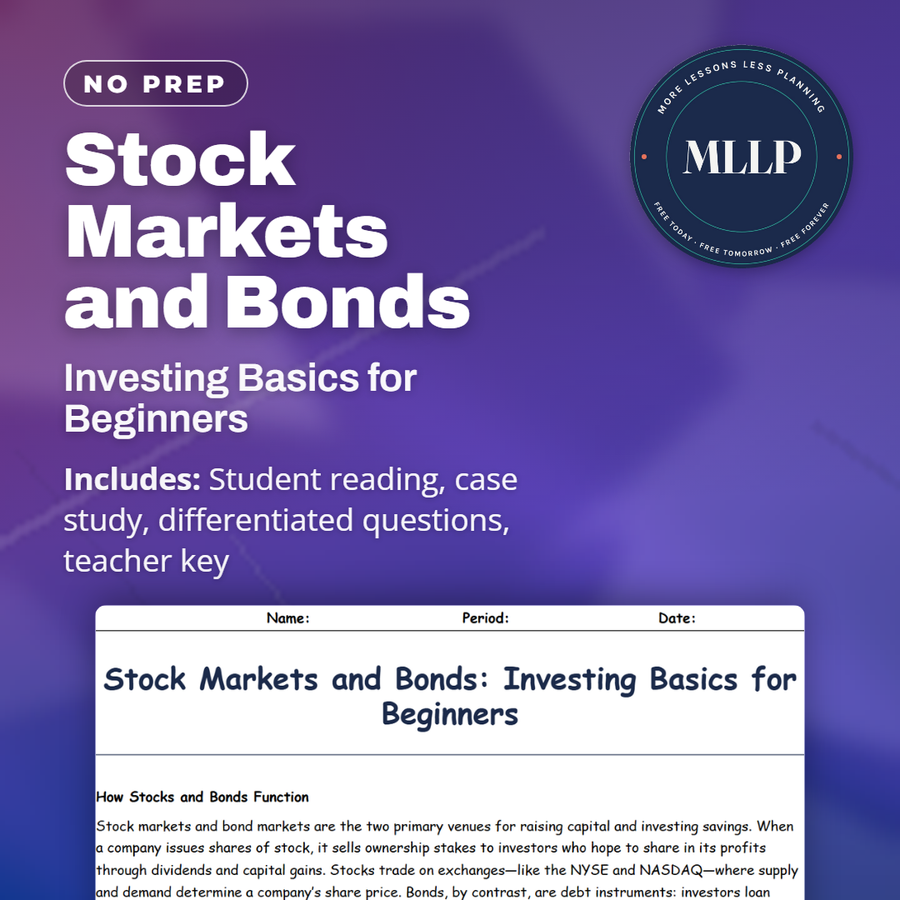
Stock Markets and Bonds: Investing Basics for Beginners
Quality reviewed September 2026
Facts verified September 8, 2026
- Grades
- Grades 9-12
- Length
- 7-page student worksheet
- Time
- About one 50-minute class period
- Great for
- Sub plans and independent work
- Includes
- Reading passage, comprehension questions + full answer key
- Format
- Print-and-go PDF
What students do
- Compare stocks (ownership stakes with variable returns) and bonds (fixed interest payments with priority in bankruptcy)
- Explain how stock exchanges (NYSE, NASDAQ) provide liquidity, transparency, and market infrastructure for trading securities
- Analyze the 2021 "meme stock" phenomenon: how GameStop prices skyrocketed via short squeezes and social media coordination, then collapsed, illustrating market psychology
- Describe why exchange-traded funds (ETFs) provide instant diversification and intraday liquidity, making them ideal for beginner investors over single stocks
What it covers
- How stocks and bonds function: equity ownership and profit-sharing versus debt instruments with contractual coupon payments and priority claims
- Stock exchanges as infrastructure: listing standards, market makers, liquidity provision, and how companies use IPOs to raise capital
- Investing for beginners: brokerage accounts, commission-free trading, and ETFs as low-cost vehicles for diversified stock and bond exposure
Start reading this worksheet
How Stocks and Bonds Function
Stock markets and bond markets are the two primary venues for raising capital and investing savings. When a company issues shares of stock, it sells ownership stakes to investors who hope to share in its profits through dividends and capital gains. Stocks trade on exchanges, like the NYSE and NASDAQ, where supply and demand determine a company’s share price. Bonds, by contrast, are debt instruments: investors loan money to issuers (corporations or governments) in exchange for regular interest payments (coupons) and return of principal at maturity. Bond prices move inversely to interest rates. When rates rise, existing bond prices fall to match higher yields available elsewhere. Together, stocks and bonds offer different risk-return profiles, enabling investors to tailor portfolios to their objectives and tolerance for volatility.
Comparing Stocks vs. Bonds
Stocks are generally higher risk, higher return investments. Over long horizons, equities have outperformed bonds, but share prices can fluctuate dramatically in the short term. Bonds are viewed as safer: coupon payments are contractual, and bondholders have priority over shareholders in bankruptcy proceedings. Yet bonds carry risks, too: interest-rate risk, credit risk, and inflation risk can erode real returns. Investors often balance the two asset classes: younger individuals, with long time horizons, may hold a larger equity allocation, while those nearing retirement shift toward bonds for income stability. Understanding these fundamental differences is essential for constructing portfolios that align with financial goals, from wealth accumulation to income generation and capital preservation.
The Role of Stock Exchanges
Stock exchanges provide the infrastructure for buying and selling shares with transparency, liquidity, and regulation. The New York Stock Exchange (NYSE), known for its iconic trading floor, hosts many large, established firms; the NASDAQ operates entirely electronically and features a high concentration of technology stocks. Exchanges enforce listing standards (minimum market capitalization, governance requirements, and financial disclosures), protecting investors and fostering confidence. Market makers and high-frequency traders contribute to liquidity by continuously posting buy and sell quotes. Public listings also confer visibility and credibility on companies, facilitating subsequent capital raises through secondary offerings. In essence, exchanges act as vital intermediaries connecting companies in need of capital with investors seeking returns.
Like what you read? The full reading, the case study, and every question set are in the free download below, along with the answer key.
Why this matters
GameStop's price didn't jump because the company suddenly made more money in 2021; it jumped because short sellers got squeezed and Reddit traders piled in through commission-free apps. That single event teaches more about how markets behave than any textbook definition of a stock or bond.
Students want to treat that lesson as permission to chase the next hot ticker. I steer them toward the ETF section instead, where one fund holds hundreds of companies for a fraction of the risk, so a diversified fund beats picking one stock and hoping.
From one teacher to another
I use this reading when students first start thinking about investing. The stock-versus-bond comparison is straightforward: stocks are riskier but have higher long-term returns; bonds offer predictable income and priority in repayment. The NYSE versus NASDAQ explanation clarifies why that distinction matters for different company types. The 2021 GameStop case study is irresistible to students. They see how short interest created a squeeze, how Reddit coordination and commission-free brokers democratized trading, and how psychology drove prices detached from fundamentals. The lesson isn't that they should pile into volatile stocks; it's that understanding market mechanics and herd behavior matters. The ETF section brings it back to prudent investing: yes, individual stocks are exciting, but diversified funds are smarter for long-term wealth building.
What you get
- Answer Key
-
Student Worksheet
The NYSE still runs a physical trading floor, while the NASDAQ operates entirely electronically with a heavy concentration of technology companies, both enforcing their own listing standards for market capitalization and disclosure. Bonds carry quieter risks of their own, including interest-rate, credit, and inflation risk, which is why younger investors lean toward stocks while those near retirement shift toward bonds for steadier income.
Download
Where should I send the next one?
Everything here is free and it stays that way. Leave your email and I'll send you the new lessons as they go up. You can unsubscribe from any one of them.
Related resources
Financial Institutions: Building Blocks of the Economy
Functions and Types of Money: Why Money Matters in the Economy
Personal Finance 101: Saving and Investing for Your Future
Risk and Return: How to Make Smart Investment Choices
Amazon Warehouses: Working Conditions Investigation
Anti-Trust Laws and Regulation: Promoting Fair Competition
Every lesson on this site is free to download and use. If one of them saved you a prep period, you can chip in a few bucks toward my three kids' daycare fund. That's genuinely where tips go.