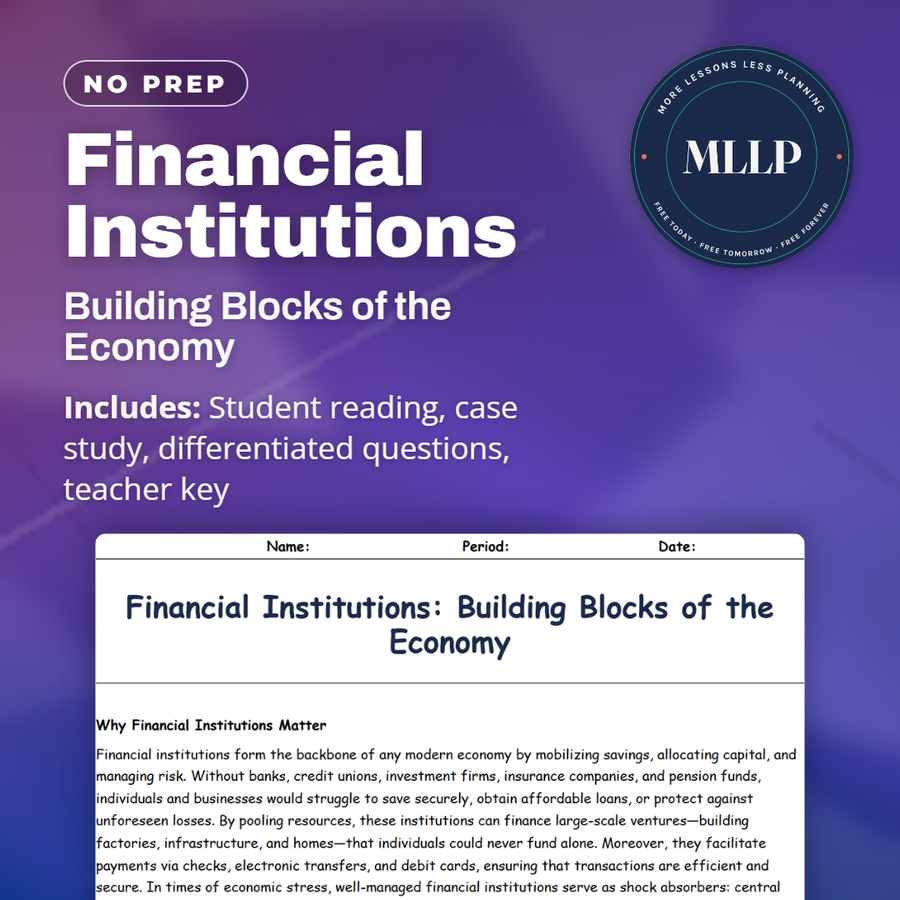
Financial Institutions: Building Blocks of the Economy
Quality reviewed September 2026
Facts verified September 8, 2026
- Grades
- Grades 9-12
- Length
- 8-page student worksheet
- Time
- About one 50-minute class period
- Great for
- Sub plans and independent work
- Includes
- Reading passage, comprehension questions + full answer key
- Format
- Print-and-go PDF
What students do
- Compare commercial banks, credit unions, investment firms, insurance companies, and pension funds across structure and mission
- Analyze how federal interventions (TARP, central bank liquidity) and community credit initiatives stabilized the 2008 financial crisis
- Categorize financial institutions by their primary purpose and the key services they provide
- Explain how banks transform short-term deposits into long-term loans and the risks this maturity transformation creates
What it covers
- Financial institutions and their role in mobilizing savings, allocating capital, and managing risk through banks, credit unions, and investment firms
- The 2008 financial crisis: from subprime mortgage collapse to Fed emergency lending, deposit insurance, and community-based credit responses
- How deposit insurance, liquidity management, and institutional diversity contribute to financial system stability
Start reading this worksheet
Why Financial Institutions Matter
Financial institutions form the backbone of any modern economy by mobilizing savings, allocating capital, and managing risk. Without banks, credit unions, investment firms, insurance companies, and pension funds, individuals and businesses would struggle to save securely, obtain affordable loans, or protect against unforeseen losses. By pooling resources, these institutions can finance large-scale ventures (building factories, infrastructure, and homes) that individuals could never fund alone. Moreover, they facilitate payments via checks, electronic transfers, and debit cards, ensuring that transactions are efficient and secure. In times of economic stress, well-managed financial institutions serve as shock absorbers: central banks provide liquidity, and deposit insurance protects small savers. Understanding how these entities operate is critical for grasping the larger forces that shape growth, stability, and financial inclusion.
Banks and Credit Unions: Managing Savings and Loans
At the heart of the financial system lie commercial banks and credit unions. Both accept deposits and issue loans, but their structures and missions differ. Commercial banks are for-profit entities owned by shareholders. They offer a broad range of services, including checking and savings accounts, mortgages, auto loans, and business credit, and they aim to maximize returns. Credit unions, by contrast, are member-owned, not-for-profit cooperatives. Each member holds an equal share and can vote in governance; surplus earnings are typically returned as lower fees, higher deposit rates, or reduced loan costs. Both institutions transform short-term deposits into longer-term loans, a process called maturity transformation. While it fuels growth, it also introduces liquidity risk: if too many depositors demand withdrawals at once, a bank run can occur. Regulators therefore require capital buffers and deposit insurance to safeguard stability.
Investment Firms: Channeling Capital
Beyond banks and credit unions, investment firms, including brokerages, asset managers, and mutual funds, play a pivotal role in channeling funds from savers to businesses and governments. By pooling individual investments into diversified portfolios of securities (stocks, bonds, and other assets), these firms help clients achieve risk-adjusted returns. They underwrite new equity and debt issuances, enabling companies to raise capital for expansion. Moreover, through secondary markets like the NYSE and NASDAQ, investment firms provide liquidity, allowing investors to buy or sell shares quickly at transparent prices. Research departments analyze economic trends, guiding both institutional and retail investors. In doing so, investment firms contribute to efficient price discovery and the smooth functioning of capital markets.
Like what you read? The full reading, the case study, and every question set are in the free download below, along with the answer key.
Why this matters
A checking account deposit could be withdrawn tomorrow, yet banks lend it out as thirty-year mortgages, a mismatch called maturity transformation that works until it does not. The 2008 financial crisis shows what happens when it stops working: credit markets froze and grassroots lending circles stepped in where large banks retreated.
Students will use a bank for checking, maybe a credit union locally, and possibly an investment firm for retirement money, often without knowing those institutions serve different purposes. Walking through TARP and emergency Fed lending shows the 2008 response was several institutions playing different roles, worth knowing before they open a first account.
From one teacher to another
I use this reading when teaching how modern economies depend on financial intermediaries to connect savers and borrowers. My students analyze why banks and credit unions differ structurally, what maturity transformation means, and how policy responses during 2008 illustrate both systemic risk and resilience. The case study shows real consequences, from credit market freezes to foreclosure crises to the grassroots lending circles that filled gaps when large banks retreated. By grounding the work in institutions they'll later encounter (banks for checking accounts, investment firms managing retirement funds, credit unions in their own communities), I help them see why understanding financial architecture matters for their own financial futures.
What you get
- Answer Key
-
Student Worksheet
Credit rating agencies overrated the mortgage-backed securities and collateralized debt obligations banks packaged from risky home loans, so when home prices fell in 2007 those products lost value and eroded bank capital. The Troubled Asset Relief Program injected more than $400 billion into major institutions, while cooperative lending circles supplied microcredit to small entrepreneurs shut out elsewhere.
Download
Where should I send the next one?
Everything here is free and it stays that way. Leave your email and I'll send you the new lessons as they go up. You can unsubscribe from any one of them.
Related resources
Functions and Types of Money: Why Money Matters in the Economy
Personal Finance 101: Saving and Investing for Your Future
Risk and Return: How to Make Smart Investment Choices

Stock Markets and Bonds: Investing Basics for Beginners
Amazon Warehouses: Working Conditions Investigation

Anti-Trust Laws and Regulation: Promoting Fair Competition
Every lesson on this site is free to download and use. If one of them saved you a prep period, you can chip in a few bucks toward my three kids' daycare fund. That's genuinely where tips go.