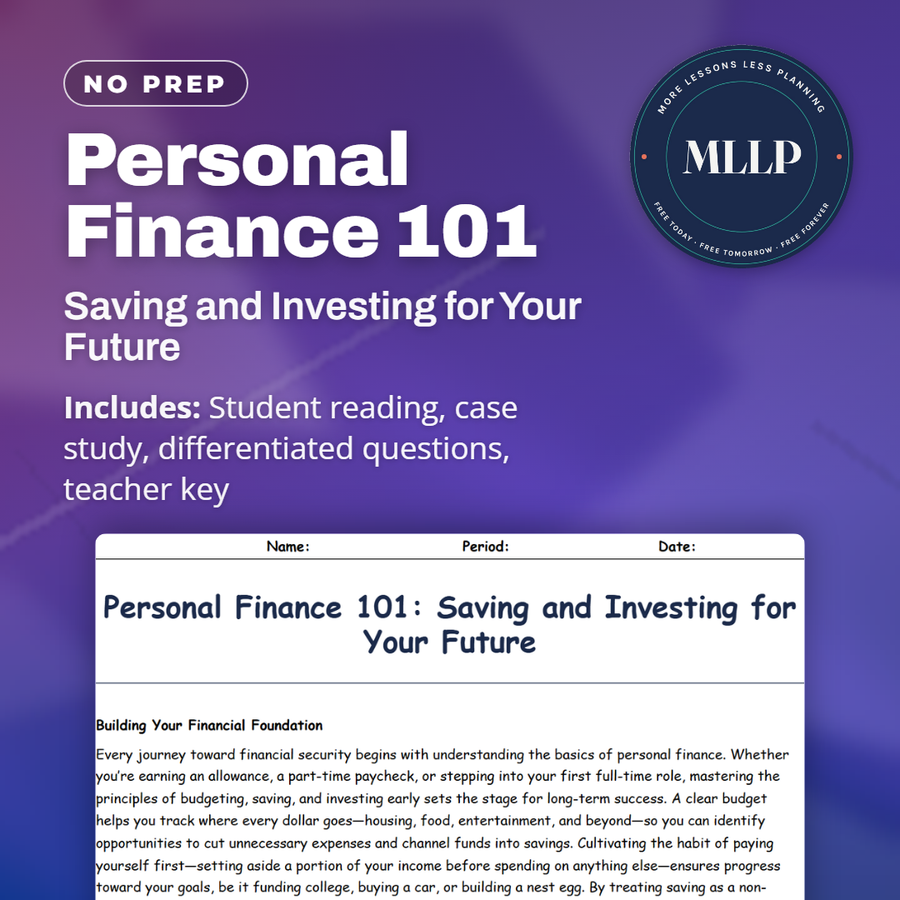
Personal Finance 101: Saving and Investing for Your Future
Quality reviewed September 2026
Facts verified September 8, 2026
- Grades
- Grades 9-12
- Length
- 6-page student worksheet
- Time
- About one 50-minute class period
- Great for
- Sub plans and independent work
- Includes
- Reading passage, comprehension questions + full answer key
- Format
- Print-and-go PDF
What students do
- Build a monthly budget using the 50/30/20 framework (50 percent needs, 30 percent wants, 20 percent savings and debt repayment)
- Compare account types: traditional savings (0.01-0.50 percent), high-yield savings (3.50-4.25 percent), CDs (4.00-5.00 percent), and brokerage accounts
- Analyze Maria's case study: how automating savings from age 16, investing in low-cost ETFs, and letting compound interest work resulted in over 50,000 dollars by age 30
- Calculate the power of compound interest using the formula A = P times (1 + r/n) to the (n times t) power with different time horizons
What it covers
- Budgeting fundamentals: tracking income, categorizing expenses (fixed, variable, discretionary), and the 50/30/20 guideline
- Savings vehicles: high-yield savings for short-term reserves, CDs for locked-away goals, brokerage accounts for long-term stock and ETF exposure
- Compound interest and the "rule of 72": how small early contributions grow exponentially over decades, making time in the market beat timing the market
Start reading this worksheet
Building Your Financial Foundation
Every journey toward financial security begins with understanding the basics of personal finance. Whether you’re earning an allowance, a part-time paycheck, or stepping into your first full-time role, mastering the principles of budgeting, saving, and investing early sets the stage for long-term success. A clear budget helps you track where every dollar goes: housing, food, entertainment, and beyond, so you can identify opportunities to cut unnecessary expenses and channel funds into savings. Cultivating the habit of paying yourself first, setting aside a portion of your income before spending on anything else, ensures progress toward your goals, be it funding college, buying a car, or building a nest egg. By treating saving as a non-negotiable line item, you transform it from an afterthought into a reliable path toward financial independence.
The Power of Budgeting
A well-crafted budget is more than a tally of dollars and cents; it’s a roadmap for achieving aspirations and a safeguard against living paycheck to paycheck. Start by listing your monthly income (after taxes and deductions) and categorizing your expenses: fixed costs (rent, utilities), variable needs (groceries, transportation), and discretionary spending (eating out, streaming services). The 50/30/20 rule offers a simple guideline: allocate 50 percent of income to needs, 30 percent to wants, and 20 percent to savings and debt repayment. Yet, every student’s reality differs; perhaps you choose a 60/20/20 split if your living expenses are higher. The key is to monitor your budget weekly, adjusting categories as circumstances change, like an unexpected car repair or a temporary reduction in work hours. This discipline not only prevents overspending but also reveals how modest cuts, like skipping a Starbucks latte or canceling an unused subscription, can free up funds for your future.
Savings Accounts and Investment Options
Once you’ve mastered budgeting, decide where to park your savings. Not all accounts are created equal: A high-yield savings account can multiply your returns on cash by offering several times the industry average. This type of account is ideal for your emergency fund or saving for a big purchase. A certificate of deposit (CD) locks in a higher rate for a set term, rewarding patience but penalizing early withdrawal. For long-term horizon (college tuition or retirement), a brokerage account provides direct access to stocks, bonds, and exchange-traded funds (ETFs), where you accept market risks in exchange for higher potential returns. Remember, higher returns usually accompany higher risk, so match the account to your timeline and comfort level.
Like what you read? The full reading, the case study, and every question set are in the free download below, along with the answer key.
Why this matters
A traditional savings account paying 0.50 percent and a high-yield account paying 4.25 percent turn the same deposit into very different totals over time. This reading uses Maria's case study, who automated savings starting at 16 and had more than fifty thousand dollars by 30, to make that gap concrete.
The 50/30/20 budgeting framework gives students a structure they can apply to an actual allowance the same week we cover it. What changes is which questions they ask about money: not just how much to save, but which account and how early. Running the compound interest formula themselves, comparing 18 versus 28, makes the rule of 72 feel like their own future.
From one teacher to another
I use this reading when I want to make personal finance concrete and achievable for students. The budgeting section walks through a realistic student scenario: how identifying modest cuts (skipping Starbucks, canceling unused subscriptions) frees up money for savings. The account comparison demystifies the choices they'll face at 18 or 22. Maria's story is motivating without being unrealistic: she started with a part-time job, automated her savings, and let decades do the heavy lifting. By age 30, she had enough for a down payment. The compound-interest formula and examples show why starting at 18 versus 28 matters. I pair this with financial independence conversations: they hear from peers or media about wealth-building, and this worksheet gives them the actual mechanics and numbers.
What you get
- Answer Key
-
Student Worksheet
Maria saved 15 percent of her paycheck starting at 16, putting $50 a month into a high-yield account earning 1.2 percent before opening a brokerage account at 18 with $100 monthly into an ETF averaging a 7 percent return. By 22 her cash reserve topped $4,000 while her portfolio neared $6,000, and after college she split 10 percent each into a 401(k) match and a Roth IRA. A separate example shows $1,000 at 5 percent becoming $1,050 after one year.
Download
Where should I send the next one?
Everything here is free and it stays that way. Leave your email and I'll send you the new lessons as they go up. You can unsubscribe from any one of them.
Related resources
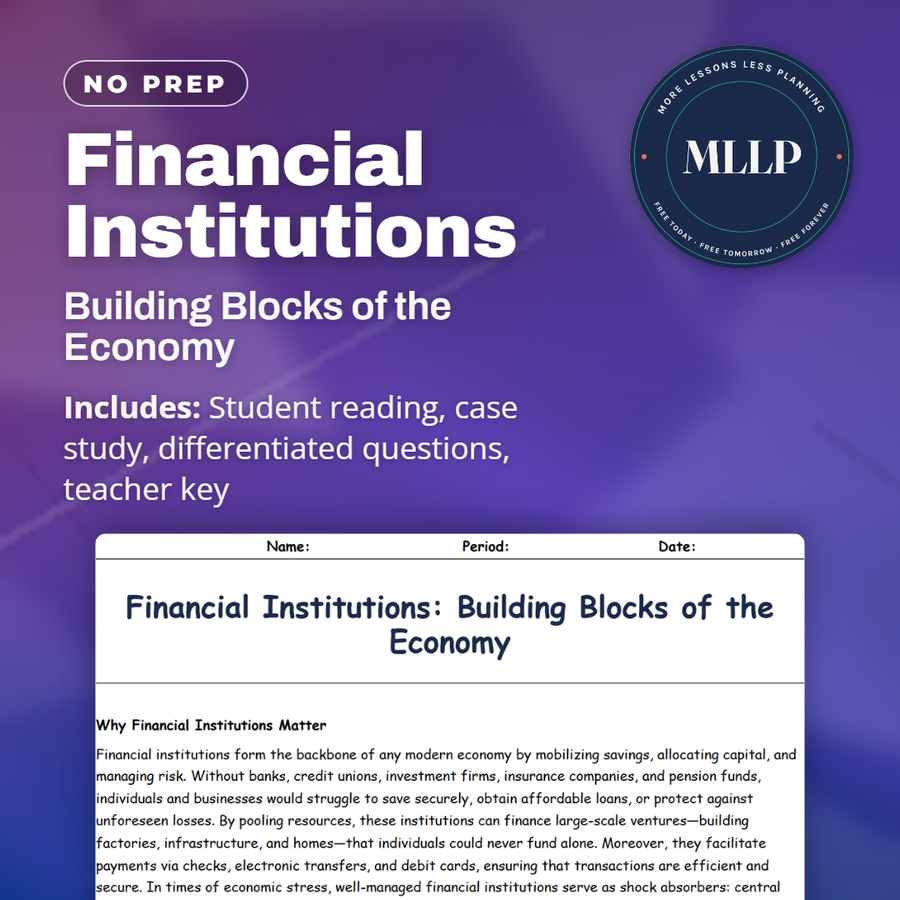
Financial Institutions: Building Blocks of the Economy
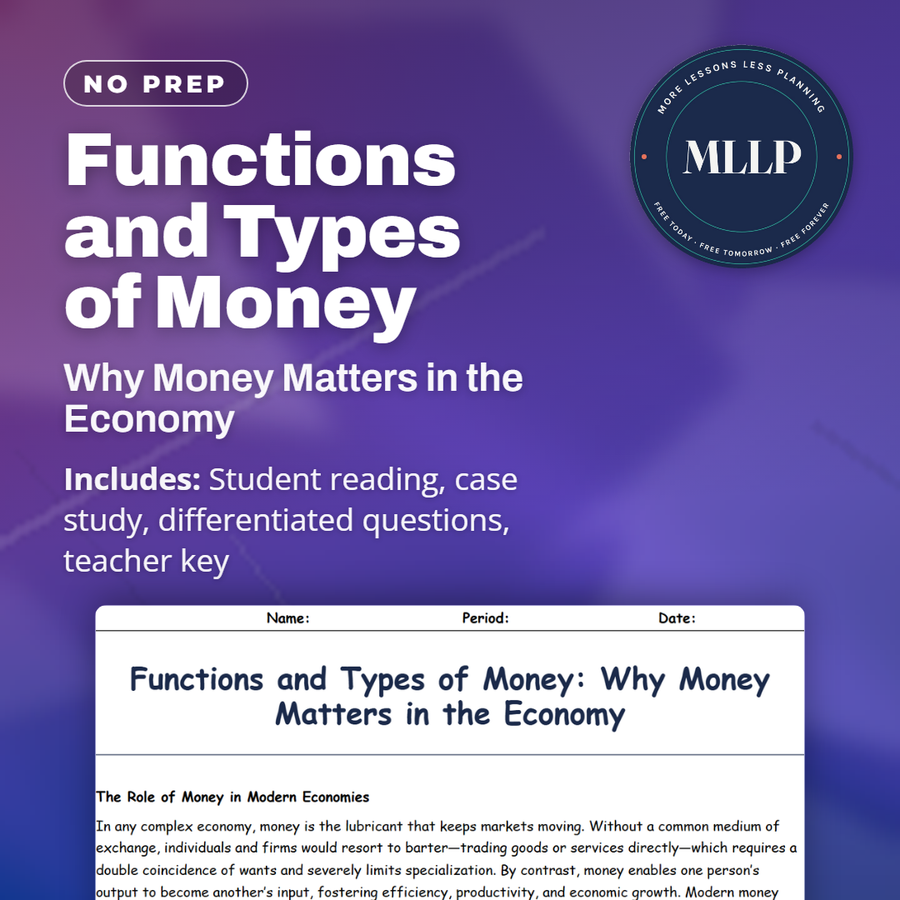
Functions and Types of Money: Why Money Matters in the Economy
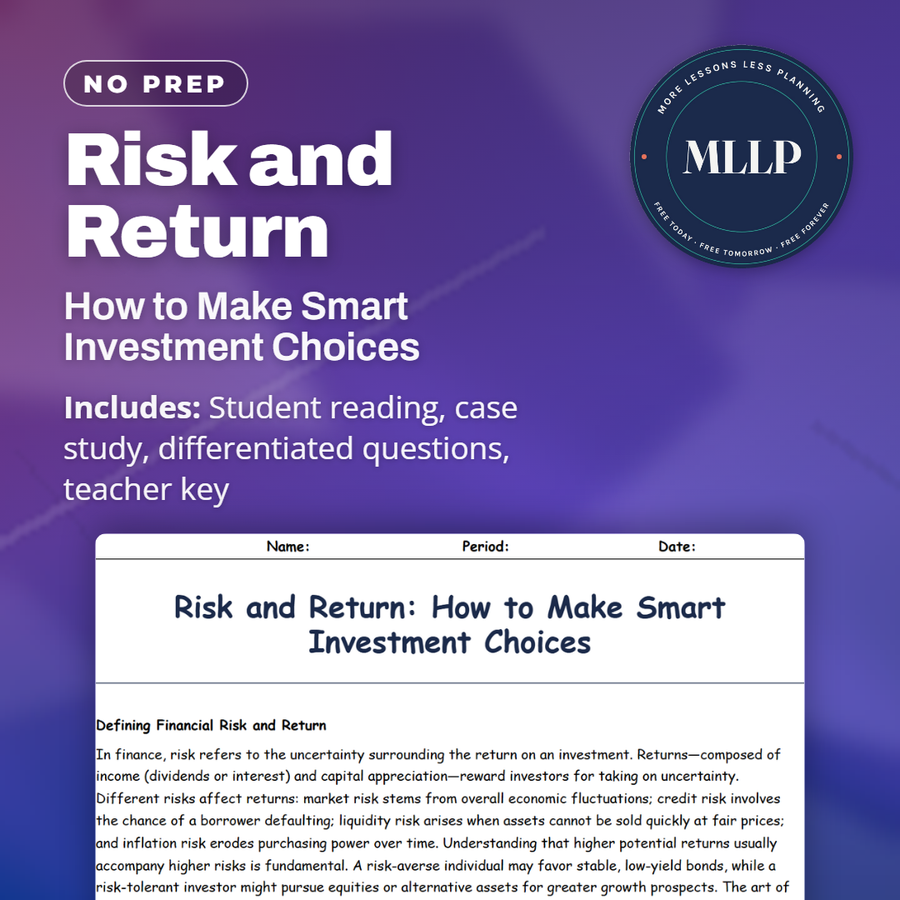
Risk and Return: How to Make Smart Investment Choices
Stock Markets and Bonds: Investing Basics for Beginners
Amazon Warehouses: Working Conditions Investigation
Anti-Trust Laws and Regulation: Promoting Fair Competition
Every lesson on this site is free to download and use. If one of them saved you a prep period, you can chip in a few bucks toward my three kids' daycare fund. That's genuinely where tips go.