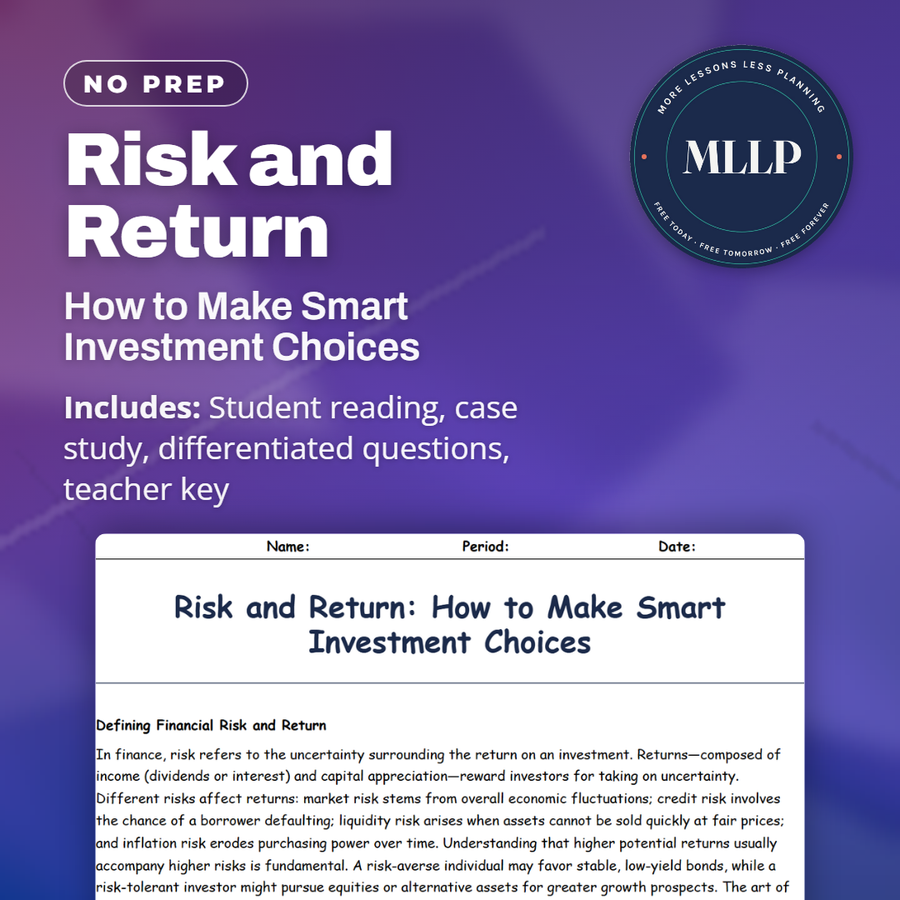
Risk and Return: How to Make Smart Investment Choices
Quality reviewed September 2026
Facts verified September 8, 2026
- Grades
- Grades 9-12
- Length
- 7-page student worksheet
- Time
- About one 50-minute class period
- Great for
- Sub plans and independent work
- Includes
- Reading passage, comprehension questions + full answer key
- Format
- Print-and-go PDF
What students do
- Define financial risk and return, distinguishing market risk, credit risk, liquidity risk, and inflation risk, with examples from bonds and equities
- Analyze the 2020 COVID-19 market downturn: how a 60/40 diversified portfolio limited losses to 20 percent versus 34 percent for an all-stock portfolio
- Explain the Capital Asset Pricing Model (CAPM) relationship and why emerging-market equities or junk bonds promise higher returns only by compensating for higher risks
- Calculate portfolio volatility using standard deviation and apply rebalancing strategies to lock in gains and maintain target risk exposure
What it covers
- The risk-return relationship: why higher potential returns accompany higher risks; emerging markets, junk bonds, and real estate examples
- Diversification as risk management: how low-correlated assets reduce portfolio volatility; the limits of diversification during systemic crises like 2008
- Portfolio risk metrics and management: standard deviation, Value at Risk (VaR), rebalancing rules, and stop-loss strategies to contain unforeseen losses
Start reading this worksheet
Defining Financial Risk and Return
In finance, risk refers to the uncertainty surrounding the return on an investment. Returns, composed of income (dividends or interest) and capital appreciation, reward investors for taking on uncertainty. Different risks affect returns: market risk stems from overall economic fluctuations; credit risk involves the chance of a borrower defaulting; liquidity risk arises when assets cannot be sold quickly at fair prices; and inflation risk erodes purchasing power over time. Understanding that higher potential returns usually accompany higher risks is fundamental. A risk-averse individual may favor stable, low-yield bonds, while a risk-tolerant investor might pursue equities or alternative assets for greater growth prospects. The art of investing lies in balancing these trade-offs to match personal goals and comfort with uncertainty.
Why Higher Returns Often Mean Higher Risk
Investments promising high returns must compensate for elevated risks. Emerging-market equities may offer double-digit growth potential, but political instability, currency swings, and lower liquidity amplify losses during downturns. Junk bonds pay steep coupons, reflecting their issuers’ greater likelihood of default, but can plunge in value during economic stress. Even real estate’s long-term rewards hinge on property market cycles and leverage risks. Financial theory, notably the Capital Asset Pricing Model (CAPM), quantifies this relationship: the expected return on an asset equals the risk-free rate plus a beta-adjusted market premium. In practice, chasing yield without appreciating the underlying risks can lead to painful drawdowns, as starkly illustrated by the 2008 credit crisis or sudden currency devaluations.
Diversification: The Investor’s Shield
Diversification is the process of spreading investments across assets that respond differently to market conditions, reducing portfolio volatility without necessarily sacrificing expected returns. By combining stocks, bonds, real estate, and perhaps commodities, investors can smooth out the ride: losses in one area may be offset by gains in another. The old adage “Don’t put all your eggs in one basket” encapsulates this principle. Asset correlation, how asset returns move relative to each other, is key: low- or negatively correlated assets provide the greatest risk reduction when combined. While diversification can’t eliminate market risk entirely, it shields against idiosyncratic shocks like a single company’s bankruptcy or sectoral downturn, making it a cornerstone of prudent financial planning.
Like what you read? The full reading, the case study, and every question set are in the free download below, along with the answer key.
Why this matters
Alex's all-stock portfolio fell 34 percent in the 2020 crash. Jordan's 60/40 mix fell only 20 percent. Same crisis, same headlines, a fourteen-point gap, because the two portfolios carried different amounts of risk. Return never arrives free of a price, and the price is how much loss a person can stomach before selling at the worst moment.
What surprises my students is that Jordan didn't do anything clever mid-crash; the diversification was already in place. Once they calculate standard deviation for a mixed portfolio themselves, the CAPM material stops being abstract and becomes a number they can measure against their own timeline.
From one teacher to another
I use this reading to challenge the "stocks always beat bonds" oversimplification students often hear. The worksheet acknowledges the risk-return trade-off honestly: yes, long-term equities outperform, but with volatility that can feel stomach-wrenching in a market downturn. The 2020 case study shows real numbers: Alex's all-stock portfolio dropped 34 percent; Jordan's 60/40 mix dropped 20 percent. Jordan slept better and stayed invested; Alex fought the urge to sell at the worst time. The CAPM and correlation sections give students the vocabulary to make informed allocations. By the end, they understand diversification isn't about maximizing annual returns; it's about aligning risk exposure with their timeline and stress tolerance. That's a lesson they'll carry into retirement planning.
What you get
- Answer Key
-
Student Worksheet
U.S. Treasury bonds carry an expected return of 3 to 5 percent, the reading's asset table shows, while large-cap stocks run 6 to 10 percent and international stocks reach 7 to 12 percent, each tier paired with its own risk. A Sharpe ratio divides excess return by volatility to weigh the payoff of holding several together, and the reading points to the 2008 credit crisis as the moment chasing yield without weighing risk proved costliest.
Download
Where should I send the next one?
Everything here is free and it stays that way. Leave your email and I'll send you the new lessons as they go up. You can unsubscribe from any one of them.
Related resources
Financial Institutions: Building Blocks of the Economy
Functions and Types of Money: Why Money Matters in the Economy
Personal Finance 101: Saving and Investing for Your Future
Stock Markets and Bonds: Investing Basics for Beginners
Amazon Warehouses: Working Conditions Investigation
Anti-Trust Laws and Regulation: Promoting Fair Competition
Every lesson on this site is free to download and use. If one of them saved you a prep period, you can chip in a few bucks toward my three kids' daycare fund. That's genuinely where tips go.