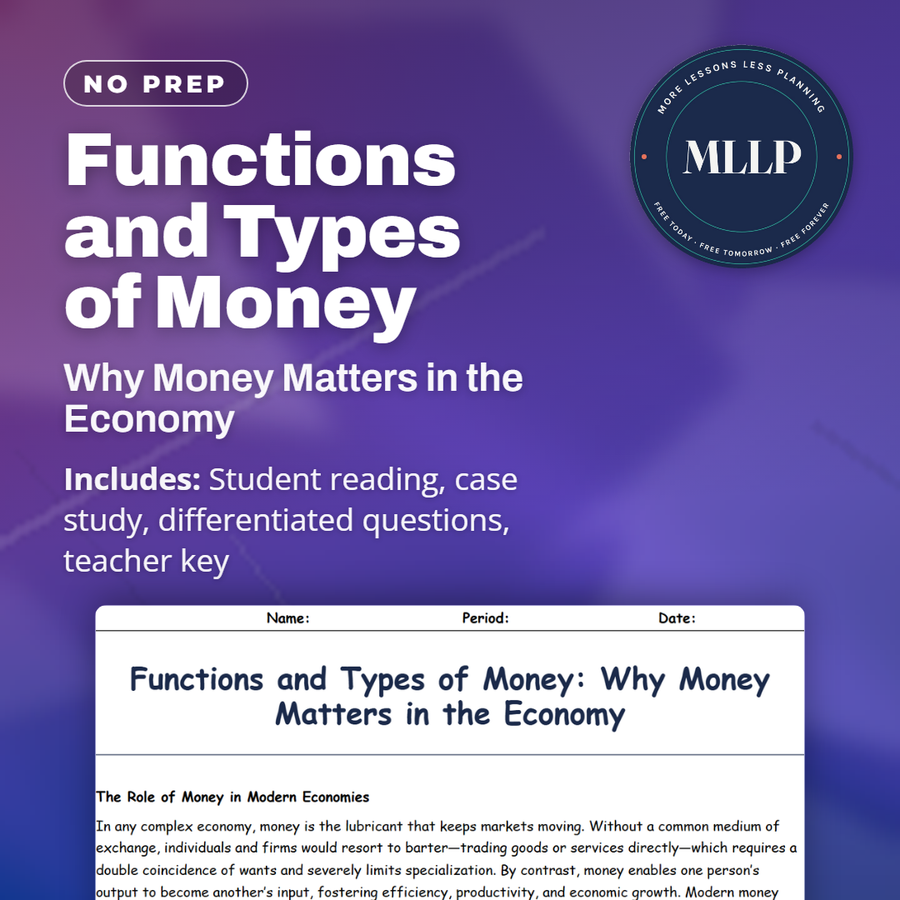
Functions and Types of Money: Why Money Matters in the Economy
Quality reviewed September 2026
Facts verified September 8, 2026
- Grades
- Grades 9-12
- Length
- 8-page student worksheet
- Time
- About one 50-minute class period
- Great for
- Sub plans and independent work
- Includes
- Reading passage, comprehension questions + full answer key
- Format
- Print-and-go PDF
What students do
- Explain how money eliminates inefficiencies of barter and enables specialization and trade
- Distinguish between commodity money (gold, silver), representative money (gold certificates), and fiat money (paper currency)
- Analyze the Nixon Shock of 1971 and how ending gold convertibility gave the Federal Reserve flexible monetary policy control
- Describe how a breakdown in money's store-of-value function (hyperinflation) cascades into reduced acceptance as a medium of exchange
What it covers
- Core functions of money: medium of exchange, store of value, and unit of account in modern economies
- History and types of money: commodity, representative, and fiat systems, with their trade-offs between convenience, stability, and control
- The transition from the gold standard to fiat currency: why the Nixon Shock in 1971 freed central banks to manage money supply flexibly
Start reading this worksheet
The Role of Money in Modern Economies
In any complex economy, money is the lubricant that keeps markets moving. Without a common medium of exchange, individuals and firms would resort to barter, trading goods or services directly, which requires a double coincidence of wants and severely limits specialization. By contrast, money enables one person’s output to become another’s input, fostering efficiency, productivity, and economic growth. Modern money comes in many forms: physical coins and banknotes, digital balances held in bank accounts, mobile payment credits, and even emerging cryptocurrencies. Regardless of form, money’s broad acceptance hinges on trust. People have to trust that it will be accepted in exchange, that it will hold value over time, and that it will serve as a reliable benchmark for measuring worth. Central banks, commercial banks, and financial markets all collaborate (directly or indirectly) to maintain this trust, regulating money’s supply, safeguarding its integrity, and ensuring its smooth circulation.
Core Functions of Money
At its foundation, money performs three indispensable functions: Medium of Exchange: Money eliminates the inefficiencies of barter by providing a universally accepted token in exchange for goods and services. In doing so, it accelerates trade and underpins market specialization. Store of Value: Beyond facilitating transactions, money preserves purchasing power over time, enabling individuals to save today and spend tomorrow. A reliable store of value must resist rapid depreciation; otherwise, people will rush to spend before prices soar. Unit of Account: Money provides a common measure for pricing goods and services, making it possible to compare values, record debts, and maintain clear accounting. In essence, it is the yardstick by which all economic worth is measured. These three roles are interlinked: a breakdown in one, such as rapid inflation undermining money’s store-of-value function, can cascade into reduced acceptance as a medium of exchange and confusion in price-setting. Understanding these functions is critical for policymakers as they employ monetary tools to foster stability and growth.
Types of Money in History and Today
Throughout history, societies have utilized various forms of money, each with unique strengths and vulnerabilities: Commodity Money derives intrinsic value from the material itself: gold, silver, shells, or even livestock. Its worth is self-evident, but it can be bulky, difficult to transport, and vulnerable to supply shocks. Representative Money represents a claim on a commodity stored elsewhere. For example, a gold certificate entitles the bearer to redeem it for physical gold on demand. While lighter and more convenient than carrying bullion, its trustworthiness hinges on the integrity of issuers and redemption mechanisms. Fiat Money carries value solely by government decree. Modern paper notes and digital central-bank reserves are fiat money: they have no intrinsic worth but are accepted because authorities mandate their use for taxes, debts, and official payments. Fiat systems offer maximum flexibility for central banks to respond to economic crises. But they demand prudent management to prevent runaway inflation. Each type reflects trade-offs between convenience, stability, and control. Over time, most economies have transitioned toward fiat systems, trusting in institutional oversight rather than precious-metal backing.
Like what you read? The full reading, the case study, and every question set are in the free download below, along with the answer key.
Why this matters
In 1971 the United States stopped letting anyone trade dollars for gold, a decision called the Nixon Shock. Currency had been tied to a physical commodity before that. After it, the Federal Reserve gained flexibility to manage the money supply directly, a trade rather than a free upgrade.
The paper in a wallet has no value of its own, a fact most students never question until they watch hyperinflation break money's store-of-value function. That collapse shows trust as the mechanism holding a currency together, not the promise printed on the bill. After the Nixon Shock case study, a central bank stops sounding like background noise.
From one teacher to another
I use this reading when I want students to understand money from first principles instead of as pieces of paper with faces on them. The worksheet walks through why barter would collapse any complex economy, how each function of money (exchange, storage, accounting) interconnects, and what happens when trust breaks down. The Nixon Shock case study is the perfect real-world anchor: students see how the U.S. government chose flexible monetary policy over a commodity peg, trading one risk (inflation without an anchor) for the ability to respond to recessions. By the end, they grasp why central banks exist and why credible policy matters more than gold reserves.
What you get
- Answer Key
-
Student Worksheet
Bretton Woods had pegged the dollar to gold at $35 an ounce since World War II, but Vietnam War spending drained U.S. gold reserves through the late 1960s as foreign governments converted dollars for bullion. On August 15, 1971, Richard Nixon announced what became the Nixon Shock, and a six-month suspension of convertibility never lifted. The reading opens earlier, with barter and its need for a double coincidence of wants.
Download
Where should I send the next one?
Everything here is free and it stays that way. Leave your email and I'll send you the new lessons as they go up. You can unsubscribe from any one of them.
Related resources
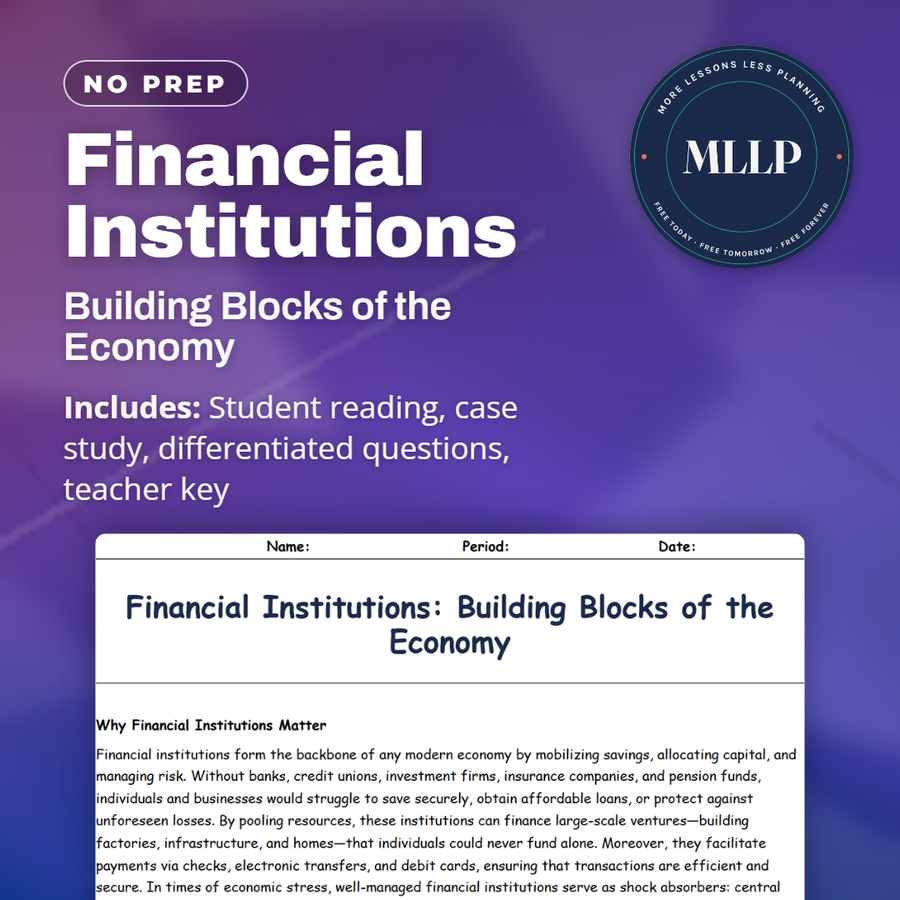
Financial Institutions: Building Blocks of the Economy

Personal Finance 101: Saving and Investing for Your Future

Risk and Return: How to Make Smart Investment Choices

Stock Markets and Bonds: Investing Basics for Beginners
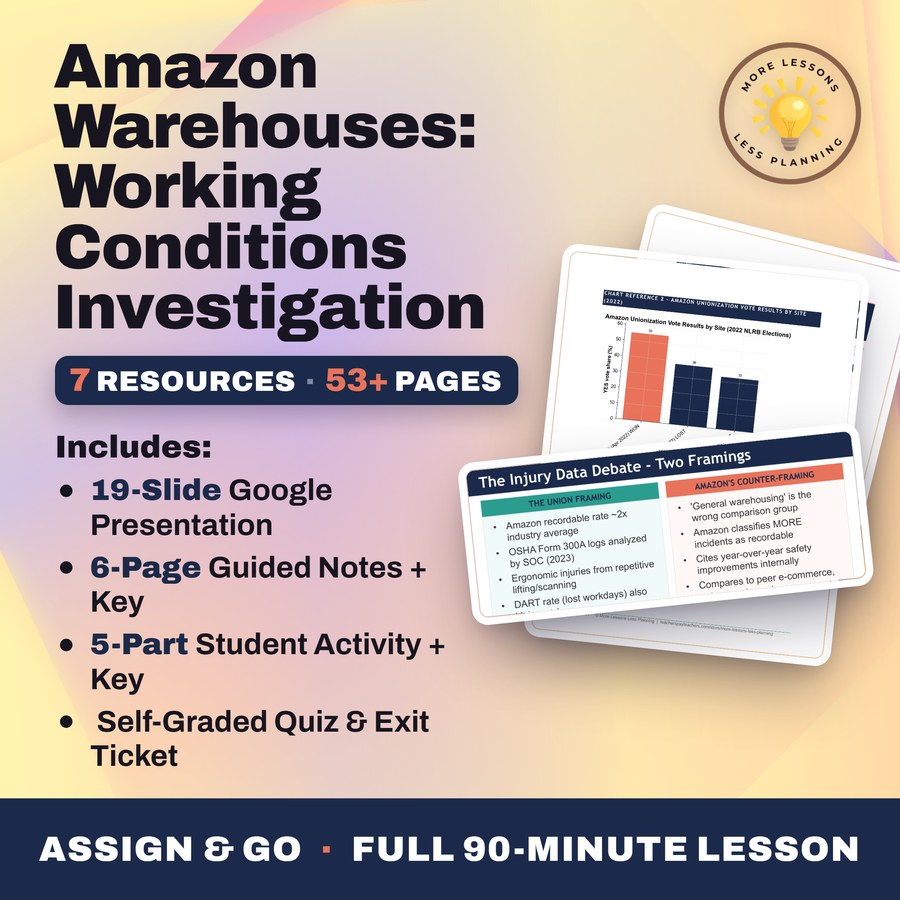
Amazon Warehouses: Working Conditions Investigation

Anti-Trust Laws and Regulation: Promoting Fair Competition
Every lesson on this site is free to download and use. If one of them saved you a prep period, you can chip in a few bucks toward my three kids' daycare fund. That's genuinely where tips go.