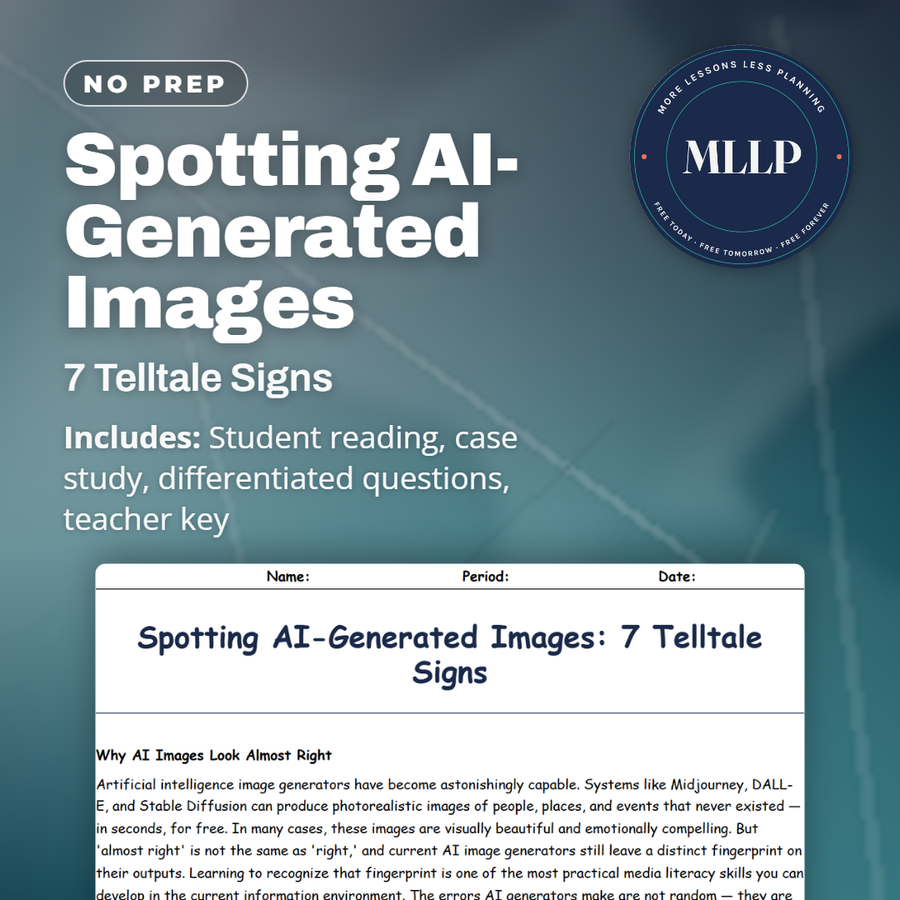
Spotting AI-Generated Images: 7 Telltale Signs
Quality reviewed September 2026
Facts verified September 20, 2026
- Subject
- Career & Life Skills
- Grades
- Grades 9-12
- Length
- 9-page student worksheet
- Time
- About one 50-minute class period
- Great for
- Sub plans and independent work
- Includes
- Reading passage, comprehension questions + full answer key
- Format
- Print-and-go PDF
What students do
- A six-fingered hand in Jordan's case study exposes a fabricated scientist quote
- Sort AI image tells like garbled text and mismatched jewelry by which body part or background feature they affect
- AI generators produce systematic, predictable errors instead of random ones, and the reading explains why
- Trace two of the seven tells back to the specific technical limitation each one reveals
What it covers
- Seven specific AI image tells, from finger count to shadow direction to garbled background text
- Jordan's case study identifying a fabricated scientist photo through a merged hand and nonsense banner text
- Why AI errors are systematic and predictable rather than random, and why that makes them learnable
Start reading this worksheet
Why AI Images Look Almost Right
Artificial intelligence image generators have become astonishingly capable. Systems like Midjourney, DALL-E, and Stable Diffusion can produce photorealistic images of people, places, and events that never existed (in seconds, for free). In many cases, these images are visually beautiful and emotionally compelling. But 'almost right' is not the same as 'right,' and current AI image generators still leave a distinct fingerprint on their outputs. Learning to recognize that fingerprint is one of the most practical media literacy skills you can develop in the current information environment. The errors AI generators make are not random; they are systematic. They stem from the way these systems work: by learning statistical patterns across billions of images rather than understanding the actual physical and biological rules that govern how the real world looks. This means AI images tend to fail in predictable places. Once you know what to look for, you'll start seeing the tells everywhere: in news feeds, on social media, in political advertising, and in content designed specifically to deceive.
Tell #1: The Hands Problem
Human hands are one of the most reliably problematic features for current AI image generators. The reason is structural: hands are geometrically complex, highly variable in position, and appear in an enormous range of configurations in photographic data. AI systems that learn from this data struggle to build a consistent model of hand structure. The result is images where hands have too many fingers, not enough fingers, fingers that bend in anatomically impossible directions, or fingers that blur indistinguishably into each other or into nearby objects. When examining a suspicious image, find the hands first. Count the fingers. Look for joints that bend the wrong way. Look for fingers that fade into the background or into other fingers without a clear border. Even in images that appear highly realistic in every other respect, hands frequently give away AI generation. This is the single most reliable quick test available to non-expert viewers.
Tell #2: Teeth, Eyes, and Hair
Three facial features deserve special attention: teeth, eyes, and hair. AI-generated teeth are often too uniform (perfectly even, perfectly white, without the natural variation in size, color, and alignment that real human teeth have). They may also have an unusual texture, appearing almost ceramic rather than biological. When someone in an AI image smiles broadly, look closely at the individual teeth. Eyes in AI images often have a quality that experienced viewers describe as 'too perfect' or 'glassy': they lack the subtle asymmetry and the complex patterns of light reflection that real eyes display. Irises may be unnaturally symmetric or have a repeating pattern that doesn't match real iris anatomy. Pupils may be slightly misaligned between the two eyes in the same image. Hair is another common failure point: AI hair often has an unusual texture at the edges; it may fade unnaturally into the background, have inconsistent strand thickness, or show repeating patterns that real hair does not.
Like what you read? The full reading, the case study, and every question set are in the free download below, along with the answer key.
Why this matters
Students already scroll past dozens of AI-generated images a week without recognizing a single one, and this reading turns that blind spot into a specific, ordered checklist they can run in seconds: hands, then teeth and eyes, then background text, then lighting. Jordan's case study matters because it shows the checklist working against a genuinely dangerous fake, a fabricated health claim attributed to a scientist rather than a harmless meme, which is the kind of image a student is actually likely to see shared as fact in a group chat.
From one teacher to another
Count the fingers first, this reading argues, because hands remain the single most reliable quick test for spotting an AI-generated image, and from there it works through six more systematic tells: teeth, eyes, hair, background text, jewelry, lighting, and skin. Jordan's case study puts the checklist to work on a fabricated photo of a scientist making a false vaccine claim, where a six-fingered hand and a banner reading "HEALT RSERCH INTTUTE" give the fake away within seconds. The reading explains why these errors are not random glitches but predictable byproducts of how generators learn statistical patterns instead of physical rules. That predictability is the whole point, once a student knows where to look, the tells show up everywhere.
What you get
Download
Where should I send the next one?
Everything here is free and it stays that way. Leave your email and I'll send you the new lessons as they go up. You can unsubscribe from any one of them.
Related resources
AI in News and Misinformation Campaigns
AI-Written Text: How to Tell If a Human Wrote It
Building a Personal Verify Before You Share Habit
Deepfake Audio: The Voice-Cloning Threat
Lateral Reading: Verifying What You See Online
Reverse Image Search and Other Detection Tools
Every lesson on this site is free to download and use. If one of them saved you a prep period, you can chip in a few bucks toward my three kids' daycare fund. That's genuinely where tips go.