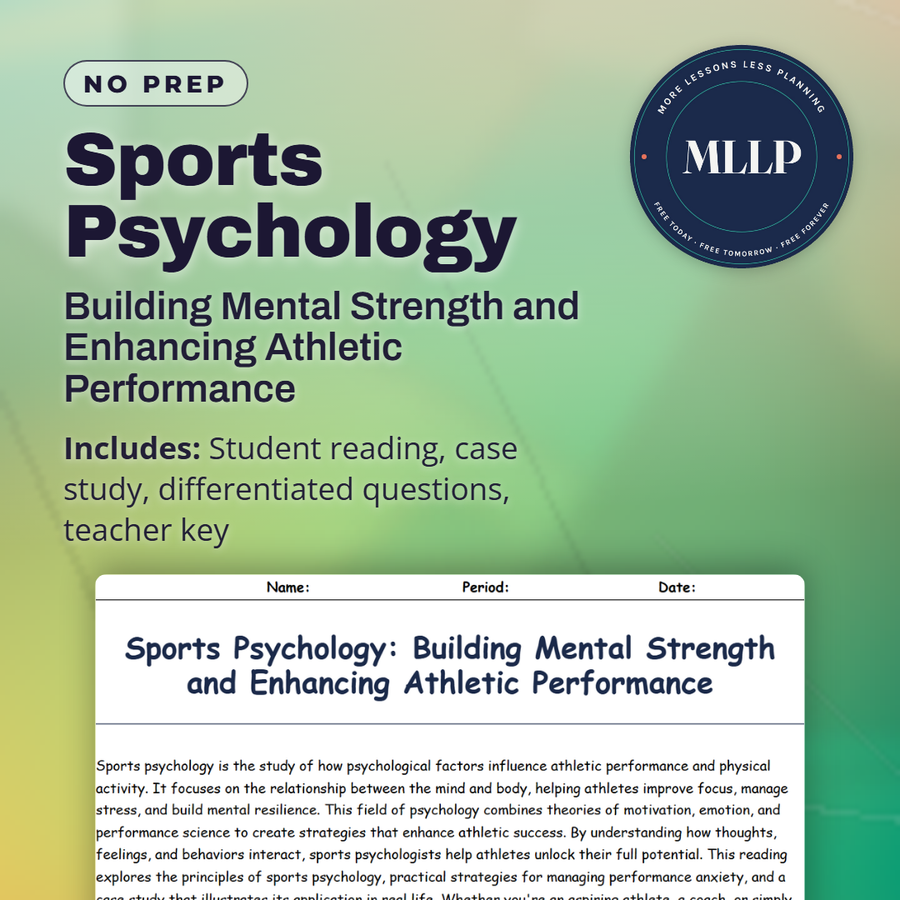
Sports Psychology: Building Mental Strength and Enhancing Athletic Performance
Quality reviewed September 2026
Facts verified September 10, 2026
- Subject
- Social Studies
- Grades
- Grades 9-12
- Length
- 7-page student worksheet
- Time
- About one 50-minute class period
- Great for
- Sub plans and independent work
- Includes
- Reading passage, comprehension questions + full answer key
- Format
- Print-and-go PDF
What students do
- Match five terms, including visualization, self-talk, and intrinsic motivation, to their definitions
- Fill in blanks on visualization, progressive muscle relaxation, and intrinsic motivation
- Read a case study on overcoming performance anxiety and answer how visualization and self-talk helped
- Write short answers on goal-setting under pressure and balancing intrinsic and extrinsic motivation
What it covers
- Mental skills that support athletic performance, including visualization and goal-setting
- Techniques for managing performance anxiety, such as progressive muscle relaxation
- Motivation and team dynamics in competitive sports
Start reading this worksheet
Sports psychology is the study of how psychological factors influence athletic performance and physical activity. It focuses on the relationship between the mind and body, helping athletes improve focus, manage stress, and build mental resilience. This field of psychology combines theories of motivation, emotion, and performance science to create strategies that enhance athletic success. By understanding how thoughts, feelings, and behaviors interact, sports psychologists help athletes reach their full potential. This reading explores the principles of sports psychology, practical strategies for managing performance anxiety, and a case study that illustrates its application in real life. Whether you're an aspiring athlete, a coach, or simply curious, sports psychology provides valuable insights into the power of the human mind.
The Role of Mental Skills in Athletic Performance
Athletes often face high levels of pressure to perform, whether it's in front of a crowd, during practice, or in critical moments of competition. Mental toughness, the ability to stay focused and confident under stress, is a key determinant of success. Unlike physical skills, which can be observed and measured, mental skills require self-awareness and consistent practice to develop. One essential component of mental toughness is self-confidence. Athletes with high confidence levels are more likely to take risks, recover from setbacks, and maintain motivation. Confidence is closely tied to self-talk, the internal dialogue that can either encourage or discourage an athlete. For example, telling yourself, "I am prepared for this challenge," can improve performance, while negative thoughts like, "I'm going to fail," can sabotage success. Another critical mental skill is focus. The ability to block out distractions and concentrate on the task at hand allows athletes to execute their skills effectively, even in high-stakes situations. Techniques such as mindfulness, visualization, and breathing exercises help athletes develop and sustain focus. For instance, before taking a free throw in basketball, an athlete might visualize the ball going through the hoop while taking slow, deep breaths to calm their nerves.
Managing Performance Anxiety
Performance anxiety, often referred to as "choking under pressure," is a common challenge in sports. It occurs when stress overwhelms an athlete, leading to muscle tension, decreased coordination, and difficulty concentrating. Managing this anxiety requires both mental and physical strategies. One effective approach is progressive muscle relaxation (PMR). This technique involves systematically tensing and relaxing different muscle groups, helping athletes release tension and regain control. PMR is often paired with deep breathing, which lowers heart rate and reduces feelings of panic. Sports psychologists also teach athletes how to use goal-setting to combat anxiety. Breaking a competition into smaller, achievable goals shifts the focus from the outcome (e.g., winning) to the process (e.g., maintaining proper form or pacing). This strategy reduces pressure and keeps athletes grounded in the present moment. A powerful tool for managing anxiety is visualization, also known as mental imagery. By imagining themselves succeeding in their sport, athletes can build confidence and rehearse scenarios they may face during competition. For example, a gymnast might visualize their routine step by step, including how they will handle minor mistakes.
Like what you read? The full reading, the case study, and every question set are in the free download below, along with the answer key.
Why this matters
Performance anxiety shows up before a competition, not just in some abstract discussion of nerves, and this reading follows an athlete working through exactly that using visualization and self-talk instead of just being told to calm down. Progressive muscle relaxation gets named as an actual technique, not a vague suggestion to relax.
I assign this during the motivation unit because most of my athletes assume mental toughness is something you either have or don't. Naming visualization and intrinsic motivation as specific, learnable skills, then having them write about their own pressure situations, is what shifts that assumption toward mental skills being trained, not inherited.
From one teacher to another
I use this one when we cover motivation and performance, since the case study on performance anxiety is something a lot of students relate to directly. They match visualization, self-talk, and intrinsic motivation to their definitions, fill in blanks on progressive muscle relaxation, then read how an athlete used visualization and positive self-talk to work through anxiety before a competition. Short answer questions ask them to connect goal-setting to their own pressure situations. Answer key included.
What you get
Download
Where should I send the next one?
Everything here is free and it stays that way. Leave your email and I'll send you the new lessons as they go up. You can unsubscribe from any one of them.
Related resources
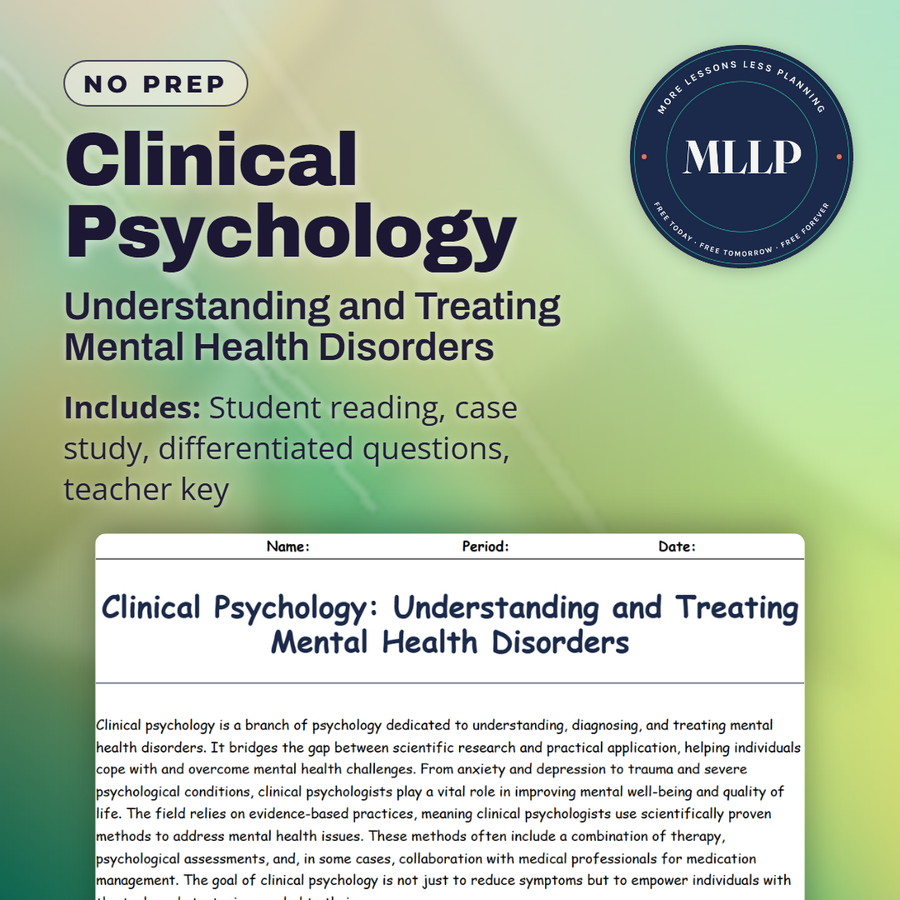
Clinical Psychology: Understanding and Treating Mental Health Disorders
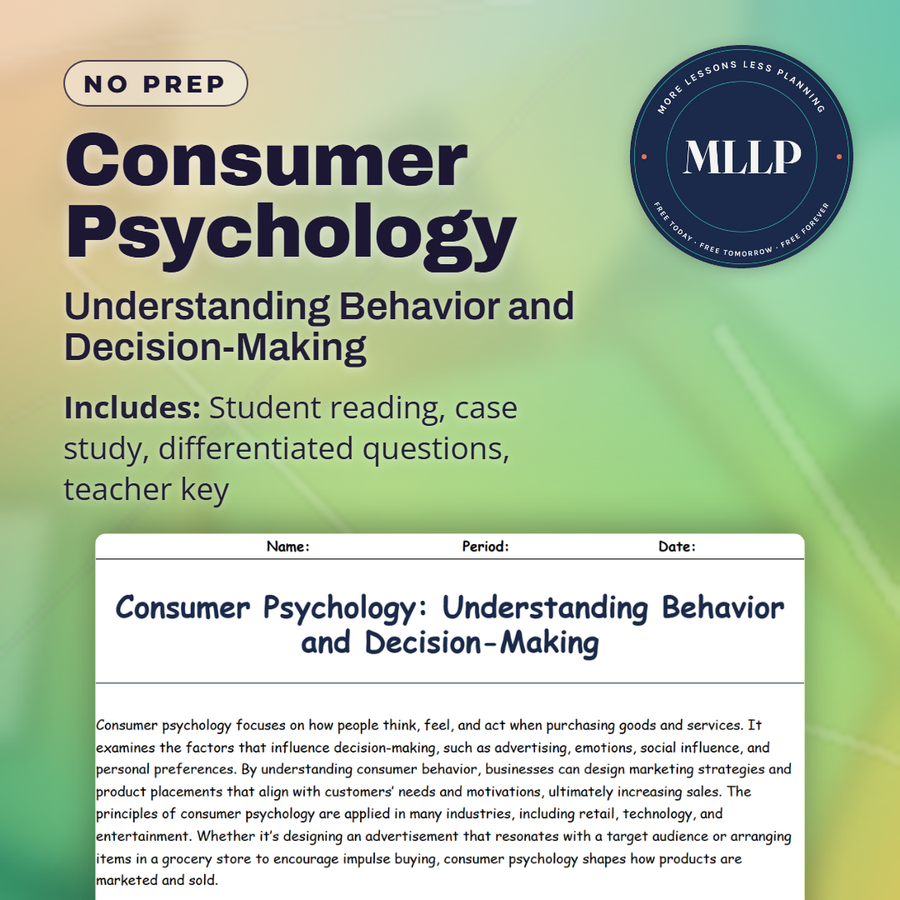
Consumer Psychology: Understanding Behavior and Decision-Making
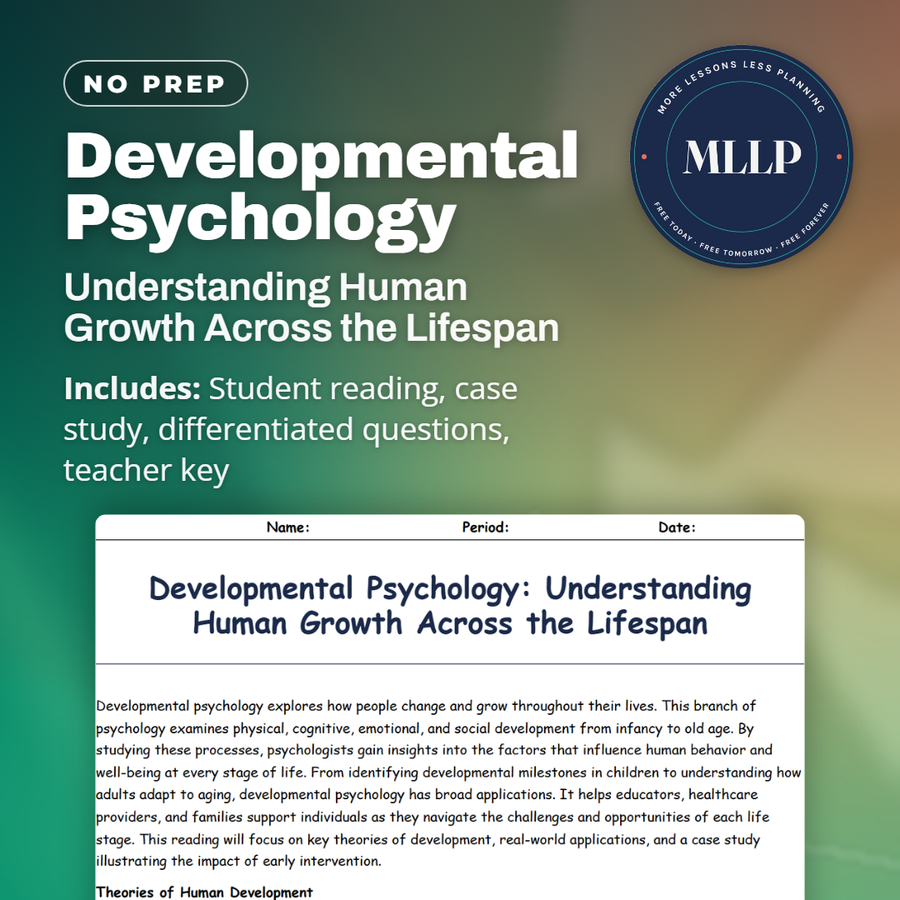
Developmental Psychology: Understanding Human Growth Across the Lifespan
Educational Psychology: Understanding Learning Processes and Teaching Strategies
Health Psychology: The Link Between Mind and Body
Industrial/Organizational Psychology: Understanding Workplace Behavior and Productivity
Every lesson on this site is free to download and use. If one of them saved you a prep period, you can chip in a few bucks toward my three kids' daycare fund. That's genuinely where tips go.