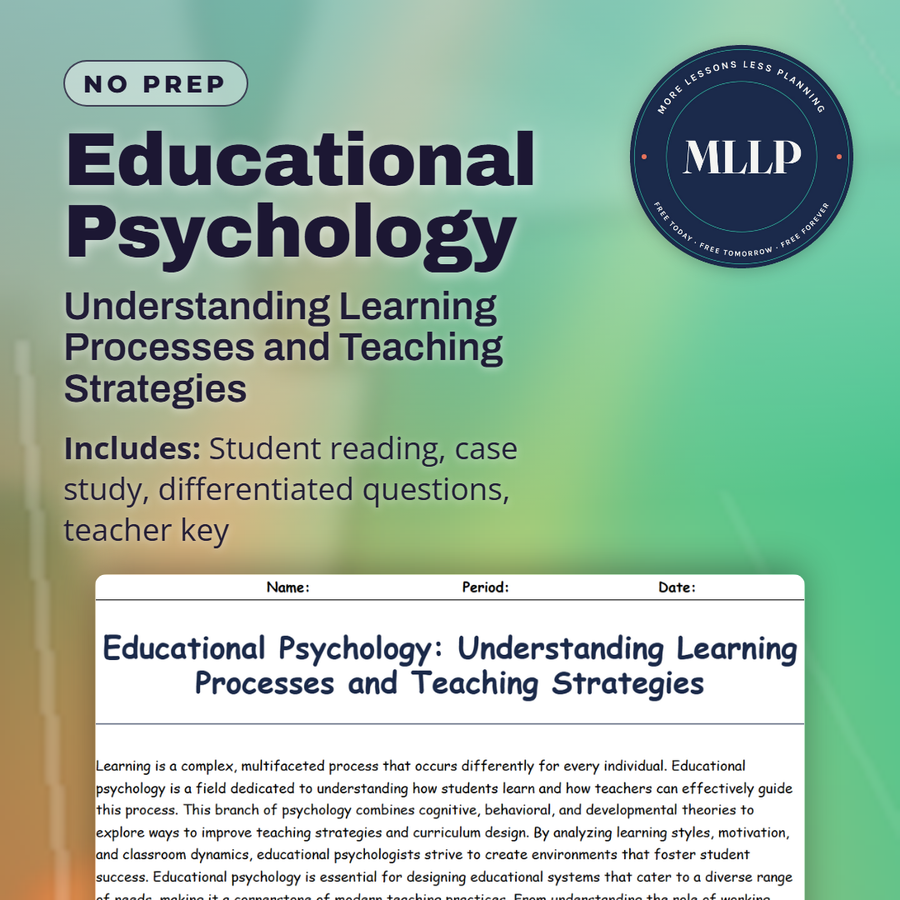
Educational Psychology: Understanding Learning Processes and Teaching Strategies
Quality reviewed September 2026
Facts verified September 10, 2026
- Subject
- Social Studies
- Grades
- Grades 9-12
- Length
- 7-page student worksheet
- Time
- About one 50-minute class period
- Great for
- Sub plans and independent work
- Includes
- Reading passage, comprehension questions + full answer key
- Format
- Print-and-go PDF
What students do
- Match five terms, including behaviorism, constructivism, and zone of proximal development, to their definitions
- Fill in blanks on Piaget's cognitive stages, multimodal teaching, and constructivism
- Read a case study on a teacher adapting lessons for diverse learners and answer how she adjusted her methods
- Write short answers on how cognitive theory and diverse learning preferences shape classroom teaching
What it covers
- Learning theories including behaviorism, cognitive theory, and constructivism
- How those theories translate into classroom practice, from reward systems to project-based learning
- Curriculum design and the case for recognizing diverse learning styles
Start reading this worksheet
Learning is a complex, multifaceted process that occurs differently for every individual. Educational psychology is a field dedicated to understanding how students learn and how teachers can effectively guide this process. This branch of psychology combines cognitive, behavioral, and developmental theories to explore ways to improve teaching strategies and curriculum design. By analyzing learning styles, motivation, and classroom dynamics, educational psychologists strive to create environments that foster student success. Educational psychology is essential for designing educational systems that cater to a diverse range of needs, making it a cornerstone of modern teaching practices. From understanding the role of working memory to adapting strategies for students with unique challenges, this field offers valuable insights into the dynamics of education. In this reading, we will explore the foundations of learning theories, the application of these theories in teaching strategies, and a real-world case study that highlights the importance of tailoring education to individual learners.
Understanding Learning Theories
Educational psychology is built on several foundational theories that explain how individuals learn. Behaviorism, for example, emphasizes the importance of reinforcement and punishment in shaping behavior. Pioneered by psychologists like B.F. Skinner, this theory suggests that students respond to stimuli in their environment, making reinforcement an effective tool for promoting desirable behaviors. On the other hand, cognitive theories focus on the mental processes involved in learning, such as perception, memory, and problem-solving. Jean Piaget's stages of cognitive development are particularly influential, outlining how children progress from basic concrete thinking to advanced abstract reasoning. These stages help teachers understand age-appropriate strategies for different developmental levels. A third major perspective is constructivism, which asserts that learners actively construct knowledge through experiences and interactions. Lev Vygotsky's concept of the zone of proximal development (ZPD) highlights the role of guided learning, where teachers and peers assist students in achieving tasks slightly beyond their current abilities. Each theory offers unique insights into how people learn, emphasizing that effective teaching often involves a blend of strategies tailored to individual needs.
Application of Learning Theories in Teaching
In practice, educational psychologists apply these theories to design teaching strategies that maximize student engagement and comprehension. For instance, in a behaviorist classroom, teachers might use reward systems to reinforce positive behaviors, such as completing homework on time or actively participating in discussions. Cognitive approaches, by contrast, emphasize the importance of structured lessons that align with how the brain processes information. Breaking down material into manageable chunks, incorporating visual aids, and using mnemonic devices are examples of cognitive strategies that enhance learning. Constructivist strategies often involve project-based learning, where students collaborate on real-world problems, encouraging critical thinking and creativity. These methods acknowledge that students learn best when they are actively engaged in their education and can see the relevance of their work to real life. Educational psychology also highlights the importance of recognizing learning styles, such as visual, auditory, and kinesthetic preferences. While modern research questions the rigid categorization of learning styles, adapting lessons to include multiple modalities can help reach a broader range of students.
Like what you read? The full reading, the case study, and every question set are in the free download below, along with the answer key.
Why this matters
Lecturing to an entire room and expecting every student to absorb it the same way is a bet, and this reading shows why that bet fails. It moves through behaviorism, cognitive theory, and constructivism, then lands on a teacher reworking her lessons once she notices her methods are not reaching everyone.
Zone of proximal development is the term students misuse most, usually as a stand-in for 'hard.' Having them apply cognitive theory to their own classroom experience is where I find out which theory actually made sense to them, and it is usually the same discussion that gets zone of proximal development used correctly instead of as another word for difficult.
From one teacher to another
This is the reading I use for our unit on learning theories since it walks straight through behaviorism, cognitive theory, and constructivism with classroom examples students recognize. They match terms to definitions, fill in blanks on Piaget's stages and multimodal teaching, then read a case study about a teacher reworking her lessons for a class with different learning styles. The short answer prompts ask them to apply cognitive theory to their own classroom. Answer key included.
What you get
Download
Where should I send the next one?
Everything here is free and it stays that way. Leave your email and I'll send you the new lessons as they go up. You can unsubscribe from any one of them.
Related resources
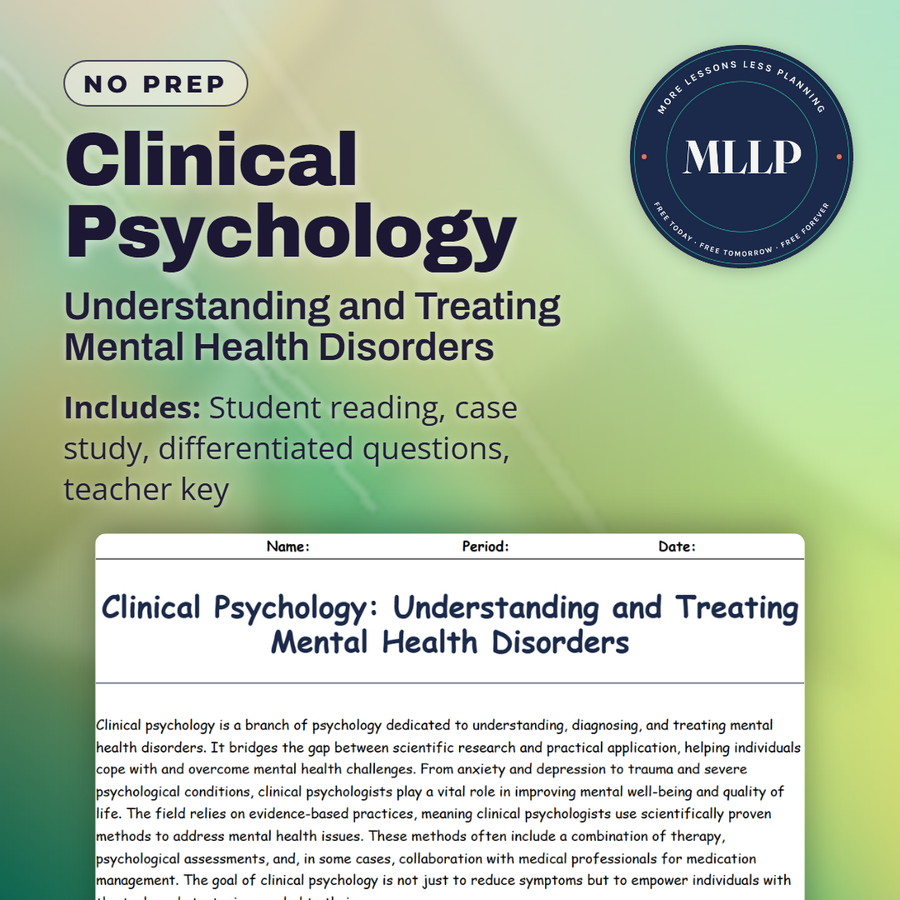
Clinical Psychology: Understanding and Treating Mental Health Disorders
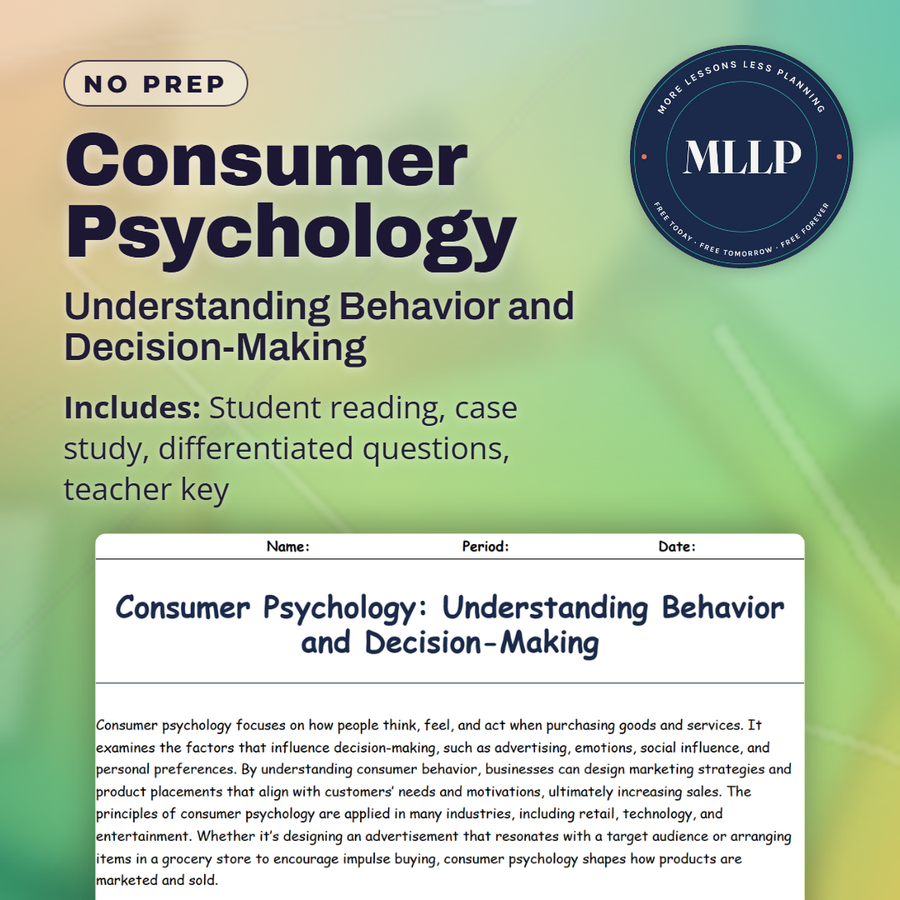
Consumer Psychology: Understanding Behavior and Decision-Making
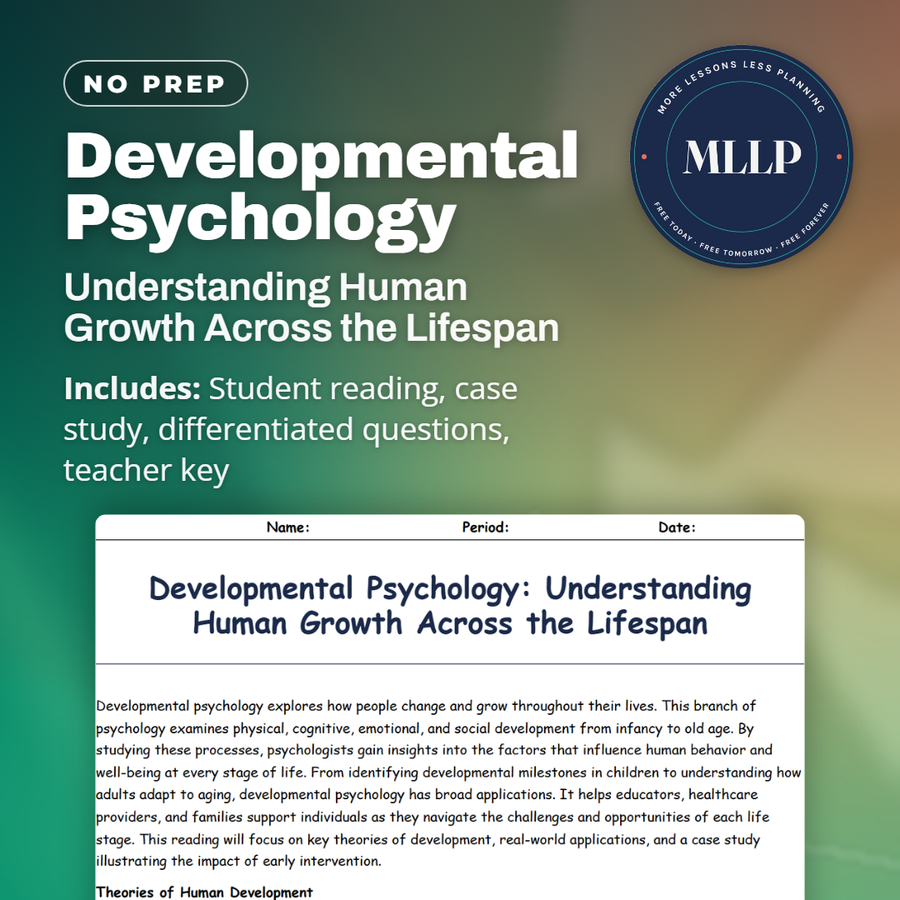
Developmental Psychology: Understanding Human Growth Across the Lifespan
Health Psychology: The Link Between Mind and Body
Industrial/Organizational Psychology: Understanding Workplace Behavior and Productivity
Military Psychology: Supporting Service Members Through Science
Every lesson on this site is free to download and use. If one of them saved you a prep period, you can chip in a few bucks toward my three kids' daycare fund. That's genuinely where tips go.