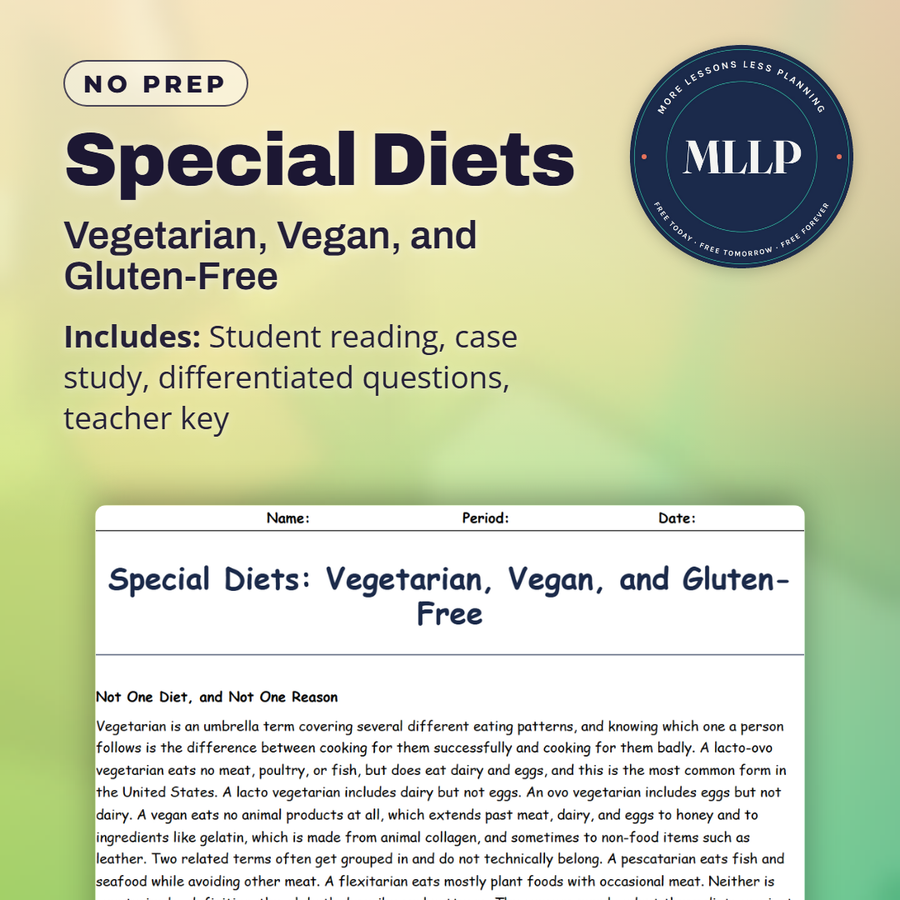
Special Diets: Vegetarian, Vegan, and Gluten-Free
Quality reviewed September 2026
Facts verified September 23, 2026
- Subject
- Career & Life Skills
- Grades
- Grades 9-12
- Length
- 8-page student worksheet
- Time
- About one 50-minute class period
- Great for
- Sub plans and independent work
- Includes
- Reading passage, comprehension questions + full answer key
- Format
- Print-and-go PDF
What students do
- Lacto-ovo vegetarian, non-heme iron, celiac disease, and cross-contact each get tied to a precise definition
- Identify why appropriately planned matters so much in claims about vegan diets
- Bryce's lab group meal gets rebuilt around rice bowls instead of two separate dishes
- The nutrients that actually require planning on a vegan diet get named one by one
What it covers
- Why vitamin B12 is the one nutrient a vegan diet cannot improvise around
- The real difference between celiac disease, a wheat allergy, and gluten sensitivity
- Bryce's rice bowl rebuild for a lab group with four different sets of rules
Start reading this worksheet
Not One Diet, and Not One Reason
Vegetarian is an umbrella term covering several different eating patterns, and knowing which one a person follows is the difference between cooking for them successfully and cooking for them badly. A lacto-ovo vegetarian eats no meat, poultry, or fish, but does eat dairy and eggs, and this is the most common form in the United States. A lacto vegetarian includes dairy but not eggs. An ovo vegetarian includes eggs but not dairy. A vegan eats no animal products at all, which extends past meat, dairy, and eggs to honey and to ingredients like gelatin, which is made from animal collagen, and sometimes to non-food items such as leather. Two related terms often get grouped in and do not technically belong. A pescatarian eats fish and seafood while avoiding other meat. A flexitarian eats mostly plant foods with occasional meat. Neither is vegetarian by definition, though both describe real patterns. The reasons people adopt these diets are just as varied and are worth taking seriously rather than assuming. Some are ethical, concerning animal welfare. Some are religious, since several major traditions include vegetarian practice either permanently or during specific observances. Some are environmental, because animal agriculture generally requires more land and water per calorie produced. Some are health-driven. And some are economic, because beans, lentils, rice, and seasonal vegetables are among the cheapest sources of calories and protein available. In a foods lab, asking which pattern and which boundaries applies is a professional courtesy that costs one question and prevents an entire ruined dish.
Protein Without Meat Is the Easy Part
The question every vegetarian gets asked is where they get their protein, and it is the least interesting nutritional question about the diet because the answer is straightforward. Protein is abundant in plant foods. Beans, lentils, chickpeas, tofu, tempeh, edamame, peanuts, tree nuts, seeds, and whole grains all supply it, and a cup of cooked lentils delivers roughly 18 grams. What differs is amino acid completeness. A complete protein contains all nine essential amino acids in useful proportions, and among plant foods soy and quinoa qualify on their own. Most other plant proteins are limited in one or two amino acids, with legumes running low in methionine and grains running low in lysine. Because those gaps are complementary, combinations like beans and rice, lentils and bread, or hummus and pita fill in each other's shortfalls. An older nutrition idea insisted these complementary proteins had to be combined within a single meal, and that requirement was later found to be unnecessary. The body maintains a circulating pool of amino acids, so eating a variety of plant proteins across a day accomplishes the same thing. The position of the Academy of Nutrition and Dietetics is that appropriately planned vegetarian and vegan diets are healthful, nutritionally adequate, and appropriate for all stages of life, including pregnancy, infancy, and athletics. The operative phrase in that sentence is appropriately planned, which is doing real work. A diet built on french fries, white bread, and soda is technically vegetarian and nutritionally poor.
The Nutrients That Actually Require Attention
The genuine planning challenges in a vegan diet are not about protein. Vitamin B12 is the one that cannot be improvised. It is produced by bacteria and is not reliably present in any unfortified plant food, so vegans need fortified foods such as nutritional yeast, fortified plant milks, or fortified cereals, or a supplement. This is not optional, and B12 deficiency can cause irreversible nerve damage that may develop slowly enough to be missed for years. Iron is the second concern, and the issue is form rather than quantity. Plant foods contain non-heme iron, which the body absorbs less efficiently than the heme iron in meat. Absorption improves substantially when iron-rich plant foods are eaten alongside vitamin C, which is why beans with tomatoes or spinach with citrus is a genuinely better combination than either alone. Calcium requires attention when dairy is excluded, and reliable sources include fortified plant milks, tofu set with calcium sulfate, and low-oxalate greens such as kale and bok choy. Spinach contains calcium but binds much of it in a form the body absorbs poorly. Zinc, iodine, and vitamin D all warrant a look. Omega-3 fats are the last item. Plant sources including flaxseed, chia, walnuts, and canola oil supply ALA, which the body converts into the longer-chain EPA and DHA found in fish only inefficiently, so algae-based supplements exist for exactly this gap. None of these are reasons to avoid the diet. They are the short list that makes planning it work.
Like what you read? The full reading, the case study, and every question set are in the free download below, along with the answer key.
Why this matters
Cooking for a table with different needs is not a rare situation, and most students will run into it at a friend's house, a family gathering, or eventually their own kitchen well before they expect to. Bryce's fix, building the meal around a naturally compliant center instead of running parallel versions of one recipe, is a genuinely useful habit that works whether the restriction is a diet choice or a medical one. The reading is also direct about the fact that gluten-free is not automatically healthier, since most gluten-free flours are not enriched the way wheat flour is required to be.
From one teacher to another
Bryce had four completely different eaters in his lab group, one vegan, one with celiac disease, and two who ate everything, and his first plan built around substitutions nearly ran out the clock. This reading covers the different vegetarian patterns, from lacto-ovo to vegan, and is honest that protein is the easy part of the diet while B12, iron, and calcium are the nutrients that actually need planning. A separate passage untangles celiac disease, a wheat allergy, and non-celiac gluten sensitivity, three conditions that get lumped under gluten free even though only one of them requires lifelong avoidance of a single crumb. The reading closes with Bryce's group building one rice bowl meal that worked for everyone instead of four separate plates.
What you get
Download
Where should I send the next one?
Everything here is free and it stays that way. Leave your email and I'll send you the new lessons as they go up. You can unsubscribe from any one of them.
Related resources
Building a Balanced Plate with MyPlate
Carbs, Protein, and Fat in the Kitchen
Decoding the Nutrition Facts Label
Food Allergies and Intolerances
Food Marketing and Nutrition Misinformation
Nutrition Across the Lifespan
Every lesson on this site is free to download and use. If one of them saved you a prep period, you can chip in a few bucks toward my three kids' daycare fund. That's genuinely where tips go.