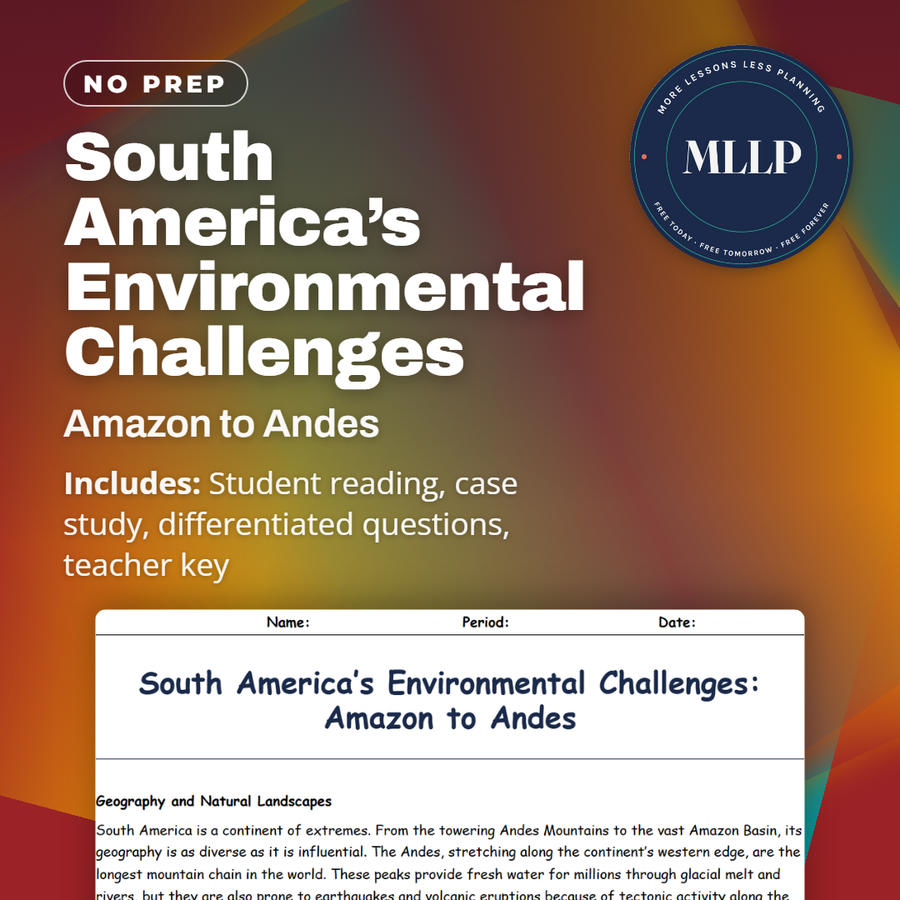
South America’s Environmental Challenges: Amazon to Andes
Quality reviewed September 2026
Facts verified September 14, 2026
- Subject
- Social Studies
- Grades
- Grades 9-12
- Length
- 8-page student worksheet
- Time
- About one 50-minute class period
- Great for
- Sub plans and independent work
- Includes
- Reading passage, comprehension questions + full answer key
- Format
- Print-and-go PDF
What students do
- Match terms like the Andes Mountains, the Amazon Rainforest, and the Galápagos Islands to their correct definitions
- Fill in the blank sentences on the Galápagos Islands, the country of Brazil, and mercury pollution from illegal mining camps
- Answer multiple choice questions on the Amazon Rainforest's nickname, mining's role in Andes water contamination, and the Pampas region
- Write short answers on how climate and landforms shape economies, why the Amazon matters for global climate regulation, and the challenges urban growth creates for cities
What it covers
- The geography of South America, from the Andes Mountains and Amazon Rainforest to the Pampas and the Atacama Desert
- Human impact on the environment, including deforestation, mining pollution in the Andes, and urban growth in cities like São Paulo, Rio de Janeiro, and Bogotá
- A case study on deforestation in the Amazon, plus a table comparing the Andes, Amazon, Pampas, Atacama Desert, and Galápagos Islands
Start reading this worksheet
Geography and Natural Landscapes
South America is a continent of extremes. From the towering Andes Mountains to the vast Amazon Basin, its geography is as diverse as it is influential. The Andes, stretching along the continent’s western edge, are the longest mountain chain in the world. These peaks provide fresh water for millions through glacial melt and rivers, but they are also prone to earthquakes and volcanic eruptions because of tectonic activity along the Pacific’s Ring of Fire. To the east, the Amazon Rainforest covers nearly 2.7 million square miles, acting as a vital carbon sink that regulates Earth’s climate. This “green lung of the planet” plays a critical role in absorbing carbon dioxide and releasing oxygen. South America’s natural features also include fertile plains like Argentina’s Pampas, famous for cattle ranching and grain farming. The continent’s climate ranges from the tropical heat of Brazil to the arid deserts of Chile’s Atacama, one of the driest places on Earth. These diverse landscapes have created opportunities for agriculture, mining, and settlement but also present environmental challenges that affect both local and global systems.
Human Impact and Environmental Strains
South America’s natural wealth has made it a target for exploitation. The Amazon, for example, faces deforestation at alarming rates due to cattle ranching, soybean farming, and logging. Each year, vast tracts of rainforest are cleared, threatening Indigenous communities and countless species of plants and animals. Deforestation also contributes to climate change, since fewer trees mean less carbon is absorbed from the atmosphere. In the Andes, mining for copper, silver, gold, and lithium has boosted economies in countries like Peru, Bolivia, and Chile. However, this extraction often contaminates rivers with toxic chemicals such as mercury and cyanide. The tension between resource development and environmental protection remains one of the region’s greatest challenges. Urban growth adds further stress. Cities like São Paulo, Rio de Janeiro, and Bogotá face air pollution, water shortages, and sprawling informal settlements. These pressures reveal the delicate balance between economic growth and sustainability.
Biodiversity and Global Significance
South America is home to some of the richest biodiversity on Earth. The Amazon alone contains more than 400 billion trees and countless species, many still undiscovered. The Galápagos Islands, part of Ecuador, inspired Charles Darwin’s theory of natural selection, and today they remain a living laboratory for evolution. From jaguars to giant river otters, from Andean condors to Amazonian pink dolphins, the continent’s wildlife is extraordinary. But this biodiversity is fragile. Habitat loss, illegal hunting, pollution, and climate change threaten species survival. Governments and organizations are working to preserve ecosystems through protected areas and conservation efforts. Brazil, for instance, has created large reserves, though enforcement remains a challenge. The survival of South America’s ecosystems matters not just regionally but globally, as their health influences weather patterns, biodiversity, and carbon cycles worldwide.
Like what you read? The full reading, the case study, and every question set are in the free download below, along with the answer key.
Why this matters
Mercury from illegal mining camps in the Andes does not stay where it is dumped, and that fact explains South America's environmental challenges better than a list of landforms could. It links mining pollution in the mountains to the same cause and effect behind deforestation in the Amazon and rapid urban growth in cities like São Paulo and Rio de Janeiro.
My students usually treat deforestation as something that only affects trees. The Amazon case study pushes back, tying rainforest loss to global climate regulation instead of just local habitat. By the end, they can explain why a decision made on a mountain shows up somewhere else entirely.
From one teacher to another
I like how this one pairs the physical geography of South America, the Andes, the Amazon, the Pampas, and the Atacama Desert, with the human side, deforestation, mining pollution, and urban growth. The case study on Amazon deforestation gives students something concrete to reason through instead of just memorizing place names. The matching and fill-in-the-blank sections reinforce vocabulary like the Galápagos Islands and mercury contamination, and the short answer questions push students to connect climate, economy, and sustainability. This works well alongside a unit on biomes or global environmental issues.
What you get
Download
Where should I send the next one?
Everything here is free and it stays that way. Leave your email and I'll send you the new lessons as they go up. You can unsubscribe from any one of them.
Related resources
Every lesson on this site is free to download and use. If one of them saved you a prep period, you can chip in a few bucks toward my three kids' daycare fund. That's genuinely where tips go.