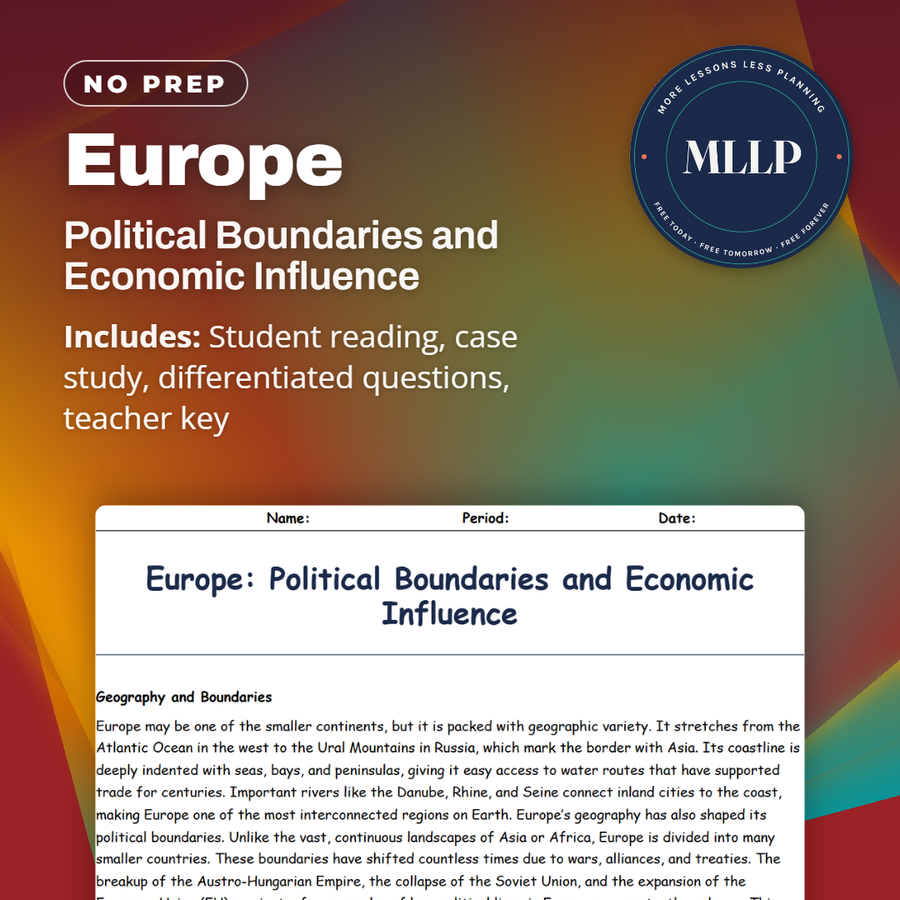
Europe: Political Boundaries and Economic Influence
Quality reviewed September 2026
Facts verified September 14, 2026
- Subject
- Social Studies
- Grades
- Grades 9-12
- Length
- 7-page student worksheet
- Time
- About one 50-minute class period
- Great for
- Sub plans and independent work
- Includes
- Reading passage, comprehension questions + full answer key
- Format
- Print-and-go PDF
What students do
- Match terms like the Berlin Wall, Brexit, and the European Union to their correct definitions
- Fill in the blank sentences on the Berlin Wall, the euro currency, and Europe's many small countries
- Answer multiple choice questions on the Danube River, the United Kingdom's departure from the EU, and the fall of the Berlin Wall
- Write short answers on how geography shaped Europe's shifting borders, why the European Union is economically powerful, and what the Berlin Wall's fall teaches about political change
What it covers
- Europe's geography and political boundaries, including rivers like the Danube and the shifting borders that followed wars and treaties
- Europe's culture and political systems, including the European Union, its shared laws, and its common currency, the euro
- A case study on the Berlin Wall, its construction during the Cold War, and its fall in 1989
Start reading this worksheet
Geography and Boundaries
Europe may be one of the smaller continents, but it is packed with geographic variety. It stretches from the Atlantic Ocean in the west to the Ural Mountains in Russia, which mark the border with Asia. Its coastline is deeply indented with seas, bays, and peninsulas, giving it easy access to water routes that have supported trade for centuries. Important rivers like the Danube, Rhine, and Seine connect inland cities to the coast, making Europe one of the most interconnected regions on Earth. Europe’s geography has also shaped its political boundaries. Unlike the vast, continuous landscapes of Asia or Africa, Europe is divided into many smaller countries. These boundaries have shifted countless times due to wars, alliances, and treaties. The breakup of the Austro-Hungarian Empire, the collapse of the Soviet Union, and the expansion of the European Union (EU) are just a few examples of how political lines in Europe are constantly redrawn. This patchwork of nations creates both opportunities for cooperation and challenges when disagreements arise.
Culture and Political Systems
Europe is often described as the birthplace of Western civilization. Ancient Greece and Rome shaped politics, philosophy, and law. The Renaissance and Enlightenment introduced ideas of science, democracy, and human rights that continue to influence the world. Today, Europe remains culturally diverse, with dozens of languages, religions, and traditions. From the cathedrals of France to the folk music of Eastern Europe, culture is one of the region’s greatest strengths. Politically, Europe contains a mixture of systems, including parliamentary democracies, constitutional monarchies, and republics. The European Union, founded after World War II, represents an effort to unite much of Europe under common goals. The EU’s members share trade agreements, laws, and even a common currency—the euro—used by 20 countries. Yet not all nations have joined, and disagreements over immigration, national sovereignty, and economic policy continue to test Europe’s unity.
Economic Power and Global Role
Europe is home to some of the largest and most advanced economies in the world. Germany, the region’s economic powerhouse, leads in manufacturing and exports. France is a leader in agriculture, aviation, and fashion, while the United Kingdom plays a major role in finance, despite leaving the EU through Brexit in 2020. Smaller countries like Switzerland, Sweden, and the Netherlands also have outsized influence due to their strong economies and global trade connections. The EU as a whole is one of the world’s largest economic entities, rivaling the United States and China. It benefits from open borders between many countries, allowing goods and workers to move freely. However, Europe also faces economic challenges. Southern countries like Greece, Spain, and Italy have struggled with debt crises, while Eastern Europe works to catch up to the wealthier west. The war in Ukraine has further strained economies by disrupting energy supplies and trade. Despite these challenges, Europe’s global influence remains strong, thanks to its financial institutions, cultural exports, and leadership in environmental and human rights issues.
Like what you read? The full reading, the case study, and every question set are in the free download below, along with the answer key.
Why this matters
The Berlin Wall went up during the Cold War and came down in 1989, and this reading uses that event to show how fast political geography can change. Students trace Europe's borders through its rivers, like the Danube, and its wars and treaties, before reaching the European Union and its shared currency.
Brexit gives this reading a second, more recent example some students already have opinions about without knowing the history behind it. The Wall's fall reshaping Germany and opening Eastern Europe to new systems makes a country leaving the EU look like the same process running in reverse.
From one teacher to another
This reading walks students through Europe's political geography, from its rivers and borders to the European Union. I like that it connects the continent's small, shifting countries to real history, especially the case study on the Berlin Wall and its fall in 1989. Students see how a single event reshaped Germany and opened Eastern Europe to new political and economic systems. This pairs well with a unit on the Cold War or European government.
What you get
Download
Where should I send the next one?
Everything here is free and it stays that way. Leave your email and I'll send you the new lessons as they go up. You can unsubscribe from any one of them.
Related resources
Every lesson on this site is free to download and use. If one of them saved you a prep period, you can chip in a few bucks toward my three kids' daycare fund. That's genuinely where tips go.