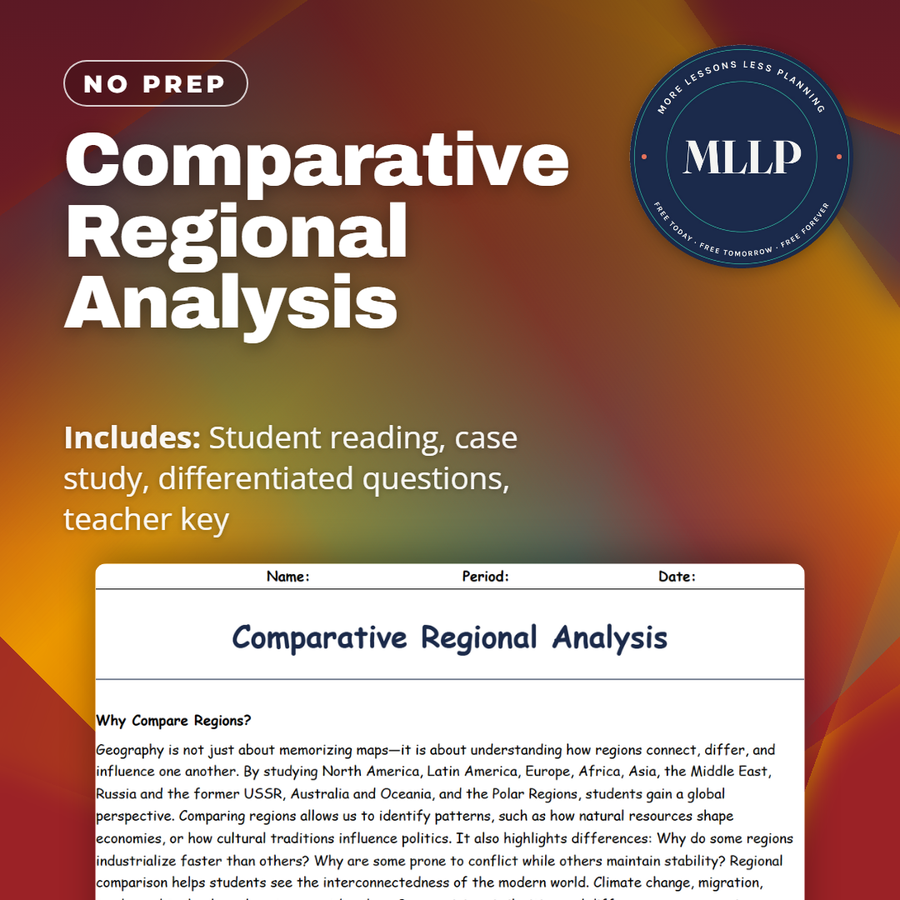
Comparative Regional Analysis
Quality reviewed September 2026
Facts verified September 14, 2026
- Subject
- Social Studies
- Grades
- Grades 9-12
- Length
- 7-page student worksheet
- Time
- About one 50-minute class period
- Great for
- Sub plans and independent work
- Includes
- Reading passage, comprehension questions + full answer key
- Format
- Print-and-go PDF
What students do
- Match regions like Africa, Oceania, Europe, and Asia to the challenge or resource that defines each one
- Fill in the blank sentences on the European Union, Latin America's exports, and Pacific island nations like Tuvalu
- Answer multiple choice questions on which regions depend on oil and gas, which face rising seas, and what the European Union represents
- Write short answers on why comparing regions clarifies global issues, why climate change requires global cooperation, and how North America and Europe compare
What it covers
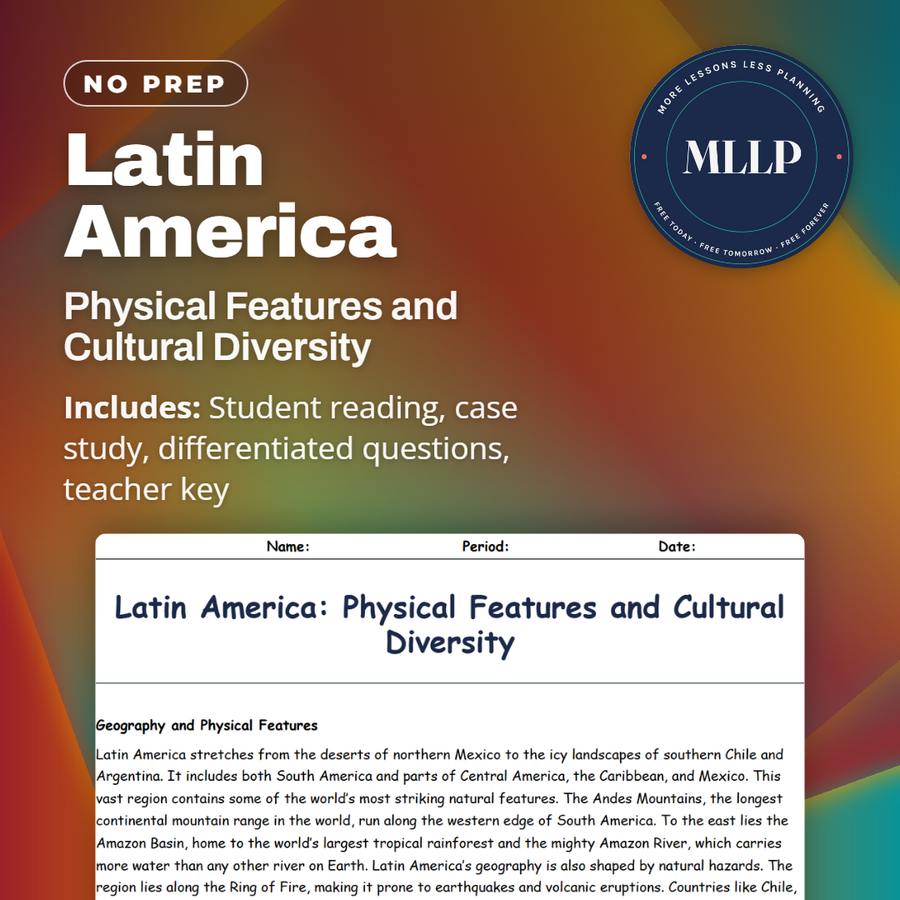
- How regions are compared by economic strength, from oil-rich Middle East and Russia to raw-material exporters like Africa and Latin America
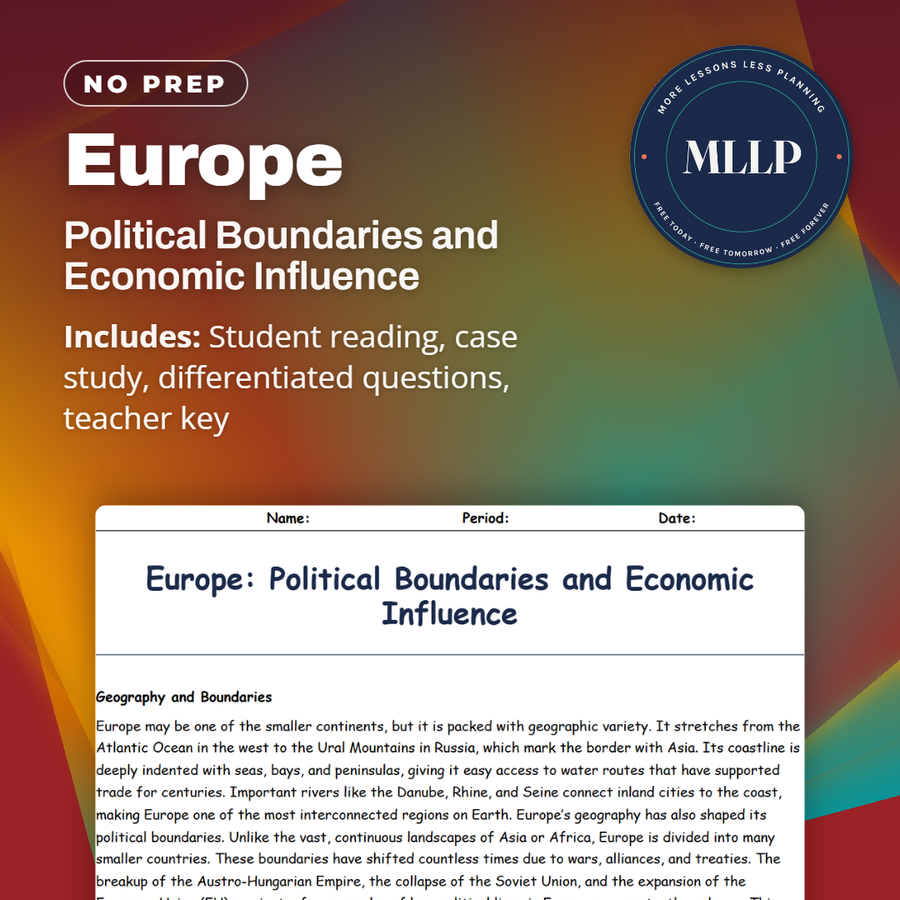
- Cultural and political patterns across regions, including religion in the Middle East and Asia and political integration in Europe
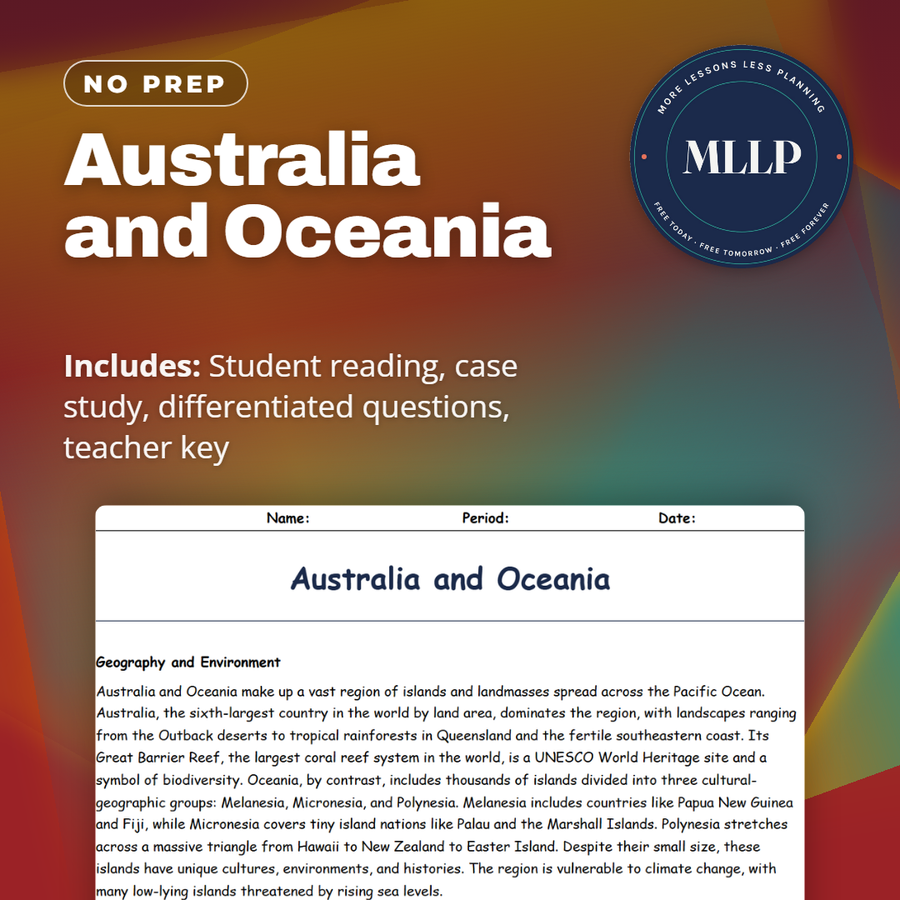
- A case study on how different regions respond to climate change, from renewable energy in Europe to rising seas in Oceania
Start reading this worksheet
Why Compare Regions?
Geography is not just about memorizing maps—it is about understanding how regions connect, differ, and influence one another. By studying North America, Latin America, Europe, Africa, Asia, the Middle East, Russia and the former USSR, Australia and Oceania, and the Polar Regions, students gain a global perspective. Comparing regions allows us to identify patterns, such as how natural resources shape economies, or how cultural traditions influence politics. It also highlights differences: Why do some regions industrialize faster than others? Why are some prone to conflict while others maintain stability? Regional comparison helps students see the interconnectedness of the modern world. Climate change, migration, trade, and technology do not respect borders. By examining similarities and differences among regions, we gain tools to analyze global issues and predict future trends.
Economic Comparisons
Economies around the world are shaped by geography. In the Middle East and Russia, oil and gas drive wealth and political influence. By contrast, Africa and Latin America rely heavily on raw materials like cocoa, copper, and coffee, leaving them vulnerable to fluctuating global markets. Europe and North America have highly developed service and technology industries, while Asia shows diversity, from advanced economies like Japan and South Korea to rapidly growing powers such as India and China. Economic inequality within regions is also important. In Latin America, wealthy elites often contrast sharply with impoverished rural populations. In Africa, mineral wealth sometimes fuels corruption rather than development. In Europe, integration through the European Union has raised living standards, while parts of Eastern Europe lag behind. Comparing economies demonstrates how geography, resources, and history influence prosperity differently across the globe.
Cultural and Political Patterns
Regions also differ in their cultural and political landscapes. The Middle East is deeply influenced by religion, while Asia shows diversity, with Buddhism, Hinduism, Islam, and Christianity shaping societies. Africa has immense cultural diversity, with thousands of ethnic groups and languages, while Europe has focused on integration through common institutions. Politically, regions vary between democratic systems, authoritarian regimes, and hybrid governments. The United States and Western Europe represent long traditions of democracy, while countries in the Middle East and former USSR often concentrate power in central governments. Regions with colonial legacies, such as Africa and Oceania, continue to address the impacts of foreign domination on borders, identity, and development. Comparing regions reveals how culture and politics interact with geography to create unique challenges.
Like what you read? The full reading, the case study, and every question set are in the free download below, along with the answer key.
Why this matters
The Middle East and Russia build economies on oil and gas while Africa and Latin America export raw materials, and lining those strategies up shows students that geography still decides how a region makes money. Tuvalu, a Pacific nation facing rising seas, sits at the opposite end, where geography threatens the economy instead.
I save this reading for the end of a world regions unit because it asks students to compare instead of recall. Watching Europe lean on renewable energy while Oceania braces for rising seas makes the point that the same problem, climate change, gets a different response depending on what a region has to work with.
From one teacher to another
This reading has students step back and compare regions side by side instead of studying them one at a time. I like that the table lays out each region's key resource and key challenge, so students can spot patterns fast, oil economies, export-dependent economies, and political systems. The case study on global responses to climate change shows how the same issue plays out differently depending on a region's wealth and geography. This works well as a wrap-up for a full world regions unit.
What you get
Download
Where should I send the next one?
Everything here is free and it stays that way. Leave your email and I'll send you the new lessons as they go up. You can unsubscribe from any one of them.
Related resources
Every lesson on this site is free to download and use. If one of them saved you a prep period, you can chip in a few bucks toward my three kids' daycare fund. That's genuinely where tips go.