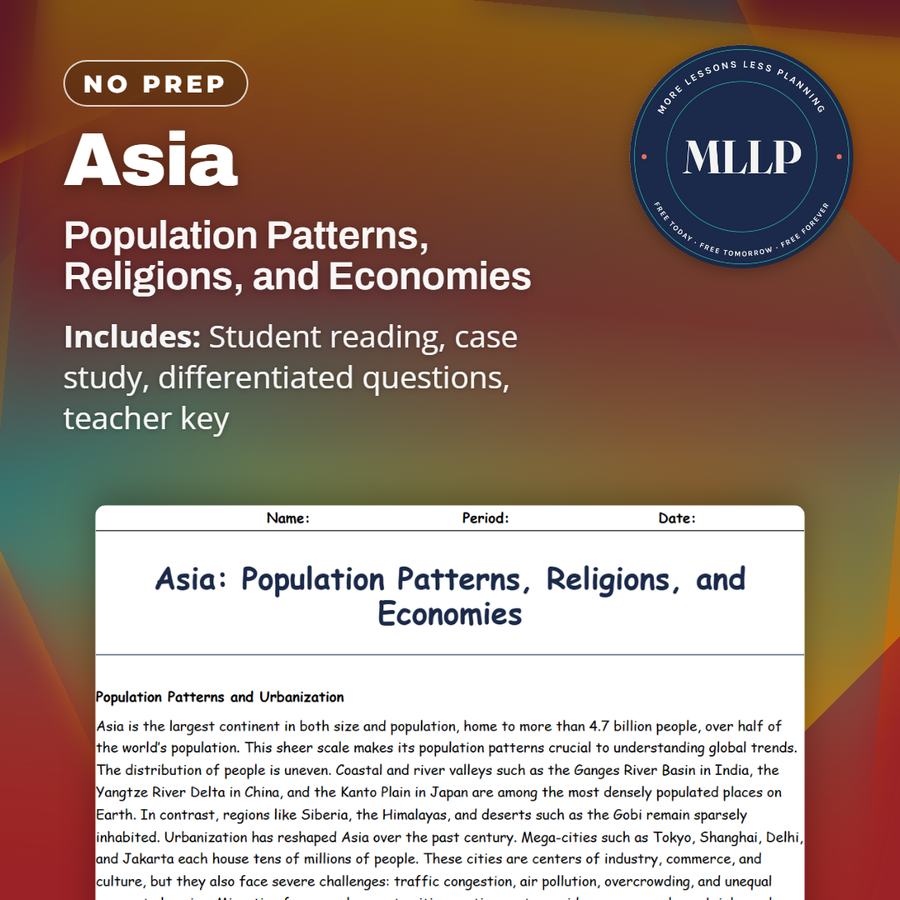
Asia: Population Patterns, Religions, and Economies
Quality reviewed September 2026
Facts verified September 14, 2026
- Subject
- Social Studies
- Grades
- Grades 9-12
- Length
- 7-page student worksheet
- Time
- About one 50-minute class period
- Great for
- Sub plans and independent work
- Includes
- Reading passage, comprehension questions + full answer key
- Format
- Print-and-go PDF
What students do
- Match terms like Tokyo, the Ganges River Basin, and the Belt and Road Initiative to their correct definitions
- Fill in the blank sentences on Asia's population size, the Belt and Road Initiative, and the year the One-Child Policy began
- Answer multiple choice questions on the Ganges River Basin, the origins of Hinduism and Buddhism, and the effects of China's One-Child Policy
- Write short answers on how urbanization has reshaped Asian megacities, why economic growth creates both opportunity and challenge, and how religion shapes cultural identity across Asia
What it covers
- Asia's population patterns and urbanization, including density in river valleys like the Ganges Basin and growth in megacities like Tokyo and Delhi
- The major religions that began in Asia, including Hinduism, Buddhism, Judaism, Christianity, and Islam
- A case study on China's One-Child Policy and its long-term effects on gender balance and an aging population
Start reading this worksheet
Population Patterns and Urbanization
Asia is the largest continent in both size and population, home to more than 4.7 billion people, over half of the world’s population. This sheer scale makes its population patterns crucial to understanding global trends. The distribution of people is uneven. Coastal and river valleys such as the Ganges River Basin in India, the Yangtze River Delta in China, and the Kanto Plain in Japan are among the most densely populated places on Earth. In contrast, regions like Siberia, the Himalayas, and deserts such as the Gobi remain sparsely inhabited. Urbanization has reshaped Asia over the past century. Mega-cities such as Tokyo, Shanghai, Delhi, and Jakarta each house tens of millions of people. These cities are centers of industry, commerce, and culture, but they also face severe challenges: traffic congestion, air pollution, overcrowding, and unequal access to housing. Migration from rural areas to cities continues at a rapid pace, as people seek jobs and better opportunities. Asia’s population growth is slowing overall, but countries like India continue to expand rapidly, while nations like Japan and South Korea face declining birth rates and aging populations. These contrasting trends illustrate the continent’s diversity and complexity.
Religions and Cultural Traditions
Asia is the birthplace of many of the world’s major religions. Hinduism, Buddhism, Judaism, Christianity, and Islam all trace their roots to the continent. In South Asia, Hinduism remains dominant in India, while Buddhism spread from India to East and Southeast Asia, shaping cultures in countries like Thailand, Myanmar, and Japan. The Middle East gave rise to Judaism, Christianity, and Islam, religions that spread across the globe. Islam today is the second-largest religion in the world, with significant populations across Asia, from Indonesia to Pakistan to the Middle East. Religious traditions continue to shape society, politics, and identity. In India, Hindu festivals like Diwali and Muslim celebrations such as Eid al-Fitr highlight the coexistence of diverse faiths. In East Asia, Confucian philosophy and Buddhism have long influenced social values, emphasizing respect for elders and harmony. In Central Asia, Islam plays a major role in cultural and political life. At the same time, rapid modernization has brought both challenges and opportunities for religious communities. Secularism, economic change, and migration create new dynamics, but Asia’s religious heritage remains deeply woven into daily life.
Economic Growth and Global Influence
Asia is now a central engine of the global economy. Countries like China, Japan, South Korea, and India are major economic powers. China’s rapid industrialization has made it the world’s second-largest economy, while Japan and South Korea remain leaders in technology and innovation. India’s growing service sector and youthful workforce make it a rising force. Southeast Asia, with nations like Vietnam, Malaysia, and Indonesia, has also emerged as a hub for manufacturing and trade. Despite this growth, Asia faces sharp economic contrasts. Wealthy nations such as Singapore and Japan enjoy high living standards, while parts of South Asia and Central Asia struggle with poverty. The region’s rapid development has also led to environmental concerns—air pollution in China and India, deforestation in Southeast Asia, and rising sea levels threatening island nations like the Maldives. Trade networks such as the Belt and Road Initiative (BRI), led by China, have expanded Asia’s economic influence worldwide, linking infrastructure projects across continents. Asia’s economic rise shows both opportunity and tension, as nations balance growth, inequality, and sustainability.
Like what you read? The full reading, the case study, and every question set are in the free download below, along with the answer key.
Why this matters
Tokyo and Delhi are two of Asia's most crowded megacities, yet the same continent contains the nearly empty stretches of Siberia and the Gobi. That gap between crowded river valleys like the Ganges Basin and open land is easy to state and hard to picture until students see it laid out side by side.
I pair China's One-Child Policy with the origins of Hinduism and Buddhism, since both show how a decision made generations ago still shapes daily life, whether from a government or a religion that still shapes identity across Asia. Students remember the gender balance and aging numbers longest once they see that link.
From one teacher to another
This reading covers Asia's population patterns, its major religions, and its economic rise all in one worksheet. I like that students see how crowded river valleys and megacities like Tokyo and Delhi sit alongside sparsely populated regions like Siberia and the Gobi. The case study on China's One-Child Policy gives students a concrete example of how population policy can reshape a country for generations. This pairs well with a broader unit on world population or human geography.
What you get
Download
Where should I send the next one?
Everything here is free and it stays that way. Leave your email and I'll send you the new lessons as they go up. You can unsubscribe from any one of them.
Related resources
Every lesson on this site is free to download and use. If one of them saved you a prep period, you can chip in a few bucks toward my three kids' daycare fund. That's genuinely where tips go.