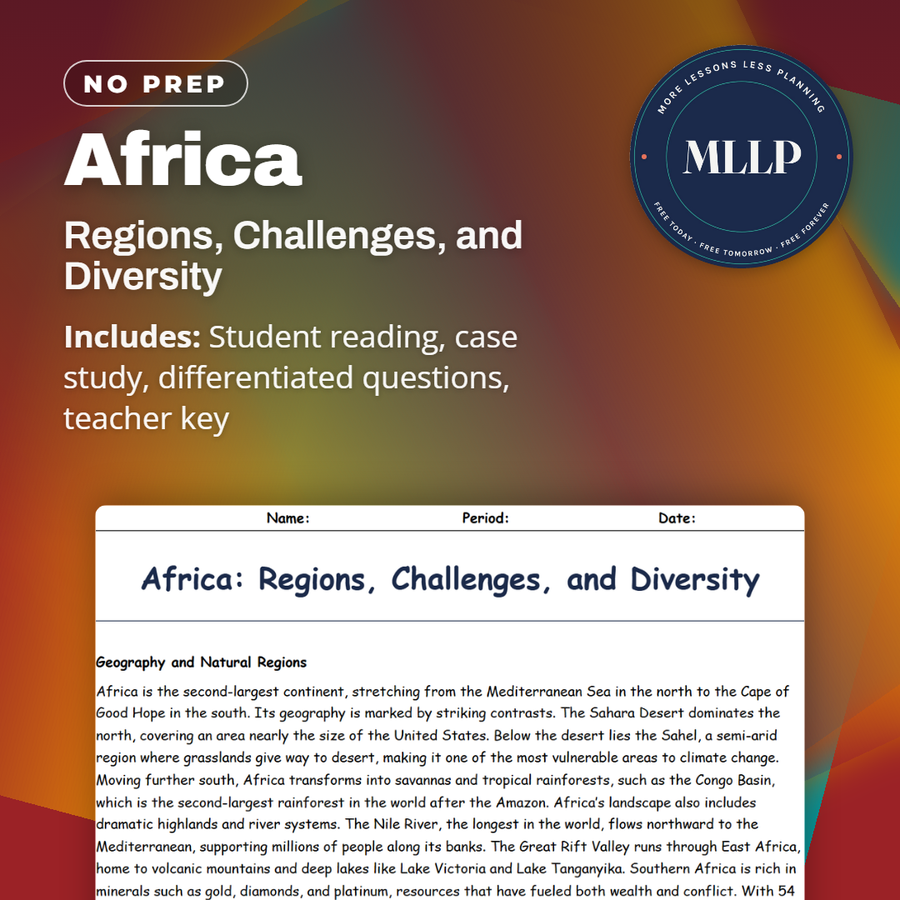
Africa: Regions, Challenges, and Diversity
Quality reviewed September 2026
Facts verified September 14, 2026
- Subject
- Social Studies
- Grades
- Grades 9-12
- Length
- 7-page student worksheet
- Time
- About one 50-minute class period
- Great for
- Sub plans and independent work
- Includes
- Reading passage, comprehension questions + full answer key
- Format
- Print-and-go PDF
What students do
- Match terms like the Sahara Desert, the Nile River, and the Great Rift Valley to their correct definitions
- Fill in the blank sentences on the Congo Basin's rainforest, Africa's youth population, and the Sahara Desert
- Answer multiple choice questions on the Nile River, the Sahara Desert, and the Rwandan genocide
- Write short answers on how geography shapes African culture, why raw material exports create economic risk, and what lessons come from Rwanda's recovery
What it covers
- Africa's physical geography, including the Sahara Desert, the Sahel, the Congo Basin rainforest, the Nile River, and the Great Rift Valley
- Africa's cultural and linguistic diversity, including its 1,500-plus languages and its mix of Islam, Christianity, and Indigenous religions
- A case study on the Rwandan genocide and the country's recovery under later reconstruction efforts
Start reading this worksheet
Geography and Natural Regions
Africa is the second-largest continent, stretching from the Mediterranean Sea in the north to the Cape of Good Hope in the south. Its geography is marked by striking contrasts. The Sahara Desert dominates the north, covering an area nearly the size of the United States. Below the desert lies the Sahel, a semi-arid region where grasslands give way to desert, making it one of the most vulnerable areas to climate change. Moving further south, Africa transforms into savannas and tropical rainforests, such as the Congo Basin, which is the second-largest rainforest in the world after the Amazon. Africa’s landscape also includes dramatic highlands and river systems. The Nile River, the longest in the world, flows northward to the Mediterranean, supporting millions of people along its banks. The Great Rift Valley runs through East Africa, home to volcanic mountains and deep lakes like Lake Victoria and Lake Tanganyika. Southern Africa is rich in minerals such as gold, diamonds, and platinum, resources that have fueled both wealth and conflict. With 54 countries, Africa is politically diverse, and its physical geography plays a major role in shaping regional identities, economies, and challenges.
Cultural and Linguistic Diversity
Africa is home to an extraordinary cultural mosaic. It is the birthplace of humanity, with human fossils discovered in East Africa dating back millions of years. Today, the continent has over 1,500 languages, with major families including Afro-Asiatic, Niger-Congo, and Nilo-Saharan. While Arabic dominates in the north and Swahili serves as a lingua franca in East Africa, local languages remain vital to cultural identity. Religiously, Africa is divided between Islam in the north and Christianity in much of sub-Saharan Africa, though Indigenous religions remain significant. Cultural practices also vary widely, from the nomadic Tuareg of the Sahara to the farming communities of West Africa and the pastoralists of East Africa. Urban centers like Lagos, Cairo, and Johannesburg represent modern Africa’s dynamism, blending global influences with local traditions. This diversity creates vibrancy but also challenges in forging unity across ethnic and national lines.
Economic Growth and Challenges
Africa is a continent of immense natural wealth, yet many countries struggle with poverty and inequality. The abundance of resources such as oil in Nigeria, cobalt in the Democratic Republic of the Congo, and coffee in Ethiopia highlights Africa’s global economic importance. However, dependence on raw material exports has made economies vulnerable to global price changes. In recent decades, African economies have begun diversifying. Countries like Kenya and Rwanda are investing in technology and services, while South Africa is a leader in finance and industry. Still, challenges remain: political instability, corruption, and lack of infrastructure slow growth. Another major issue is rapid population increase. Africa has the world’s fastest-growing population, with over 60% under the age of 25, creating opportunities for future labor but also pressure on jobs, education, and resources. How Africa balances growth with sustainability will shape its future role in the world.
Like what you read? The full reading, the case study, and every question set are in the free download below, along with the answer key.
Why this matters
More than 1,500 languages exist across one continent, which makes it hard to treat African culture as one thing. Setting that diversity next to the Sahara Desert, the Nile River, and the Congo Basin rainforest shows students how landscape and language grew up together.
The physical geography sets up the Rwandan genocide case study, and once students have it, the causes and the recovery finally make sense together. They tend to assume one continent shares one history, so weighing what led to the genocide against what rebuilding required pushes past that assumption fast.
From one teacher to another
This reading walks students through Africa's geography, from the Sahara Desert and the Nile River to the Great Rift Valley and the Congo Basin rainforest. I like that it pairs physical geography with the continent's cultural and linguistic diversity, so students see how landscape connects to language and religion. The case study on the Rwandan genocide gives students a real historical event to analyze, with questions on both causes and recovery. This works well alongside a broader unit on world regions or human geography.
What you get
Download
Where should I send the next one?
Everything here is free and it stays that way. Leave your email and I'll send you the new lessons as they go up. You can unsubscribe from any one of them.
Related resources
Every lesson on this site is free to download and use. If one of them saved you a prep period, you can chip in a few bucks toward my three kids' daycare fund. That's genuinely where tips go.