Antarctica and the Arctic
Quality reviewed September 2026
Facts verified September 14, 2026
- Subject
- Social Studies
- Grades
- Grades 9-12
- Length
- 7-page student worksheet
- Time
- About one 50-minute class period
- Great for
- Sub plans and independent work
- Includes
- Reading passage, comprehension questions + full answer key
- Format
- Print-and-go PDF
What students do
- Match terms like the albedo effect, the Antarctic Treaty, and the Northern Sea Route to their correct definitions
- Fill in the blank sentences on Arctic Indigenous peoples, Antarctica's freshwater supply, and the Northern Sea Route
- Answer multiple choice questions on the difference between Antarctica and the Arctic, the Antarctic Treaty, and the albedo effect
- Write short answers on why the polar regions matter globally, how wildlife adapts to extreme cold, and the role of international cooperation
What it covers
- The geography and climate of Antarctica and the Arctic, including ice sheets, tundra, and the Indigenous peoples of the Arctic
- Resources and human activity at the poles, including the Antarctic Treaty, Arctic oil and gas, and new shipping routes like the Northern Sea Route
- A case study on melting ice in Greenland and its effects on sea levels and traditional ways of life
Start reading this worksheet
Geography and Climate
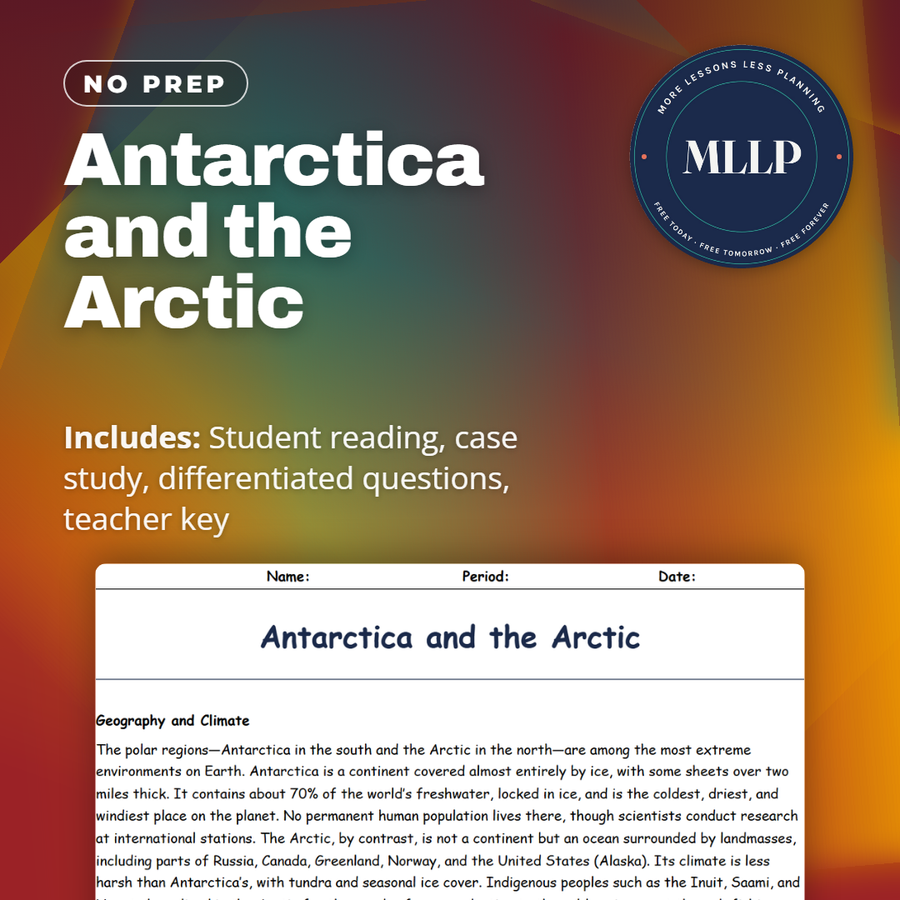
The polar regions, Antarctica in the south and the Arctic in the north, are among the most extreme environments on Earth. Antarctica is a continent covered almost entirely by ice, with some sheets over two miles thick. It contains about 70% of the world’s freshwater, locked in ice, and is the coldest, driest, and windiest place on the planet. No permanent human population lives there, though scientists conduct research at international stations. The Arctic, by contrast, is not a continent but an ocean surrounded by landmasses, including parts of Russia, Canada, Greenland, Norway, and the United States (Alaska). Its climate is less harsh than Antarctica’s, with tundra and seasonal ice cover. Indigenous peoples such as the Inuit, Saami, and Nenets have lived in the Arctic for thousands of years, adapting to the cold environment through fishing, hunting, and herding. While Antarctica is protected from permanent settlement, the Arctic is home to millions of people, making it a very different type of polar region.
Resources and Human Activity
Antarctica is protected by the Antarctic Treaty of 1959, which bans military activity, mineral mining, and permanent settlement while promoting scientific research and international cooperation. Its isolation and protection mean it remains one of the least disturbed environments on Earth. However, climate change threatens its ice sheets, raising global sea levels. The Arctic, on the other hand, is rich in oil, natural gas, and mineral resources. Melting ice has made these resources more accessible, sparking competition among nations. The Arctic Ocean also holds new shipping routes, such as the Northern Sea Route, which could shorten travel between Europe and Asia. While these opportunities bring economic potential, they also raise environmental concerns, especially for Indigenous communities whose ways of life depend on fragile ecosystems.
Wildlife and Ecosystems
Both regions are vital to global biodiversity. In Antarctica, unique species such as penguins, seals, and krill form the foundation of the ecosystem. The Arctic is home to polar bears, walruses, caribou, and Arctic foxes, along with migratory birds. These animals have adapted to extreme cold and rely on ice for survival. Melting ice and warming temperatures disrupt their habitats, threatening extinction for some species. Global climate systems are tied to the poles. Melting ice sheets in Antarctica and the Arctic contribute to rising sea levels, while shrinking Arctic sea ice reduces the Earth’s ability to reflect sunlight, accelerating warming: a process called the albedo effect. This makes the poles not only unique ecosystems but also central to understanding and addressing global climate change.
Like what you read? The full reading, the case study, and every question set are in the free download below, along with the answer key.
Why this matters
Antarctica has no permanent residents. The Arctic is the opposite, an ocean ringed by nations and Indigenous communities who call it home. Students tend to lump both poles together as empty and cold, and setting the Antarctic Treaty next to Arctic oil and gas exploration shows how differently the world actually treats each one.
I use the Greenland case study so melting ice means more than a number on a chart. When ice loss threatens both sea levels and traditional ways of life at the top of the map, students start asking who pays for a warming pole they will never visit.
From one teacher to another
This reading compares Antarctica and the Arctic side by side, covering their geography, resources, and wildlife. I like that it makes the differences concrete. One is a continent with no permanent residents, the other an ocean surrounded by people and Indigenous communities. The case study on melting ice in Greenland ties the poles to something students can picture, rising seas and disrupted livelihoods. It pairs well with a unit on climate and environmental geography.
What you get
Download
Where should I send the next one?
Everything here is free and it stays that way. Leave your email and I'll send you the new lessons as they go up. You can unsubscribe from any one of them.
Related resources
Every lesson on this site is free to download and use. If one of them saved you a prep period, you can chip in a few bucks toward my three kids' daycare fund. That's genuinely where tips go.