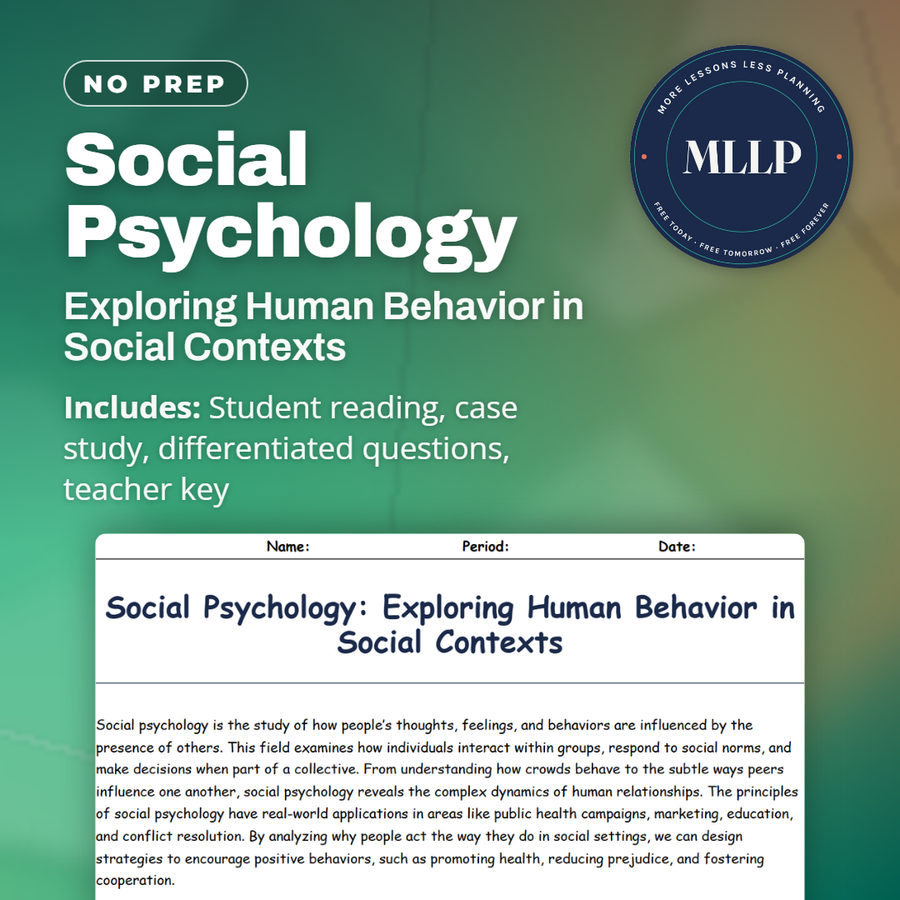
Social Psychology: Exploring Human Behavior in Social Contexts
Quality reviewed September 2026
Facts verified September 10, 2026
- Subject
- Social Studies
- Grades
- Grades 9-12
- Length
- 8-page student worksheet
- Time
- About one 50-minute class period
- Great for
- Sub plans and independent work
- Includes
- Reading passage, comprehension questions + full answer key
- Format
- Print-and-go PDF
What students do
- Match five terms, including cognitive dissonance, groupthink, and social loafing, to their definitions
- Fill in blanks naming the bystander effect, conformity, and cognitive dissonance
- Read a case study on the bystander effect and answer how diffusion of responsibility explains it
- Write short answers on cognitive dissonance in public health campaigns and reducing groupthink
What it covers
- Social influence and how other people shape individual behavior
- Social norms, conformity, and the psychology behind fitting in
- Group behavior and decision-making, including groupthink and social loafing
Start reading this worksheet
Social psychology is the study of how people’s thoughts, feelings, and behaviors are influenced by the presence of others. This field examines how individuals interact within groups, respond to social norms, and make decisions when part of a collective. From understanding how crowds behave to the subtle ways peers influence one another, social psychology reveals the complex dynamics of human relationships. The principles of social psychology have real-world applications in areas like public health campaigns, marketing, education, and conflict resolution. By analyzing why people act the way they do in social settings, we can design strategies to encourage positive behaviors, such as promoting health, reducing prejudice, and fostering cooperation.
Social Influence: How Others Shape Behavior
One of the key areas of social psychology is the study of social influence, which explores how individuals’ actions change based on their social environment. This influence can manifest in several ways: Conformity occurs when people adjust their behaviors or opinions to align with a group. This is often driven by a desire for acceptance or fear of rejection. For example, someone may adopt a popular fashion trend even if they initially disliked it. Compliance involves agreeing to a request or suggestion, often from someone perceived as an authority figure. Compliance doesn’t necessarily mean internal agreement; it simply reflects outward behavior. Obedience is a more extreme form of compliance, where individuals follow direct orders from an authority figure, even if those orders conflict with their personal beliefs. Milgram’s famous obedience experiments demonstrated how far people would go under authority pressure. Understanding social influence helps us see how people’s actions are often guided by their surroundings, rather than purely by internal motivations.
The Power of Social Norms
Social norms are unwritten rules about acceptable behavior in a society or group. These norms shape everything from how we greet strangers to how we behave in classrooms. Breaking these norms often results in social sanctions, such as disapproval or exclusion, which reinforce conformity. For example, imagine walking into a classroom where everyone is sitting silently, and you start speaking loudly. The disapproving stares from others would likely prompt you to lower your voice. This immediate feedback enforces the norm and reminds individuals of group expectations. However, not all social norms are beneficial. In some cases, they perpetuate harmful practices or prejudices. Social psychologists work to understand how these norms can be challenged and redefined to create healthier, more inclusive societies.
Like what you read? The full reading, the case study, and every question set are in the free download below, along with the answer key.
Why this matters
Students already have opinions about conformity and the bystander effect before they have the vocabulary for either, usually built from stories about someone not stepping in to help. This reading names the actual mechanism behind that hesitation, diffusion of responsibility, and asks students to explain it instead of just reacting to it.
Cognitive dissonance tends to land once it's tied to something outside class, and public health campaigns give them a real example of a message built to create discomfort on purpose. Groupthink needs a second pass, since students confuse it with peer pressure until they see how it operates inside a decision-making group.
From one teacher to another
I use this reading when we get to social influence, since students already have opinions about conformity and the bystander effect before they have the vocabulary for either. They match cognitive dissonance, groupthink, and social loafing to their definitions, fill in blanks on conformity and the bystander effect, then read a case study explaining diffusion of responsibility. Short answer questions ask them to apply cognitive dissonance to public health messaging. Answer key included.
What you get
Download
Where should I send the next one?
Everything here is free and it stays that way. Leave your email and I'll send you the new lessons as they go up. You can unsubscribe from any one of them.
Related resources
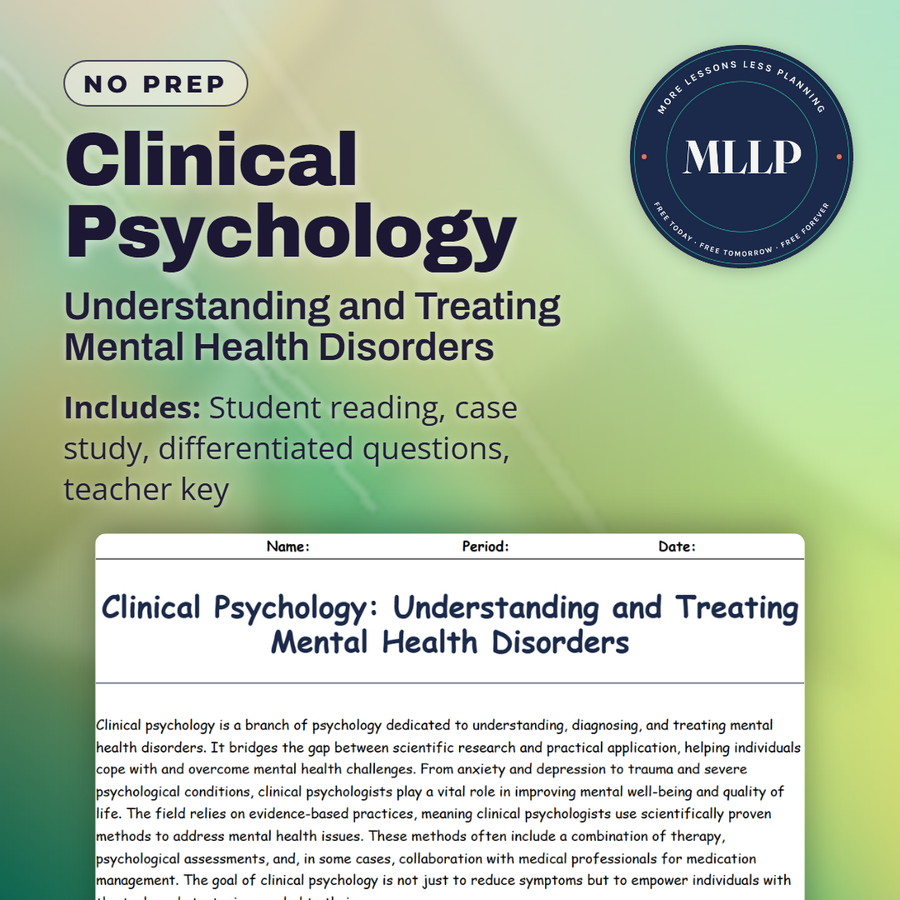
Clinical Psychology: Understanding and Treating Mental Health Disorders
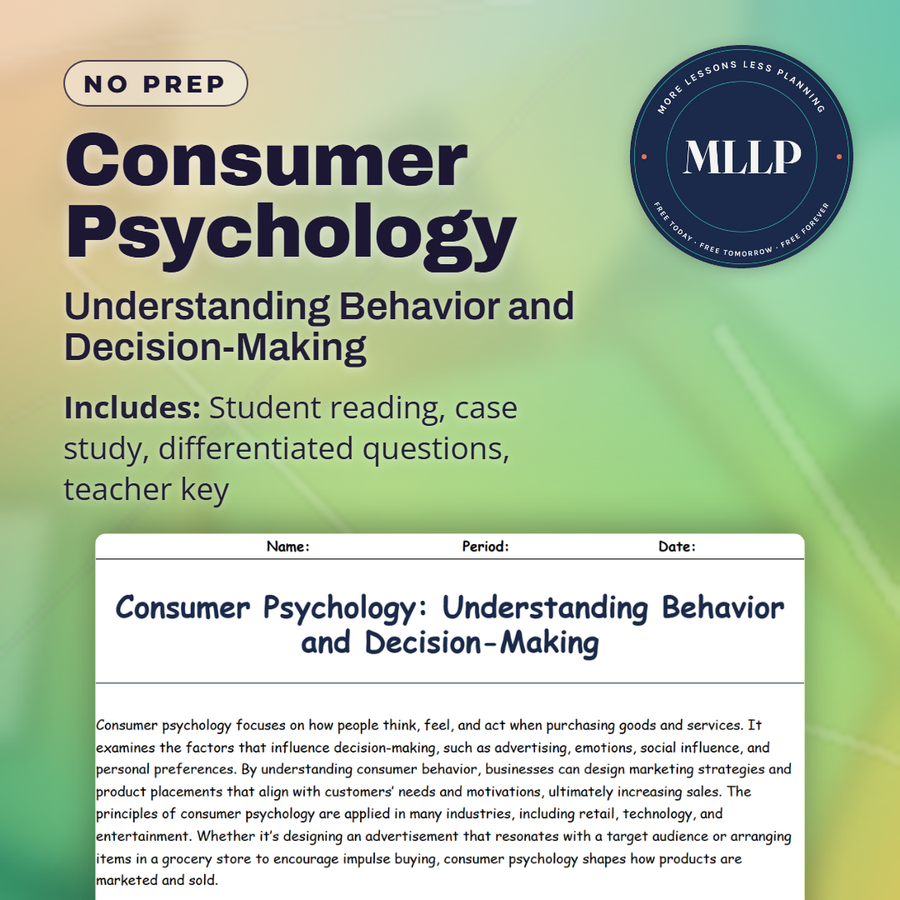
Consumer Psychology: Understanding Behavior and Decision-Making
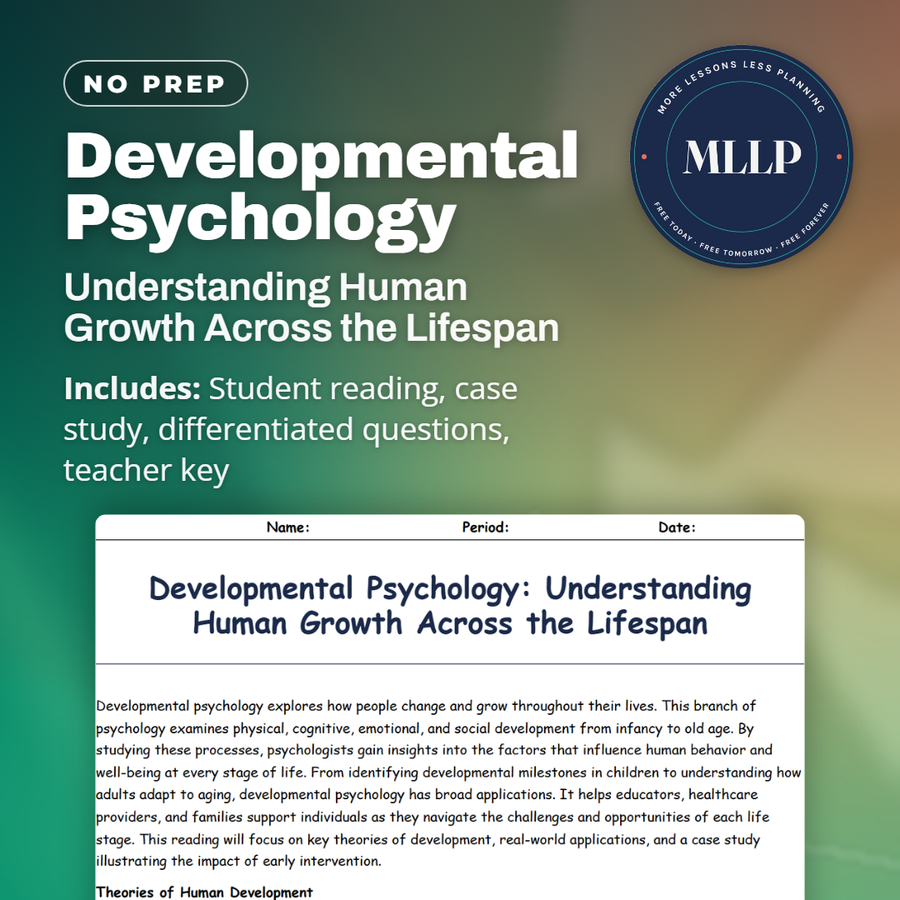
Developmental Psychology: Understanding Human Growth Across the Lifespan
Educational Psychology: Understanding Learning Processes and Teaching Strategies
Health Psychology: The Link Between Mind and Body
Industrial/Organizational Psychology: Understanding Workplace Behavior and Productivity
Every lesson on this site is free to download and use. If one of them saved you a prep period, you can chip in a few bucks toward my three kids' daycare fund. That's genuinely where tips go.