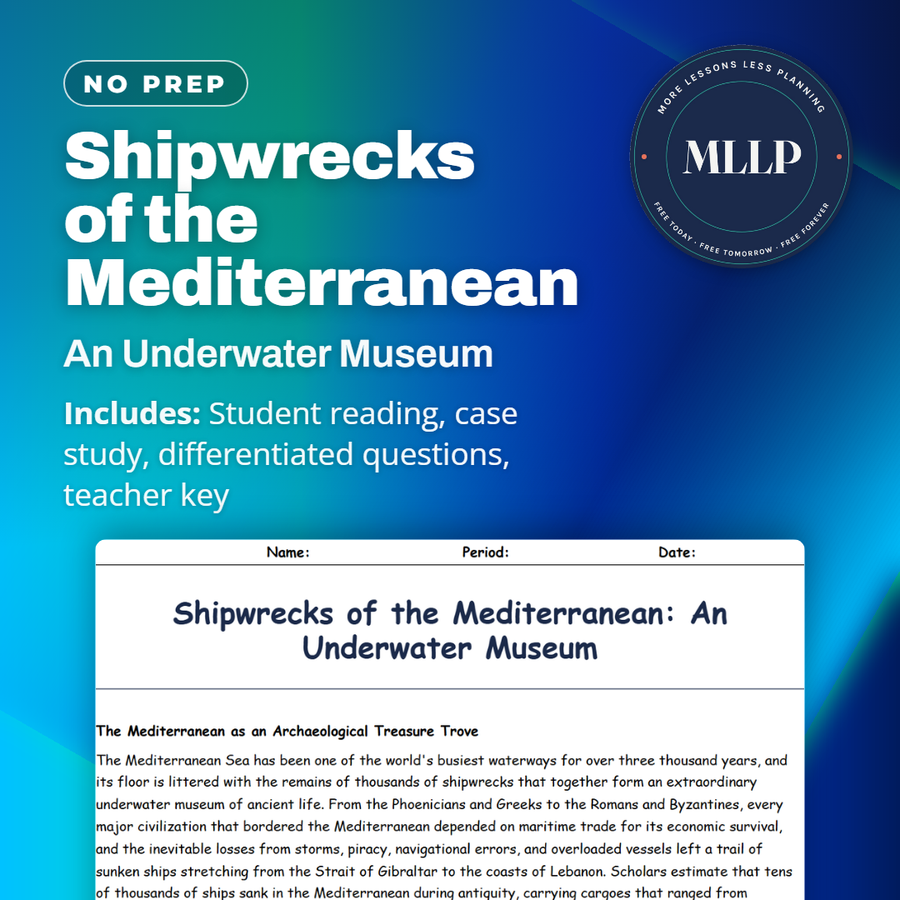
Shipwrecks of the Mediterranean: An Underwater Museum
Quality reviewed September 2026
Facts verified September 21, 2026
- Subject
- Social Studies
- Grades
- Grades 9-12
- Length
- 9-page student worksheet
- Time
- About one 50-minute class period
- Great for
- Sub plans and independent work
- Includes
- Reading passage, comprehension questions + full answer key
- Format
- Print-and-go PDF
What students do
- Load Ammon's ship as a Bronze Age merchant captain, balancing copper, tin, glass, and ivory from at least six civilizations before a risky voyage
- Match five terms, including amphora and marine archaeology, to their correct definitions
- Compare why cold, low-oxygen water preserves a shipwreck's cargo better than most land-based sites preserve the same objects
- Three short-answer questions ask how a corroded bronze lump from the Antikythera wreck turned out to be a 2,000-year-old mechanical computer
What it covers
- The Uluburun wreck's cargo from at least seven Bronze Age civilizations in a single ship
- How the Antikythera mechanism's 30-plus gears predicted eclipses over 2,000 years ago
- Why cold, low-oxygen deep water preserves shipwrecks better than most land-based sites
Start reading this worksheet
The Mediterranean as an Archaeological Treasure House
The Mediterranean Sea has been one of the world's busiest waterways for over three thousand years, and its floor is littered with the remains of thousands of shipwrecks that together form an extraordinary underwater museum of ancient life. From the Phoenicians and Greeks to the Romans and Byzantines, every major civilization that bordered the Mediterranean depended on maritime trade for its economic survival, and the inevitable losses from storms, piracy, navigational errors, and overloaded vessels left a trail of sunken ships stretching from the Strait of Gibraltar to the coasts of Lebanon. Scholars estimate that tens of thousands of ships sank in the Mediterranean during antiquity, carrying cargoes that ranged from everyday pottery and basic foodstuffs to priceless works of art and precious metals. Unlike sites on land, which are often disturbed by centuries of human activity, construction, and farming, shipwrecks on the sea floor can remain remarkably well preserved. The cold, dark, oxygen-poor conditions of deep water slow the decay of organic materials like wood, leather, rope, and even food, sometimes keeping them intact for thousands of years. Sediment gradually buries a wreck, creating an additional protective layer that shields artifacts from ocean currents and marine organisms that would otherwise break them down. A single shipwreck can function as a time capsule, preserving a snapshot of a specific moment in history along with the complete cargo manifest of goods being traded between civilizations. Because the cargo sank all at once, archaeologists can study the full range of goods that traveled together on a single voyage, something that is almost impossible to reconstruct from scattered land-based finds. Marine archaeology, the scientific study of these underwater sites, has transformed our understanding of ancient trade networks, shipbuilding technology, and cultural exchange across the ancient world. Before underwater archaeology developed in the mid-twentieth century, much of what scholars knew about ancient maritime trade came from written records and the occasional artifact that washed ashore or was pulled up in fishing nets. The invention of the aqualung by Jacques Cousteau and Emile Gagnan in 1943 made underwater sites far easier to reach, allowing divers to remain submerged long enough to conduct systematic excavations for the first time. Today, marine archaeologists use advanced technology including sonar mapping, remotely operated vehicles, photogrammetry for creating three-dimensional digital models of wreck sites, and saturation diving techniques to locate and carefully excavate shipwrecks at depths that were previously unreachable.
The Uluburun Wreck: A Bronze Age Time Capsule
One of the most important shipwrecks ever discovered is the Uluburun wreck, found in 1982 by a local sponge diver named Mehmed Cakir off the southwestern coast of Turkey at a depth of about 50 meters. Dating to approximately 1300 BCE during the Late Bronze Age, this ship carried one of the richest and most diverse cargoes ever recovered from the ancient world. Over eleven consecutive excavation seasons led by George Bass and Cemal Pulak of the Institute of Nautical Archaeology, divers made over 22,000 individual dives and recovered more than 18,000 individual artifacts, making it one of the most thoroughly excavated underwater sites in history. The cargo included ten tons of Cypriot copper ingots shaped like oxhides for easy handling, one ton of tin ingots from central Asia, hundreds of glass ingots from Egypt or Mesopotamia in shades of cobalt blue and turquoise, ebony logs from tropical Africa, elephant tusks and hippopotamus teeth from the eastern Mediterranean, Baltic amber that had traveled thousands of miles from northern Europe, and Canaanite jars filled with resin and other trade goods. The sheer weight of the metal cargo alone exceeded eleven tons, making this one of the most heavily laden merchant vessels known from the Bronze Age. The ship also carried weapons, tools, jewelry, and personal items belonging to the crew, including a gold scarab bearing the name of Egyptian Queen Nefertiti and a set of bronze merchant weights that suggest the crew conducted business using multiple measurement systems from different cultures. Archaeologists also recovered a wooden writing tablet, the oldest known example of a book-like object, which would have been coated in wax for recording commercial transactions during the voyage. What makes the Uluburun wreck so significant is not just the volume of its cargo but the number of different civilizations represented in a single ship. Goods from at least seven distinct cultures, including Mycenaean Greek, Egyptian, Canaanite, Cypriot, Kassite, Assyrian, and Baltic, were packed aboard this vessel, demonstrating that international trade during the Bronze Age was far more extensive and interconnected than scholars had previously believed. The wreck fundamentally changed how historians understand the ancient economy, proving that a sophisticated system of long-distance exchange linked civilizations across thousands of miles long before the classical Greek and Roman periods. Analysis of the ship's hull revealed it was constructed from cedar and oak using a technique called plank-first construction, where the outer shell was built before the internal frame, a method common in the eastern Mediterranean during the Bronze Age.
Like what you read? The full reading, the case study, and every question set are in the free download below, along with the answer key.
Why this matters
Shipwrecks solve a problem land archaeology cannot, a sunken cargo hold is a single moment frozen in place, while a house site gets rebuilt, looted, and reused for centuries before anyone excavates it. That is why the Uluburun wreck is more useful to historians than a comparable amount of scattered land finds would be, and it is worth having students sit with why completeness matters as much as age. The Antikythera mechanism adds a second point worth naming directly, the assumption that ancient technology was simple gets disproven by a single object, and the object that did it spent two thousand years on a seabed nobody had searched.
From one teacher to another
The Mediterranean seafloor holds an estimated tens of thousands of ancient shipwrecks, and this reading uses two of the most famous to show what that cargo can teach historians. The Uluburun wreck, found off Turkey in 1982, carried ten tons of copper, a ton of tin, glass ingots, ebony, ivory, and even Baltic amber, goods from at least seven distinct Bronze Age cultures packed onto a single ship around 1300 BCE. A case study asks students to think through that same voyage from the deck, as merchant captain Ammon loads his hold and checks the balance of a heavily weighted vessel before sailing into waters known for sudden storms. The Antikythera wreck gets equal attention, especially the corroded bronze device pulled from its debris field that turned out to be a mechanical computer with more than 30 gears, built to predict eclipses roughly 2,000 years before Europe built anything comparable again. Roman amphorae round out the reading, showing how a simple ceramic jar shape can map an entire empire's trade routes.
What you get
Download
Where should I send the next one?
Everything here is free and it stays that way. Leave your email and I'll send you the new lessons as they go up. You can unsubscribe from any one of them.
Related resources
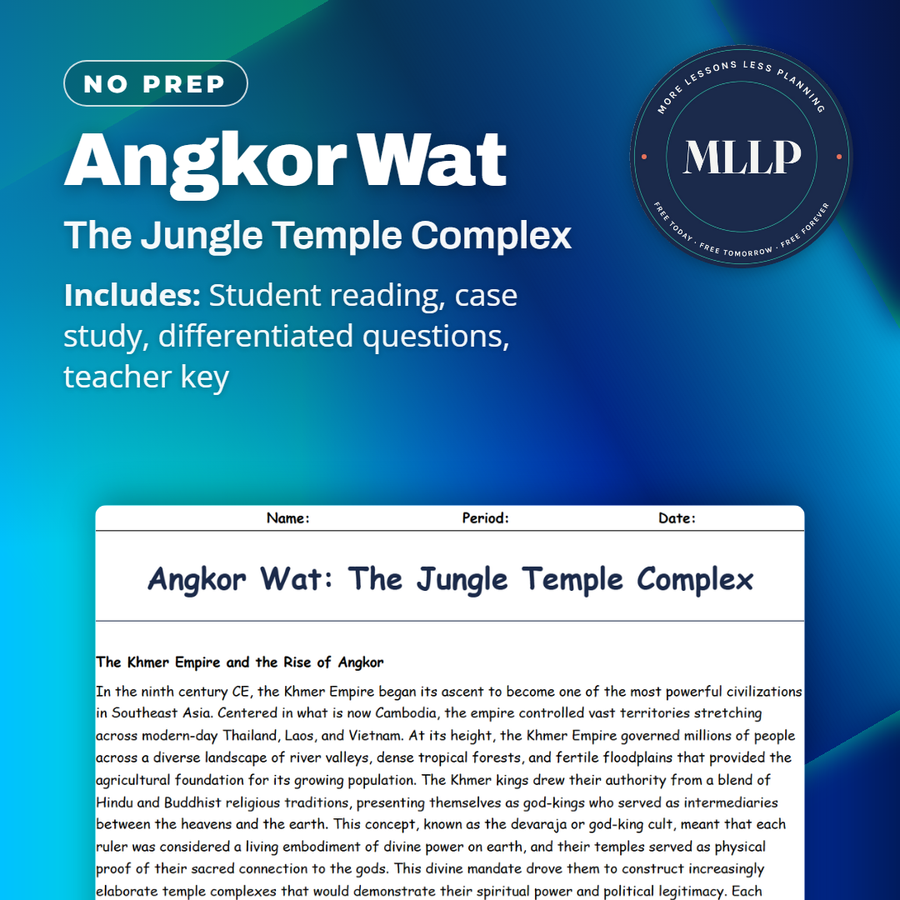
Angkor Wat: The Jungle Temple Complex
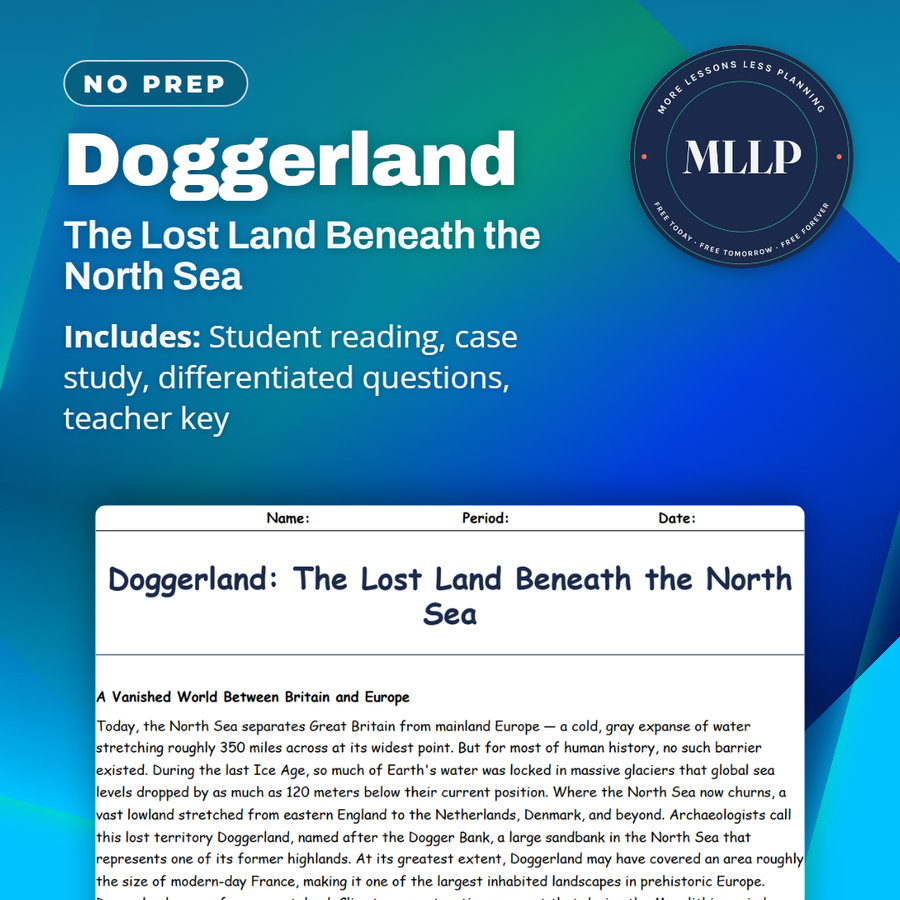
Doggerland: The Lost Land Beneath the North Sea
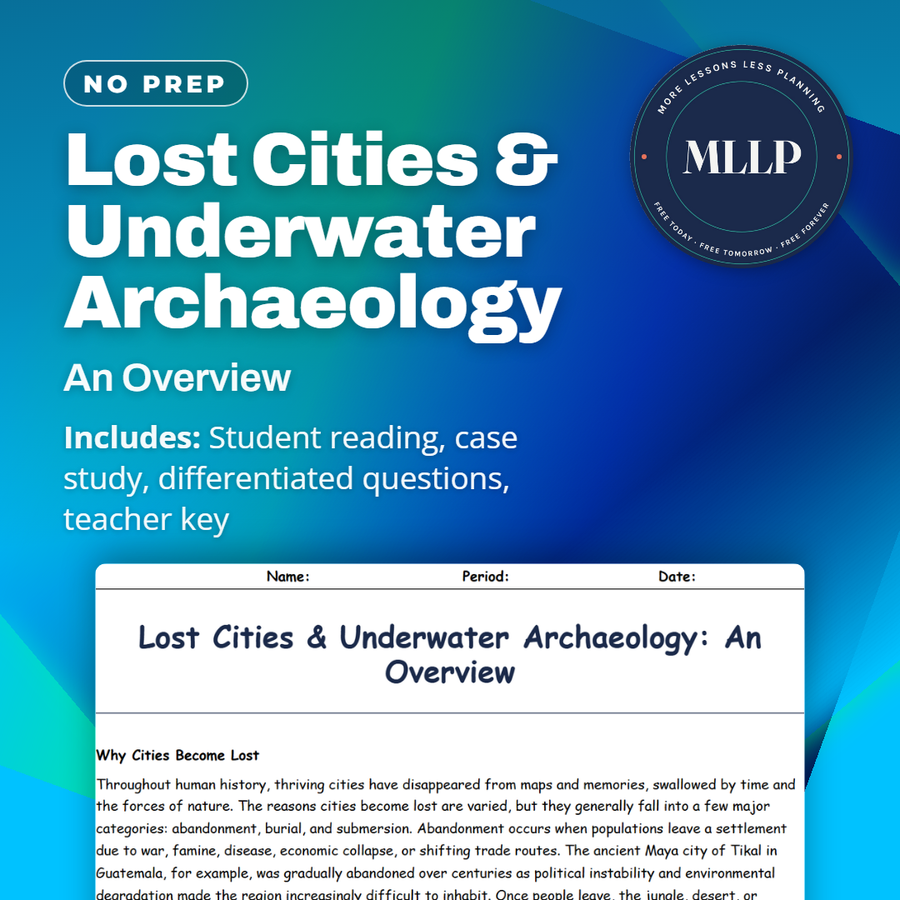
Lost Cities & Underwater Archaeology: An Overview
Machu Picchu to Gobekli Tepe: Sites That Rewrote the Textbooks
Petra: The Rose-Red City Carved in Stone
Pompeii and Herculaneum Revisited: New Discoveries Still Emerging
Every lesson on this site is free to download and use. If one of them saved you a prep period, you can chip in a few bucks toward my three kids' daycare fund. That's genuinely where tips go.