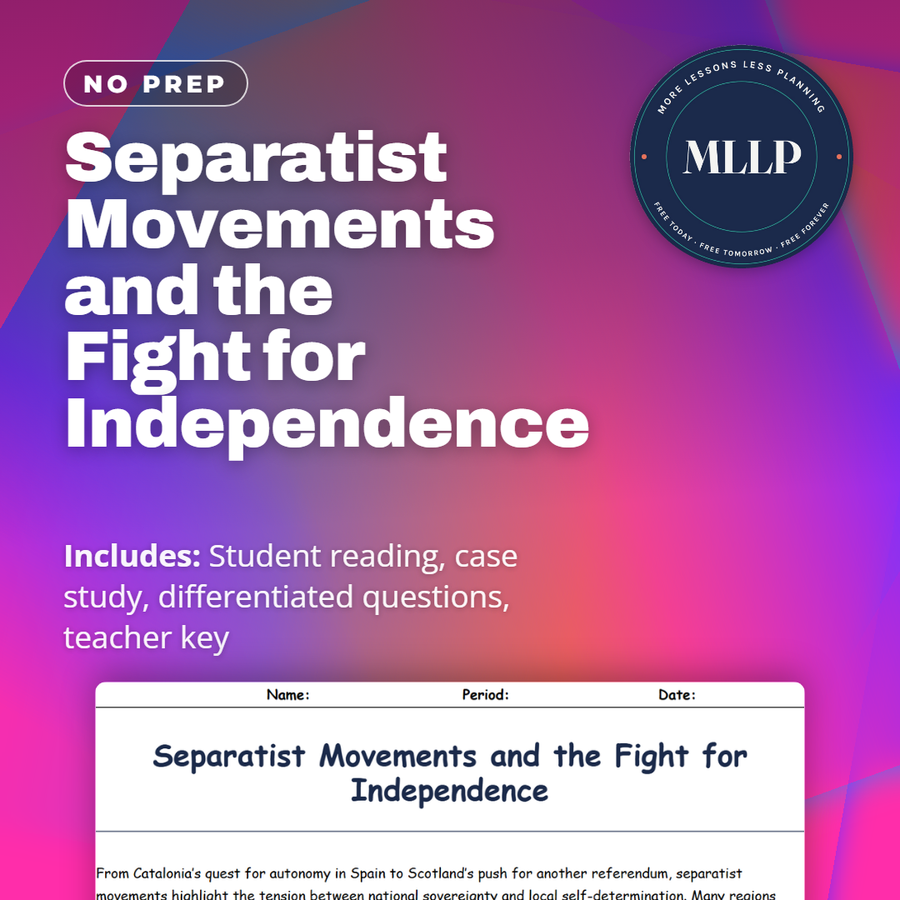
Separatist Movements and the Fight for Independence
Quality reviewed September 2026
Facts verified September 14, 2026
- Subject
- Social Studies
- Grades
- Grades 9-12
- Length
- 7-page student worksheet
- Time
- About one 50-minute class period
- Great for
- Sub plans and independent work
- Includes
- Reading passage, comprehension questions + full answer key
- Format
- Print-and-go PDF
What students do
- Match terms like Self-Determination, Federalism, and Secession to their correct definitions
- Fill in the blank sentences on the Quebec referendum, federal systems, and secession
- Answer multiple choice questions on why separatist movements emerge and which region seceded from Sudan in 2011
- Write short answers on how economic disparity can fuel separatist movements and what a successful secession can inspire elsewhere
What it covers
- Separatist movements in Catalonia, Scotland, Quebec, and South Sudan, and what drives each one
- The legal challenges facing secession attempts, including the fear of a domino effect among states
- A case study excerpt on Quebec's cultural identity within Canada's federal system
Start reading this worksheet
From Catalonia’s quest for autonomy in Spain to Scotland’s push for another referendum, separatist movements highlight the tension between national sovereignty and local self-determination. Many regions seek greater control over their affairs—some want full independence, others desire federal arrangements or cultural recognition.
Historical and Modern Contexts
Separatist movements have long existed, from the American colonies breaking away from Britain to Balkan states leaving the Ottoman Empire. Today, some movements rely on democratic methods like referendums, while others engage in armed conflict. Economic grievances often spark separatist sentiment, as regions feel their resources benefit the central government more than local communities. Cultural and linguistic differences can deepen the divide, especially if minorities feel marginalized.
Case Studies: Catalonia and Scotland
Catalonia, a wealthy Spanish region with its own language, has repeatedly called for independence. The Spanish government argues that such a move violates the constitution and threatens national unity. Tensions peaked in a 2017 referendum deemed illegal by Madrid, leading to arrests of Catalan leaders. Many Catalans resent perceived overreach by Spain, though others worry about the economic fallout of secession. Scotland, part of the UK since 1707, held a referendum in 2014. Although a majority voted to stay, the Brexit decision revived independence debates, as Scots largely opposed leaving the EU. In both cases, cultural identity and economic concerns intersect.
Like what you read? The full reading, the case study, and every question set are in the free download below, along with the answer key.
Why this matters
Most students assume every separatist movement wants what South Sudan got in 2011: a clean break into a new country. Reading Catalonia, Scotland, and Quebec side by side breaks that assumption fast. Quebec never left Canada's federal system, and that shows secession is one outcome among several, not the definition of the whole movement.
What I want students to notice is the pattern underneath the different outcomes: economic disparity mixed with cultural identity shows up in nearly every case here. Naming that pattern is what stops them from treating each movement as its own isolated story, and gets them asking the same questions about the next one.
From one teacher to another
I like that this reading covers several separatist movements side by side instead of just one, so students start to see the pattern of economic grievance plus cultural identity that shows up again and again. The Quebec case study is a nice contrast to Catalonia and South Sudan because it shows a movement that stayed inside the federal system rather than breaking away. The key terms table gives students the vocabulary, like self-determination and domino effect, to talk about why some regions push for independence and others settle for autonomy. This pairs well with the nation-state reading.
What you get
Download
Where should I send the next one?
Everything here is free and it stays that way. Leave your email and I'll send you the new lessons as they go up. You can unsubscribe from any one of them.
Related resources
Colonialism and Imperialism: Shaping the Modern Political Map
Drawing the Lines: Borders, Boundaries, and Political Control
Geopolitics Explained: Power, Territory, and Global Influence
How Elections Are Mapped: A Guide to Electoral Geography
Nation, State, or Nation-State? Understanding Global Political Units
Political Conflicts and Border Disputes Around the World
Every lesson on this site is free to download and use. If one of them saved you a prep period, you can chip in a few bucks toward my three kids' daycare fund. That's genuinely where tips go.