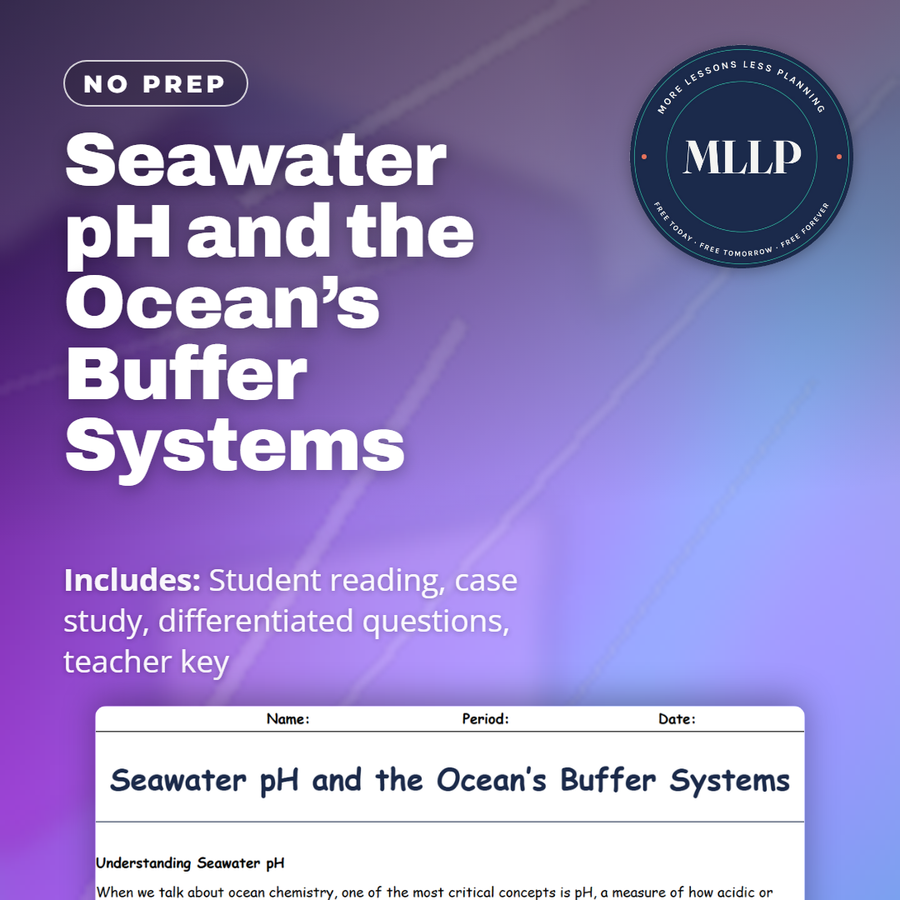
Seawater pH and the Ocean’s Buffer Systems
Quality reviewed September 2026
Facts verified September 14, 2026
- Subject
- Science
- Grades
- Grades 9-12
- Length
- 7-page student worksheet
- Time
- About one 50-minute class period
- Great for
- Sub plans and independent work
- Includes
- Reading passage, comprehension questions + full answer key
- Format
- Print-and-go PDF
What students do
- Match terms like carbonate buffer, carbonic acid, ocean acidification, bicarbonate, and calcium carbonate to their correct definitions
- Fill in the blank sentences on whether seawater pH runs basic or acidic, what makes up the carbonate buffer, and what shell-building removes from seawater
- Answer multiple choice questions on the average pH of seawater, which ion marine organisms use to build shells, and what happens when extra hydrogen ions enter the water
- Write short answers and case study questions on why the ocean's buffer is compared to blood pH regulation, how human activity threatens the buffer system, and why coral reefs act as an early-warning ecosystem for pH change
What it covers
- How the carbonate buffer system, built on the balance between carbon dioxide, bicarbonate, and carbonate ions, keeps seawater pH stable
- How the buffer system can be overwhelmed by the volume of carbon dioxide humans release, lowering pH faster than natural processes normally allow
- A case study on how lower pH from upwelling and other stressors slows coral growth and weakens reef skeletons in parts of the Pacific Ocean
Start reading this worksheet
Understanding Seawater pH
When we talk about ocean chemistry, one of the most critical concepts is pH, a measure of how acidic or basic a solution is. Pure water has a neutral pH of 7, while lower numbers indicate acidity and higher numbers indicate alkalinity. The pH of seawater is slightly basic, averaging around 8.1. This might not seem far from neutral, but even small shifts in pH can have big consequences for marine life. The reason seawater maintains such a stable pH is because of its buffering capacity. Buffers are systems that resist rapid changes in pH, even when acids or bases are added. In the ocean, the most important buffering system is the carbonate system. This involves a balance between carbon dioxide (CO₂), bicarbonate (HCO₃⁻), and carbonate (CO₃²⁻) ions. The carbonate buffer works by shifting chemical reactions depending on whether the seawater becomes more acidic or more basic. If extra hydrogen ions (H⁺) are introduced, bicarbonate can absorb them, preventing a major drop in pH. On the other hand, if the water becomes too basic, carbonate can release ions to balance things out. This self-regulating system is what makes seawater chemistry both stable and resilient—at least under natural conditions.
The Carbonate Buffer in Action
The carbonate buffer system operates like a natural safety net. When CO₂ dissolves into seawater, it reacts with water to form carbonic acid (H₂CO₃). This acid quickly dissociates into bicarbonate and hydrogen ions. These hydrogen ions can then interact with carbonate to form more bicarbonate. Because of this, the ocean can absorb large amounts of CO₂ without dramatic shifts in pH. This balance is vital for marine life. Many organisms, including corals, mollusks, and some plankton, rely on carbonate ions to build their calcium carbonate (CaCO₃) shells and skeletons. If pH changes too much, the concentration of carbonate ions decreases, threatening these organisms. Scientists compare the buffering system of the ocean to the body’s ability to regulate blood pH. Just as blood must stay within a narrow pH range to keep us alive, seawater must maintain a steady balance to support ecosystems. Without the carbonate buffer, the ocean would be much more vulnerable to changes in acidity from natural processes such as volcanic eruptions or river runoff.
Like what you read? The full reading, the case study, and every question set are in the free download below, along with the answer key.
Why this matters
Human blood holds its pH within a narrow range because even a small shift is dangerous, and seawater runs on a similar chemical guardrail. The carbonate buffer absorbs extra hydrogen ions by shuffling carbon dioxide, bicarbonate, and carbonate back and forth, keeping ocean pH just above neutral.
Students assume a buffer means the ocean is protected no matter what, so the coral reef case study matters. Reefs in parts of the Pacific already show slower growth and weaker skeletons as the buffer gets pushed past what it can recover from, a chemistry problem turning visible as biology.
From one teacher to another
Seawater sits at a pH just above neutral, and keeping it there takes a constant chemical balancing act. This worksheet explains the carbonate buffer system, how it absorbs extra hydrogen ions without letting pH swing wildly, and what happens when it gets pushed past its limits. The case study on coral reefs shows how even modest drops in pH can slow reef growth and weaken existing structures.
What you get
Download
Where should I send the next one?
Everything here is free and it stays that way. Leave your email and I'll send you the new lessons as they go up. You can unsubscribe from any one of them.
Related resources
Chemical Tracers and Ocean Circulation
Dissolved Gases in Seawater: Oxygen, CO₂, and Nitrogen
Gas Solubility in the Ocean: Temperature and Salinity Effects
Nitrogen and Phosphorus in the Ocean: Vital Nutrient Cycles
Nutrient Limitation Across Ocean Zones
Ocean Acidification: Threats to Marine Life
Every lesson on this site is free to download and use. If one of them saved you a prep period, you can chip in a few bucks toward my three kids' daycare fund. That's genuinely where tips go.