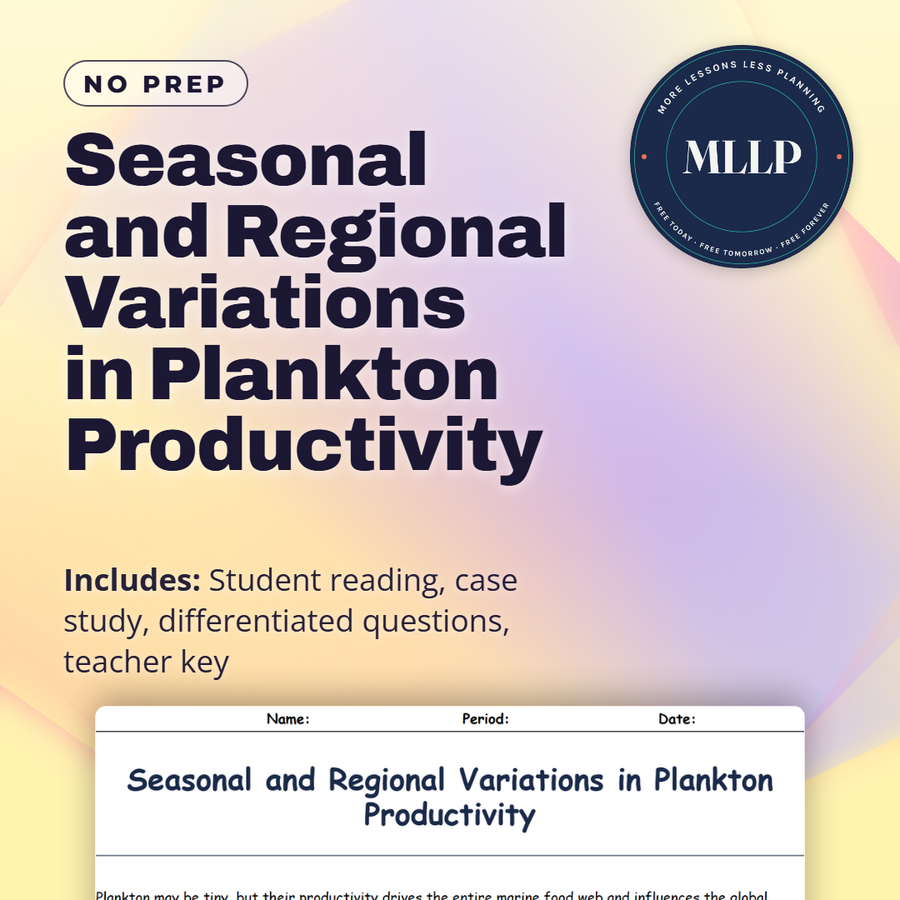
Seasonal and Regional Variations in Plankton Productivity
Quality reviewed September 2026
Facts verified September 14, 2026
- Subject
- Science
- Grades
- Grades 9-12
- Length
- 6-page student worksheet
- Time
- About one 50-minute class period
- Great for
- Sub plans and independent work
- Includes
- Reading passage, comprehension questions + full answer key
- Format
- Print-and-go PDF
What students do
- Match terms like polar oceans, temperate oceans, tropical oceans, and upwelling zones to their correct definitions
- Fill in the blank sentences on seasonal sunlight, krill, and global fisheries
- Answer multiple choice questions on summer productivity declines, the least productive ocean regions, and upwelling
- Write short answers on why open ocean gyres are called marine deserts, how climate change threatens plankton cycles, and why upwelling regions matter to economies
What it covers
- How seasonal cycles of light, nutrients, and stratification drive plankton blooms in temperate and polar regions
- Why open ocean gyres stay unproductive while upwelling zones support major fisheries
- A case study on the North Atlantic spring bloom and its link to global carbon storage
Start reading this worksheet
Plankton may be tiny, but their productivity drives the entire marine food web and influences the global climate. Phytoplankton, the photosynthetic organisms in the ocean, are the foundation of marine ecosystems. Their abundance, however, is not constant. It changes with the seasons and varies by region. These fluctuations are controlled by factors such as light availability, nutrient supply, water temperature, and mixing of ocean layers. Studying plankton productivity helps scientists understand why some regions of the ocean are teeming with life while others are comparatively barren. It also explains why fish migrations, whale feeding patterns, and even global carbon cycles are tied to the seasonal rhythms of plankton.
Seasonal Changes in Productivity
In temperate and polar regions, plankton productivity follows a distinct seasonal cycle. During spring, increasing sunlight and nutrient-rich waters create massive spring blooms of phytoplankton. These blooms often support equally large populations of zooplankton, which feed on the phytoplankton and in turn support higher-level predators such as fish and whales. By summer, surface waters warm and stratify, creating a barrier that prevents nutrients from mixing upward from deeper layers. This leads to a decline in productivity, even though sunlight remains abundant. In autumn, cooling waters allow mixing again, sparking smaller secondary blooms. Winter typically brings low productivity due to limited sunlight, but nutrients accumulate for the following spring. In tropical waters, the cycle is less dramatic because sunlight is available year-round. However, nutrient scarcity limits productivity. Seasonal changes here often depend on events like monsoons or upwelling, which bring nutrients to the surface.
Regional Differences in Productivity
Not all parts of the ocean are equally productive. The polar oceans experience intense but brief periods of high productivity during summer, when continuous daylight supports large phytoplankton blooms. These blooms are critical for species such as krill, which form the base of Antarctic food webs. In contrast, the open ocean gyres—vast central areas of the Pacific and Atlantic—are among the least productive regions on Earth. These areas lack nutrients due to stable, stratified water columns. Although sunlight is plentiful, phytoplankton cannot thrive without the necessary building blocks. Coastal zones and upwelling regions are the most productive areas, supporting rich fisheries. For example, the California, Peru, and Canary Current upwellings bring deep, nutrient-rich water to the surface, fueling massive plankton blooms. These regions are responsible for a disproportionate share of global fish catches.
Like what you read? The full reading, the case study, and every question set are in the free download below, along with the answer key.
Why this matters
Picture the open ocean and it's tempting to imagine the richest habitat on the planet. The center of a gyre tells a different story: a nutrient-starved marine desert, while productivity elsewhere swings hard with season, from a brief polar summer bloom to the upwelling zones that support entire fisheries.
What trips students up is assuming more sunlight always means more life, so the North Atlantic spring bloom corrects that. Copepods, herring, and cod key their year around that seasonal surge, and the same bloom pulls carbon into the ocean, tying plankton timing to a real fishing economy.
From one teacher to another
Plankton productivity swings with the seasons and the region in this reading, from brief polar summer blooms to the steady, nutrient-starved waters of the open ocean gyres. The case study returns to the North Atlantic spring bloom, tracking how copepods and fish like herring and cod respond to the seasonal surge in phytoplankton. It ties bloom timing to both marine food webs and carbon storage.
What you get
Download
Where should I send the next one?
Everything here is free and it stays that way. Leave your email and I'll send you the new lessons as they go up. You can unsubscribe from any one of them.
Related resources
Chemosynthesis at Hydrothermal Vent Communities

Cyanobacteria and the Breath of Life
Diatoms, Dinoflagellates, and Coccolithophores Explained
Harmful Algal Blooms: Red Tides, Toxins, and Ecological Consequences
Photosynthesis in the Marine Environment
Phytoplankton: The Powerhouse of the Oceans
Every lesson on this site is free to download and use. If one of them saved you a prep period, you can chip in a few bucks toward my three kids' daycare fund. That's genuinely where tips go.