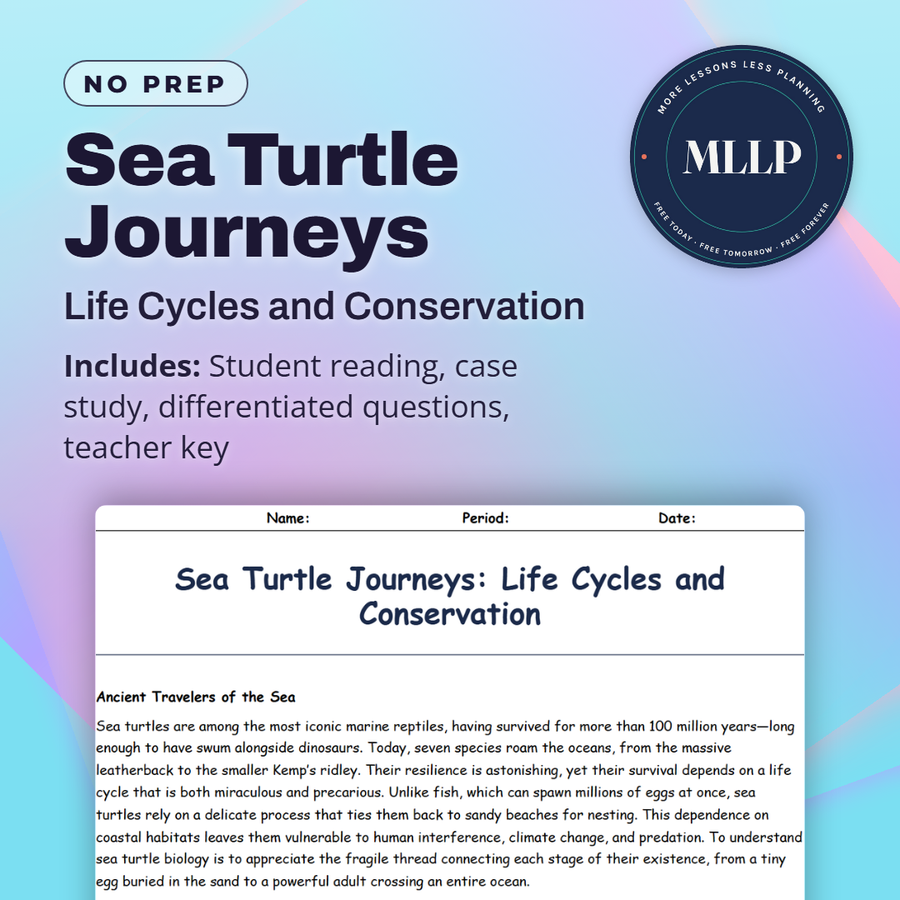
Sea Turtle Journeys: Life Cycles and Conservation
Quality reviewed September 2026
Facts verified September 14, 2026
- Subject
- Science
- Grades
- Grades 9-12
- Length
- 8-page student worksheet
- Time
- About one 50-minute class period
- Great for
- Sub plans and independent work
- Includes
- Reading passage, comprehension questions + full answer key
- Format
- Print-and-go PDF
What students do
- Match prompts like hatchling crawl, juvenile years, magnetic orientation, and turtle-excluder devices to the correct description
- Fill in the blank sentences on the 1 in 1,000 hatchling survival rate, magnetic field navigation, and plastic mistaken for jellyfish
- Answer multiple choice questions on what determines hatchling sex, what the lost years are, and what happens when turtles mistake plastic for food
- Write short answers on why the lost years are hard to study, how adult turtles benefit ecosystems through diet, and how climate change threatens turtles at nesting and at sea
What it covers
- The full sea turtle life cycle, from eggs buried in sand through the mysterious lost years to adult migration and nesting
- How rising temperatures and other conservation threats affect sea turtle populations, including bycatch and plastic pollution
- A case study on the Kemp's ridley sea turtle recovery at Rancho Nuevo, Mexico, after decades of egg poaching and bycatch
Start reading this worksheet
Ancient Travelers of the Sea
Sea turtles are among the most iconic marine reptiles, having survived for more than 100 million years—long enough to have swum alongside dinosaurs. Today, seven species roam the oceans, from the massive leatherback to the smaller Kemp’s ridley. Their resilience is astonishing, yet their survival depends on a life cycle that is both miraculous and precarious. Unlike fish, which can spawn millions of eggs at once, sea turtles rely on a delicate process that ties them back to sandy beaches for nesting. This dependence on coastal habitats leaves them vulnerable to human interference, climate change, and predation. To understand sea turtle biology is to appreciate the fragile thread connecting each stage of their existence, from a tiny egg buried in the sand to a powerful adult crossing an entire ocean.
From Egg to Hatchling: A Risky Beginning
Every sea turtle life begins with a journey ashore by the mother. At night, females drag themselves onto beaches, often the very same ones where they hatched years earlier. Using their powerful front flippers, they dig a deep nest and lay anywhere from 50 to over 100 eggs. Once covered with sand, the nest incubates for about two months. During this time, temperature plays a decisive role. Warmer sand produces more female hatchlings, while cooler sand produces more males—a phenomenon called temperature-dependent sex determination. When the hatchlings emerge, their struggle begins. Tiny and vulnerable, they must scramble from nest to surf while avoiding predators like birds, crabs, and raccoons. Even reaching the water does not guarantee safety; fish and larger predators await in the shallows. It is estimated that only 1 in 1,000 hatchlings will survive to adulthood, underscoring how every successful nest is critical for population stability.
Adolescence at Sea: The Lost Years
After entering the ocean, hatchlings embark on what biologists call the “lost years.” For a decade or more, young turtles drift with ocean currents, carried by systems like the Gulf Stream. During this time, they remain elusive to researchers, feeding on plankton, small invertebrates, and anything they can find while floating among seaweed mats. Their small size and wide distribution make them difficult to study, which is why these years remain one of the greatest mysteries in marine biology. As they grow larger, turtles shift habitats, moving from open ocean to coastal feeding grounds. Species diverge in their diets: green turtles transition to seagrass, shaping seafloor ecosystems; hawksbills consume sponges, influencing reef communities; loggerheads crush crabs and mollusks with strong jaws. Each species fills an important ecological niche, maintaining balance within ocean ecosystems.
Like what you read? The full reading, the case study, and every question set are in the free download below, along with the answer key.
Why this matters
Out of every 1,000 hatchlings that crawl toward the surf, roughly one survives to adulthood. This reading follows what happens to the rest as well as the lucky few: the lost years at sea researchers still cannot fully track, plus threats like plastic mistaken for jellyfish and bycatch.
Students are surprised that a species that has survived more than 100 million years can still be pushed toward collapse this fast, so the Kemp's ridley recovery at Rancho Nuevo matters. Decades of egg poaching and bycatch nearly ended that population, and decades of protection brought it back. Conservation runs in decades, not school years.
From one teacher to another
Sea turtles have survived for more than 100 million years, and this worksheet traces the fragile life cycle that keeps them going today. Students follow a turtle from a buried nest on a beach through the little-understood lost years at sea to adulthood, when magnetic navigation guides long migrations back to nesting beaches. The case study covers the Kemp's ridley recovery at Rancho Nuevo, where conservation efforts brought a nearly lost population back from the edge.
What you get
Download
Where should I send the next one?
Everything here is free and it stays that way. Leave your email and I'll send you the new lessons as they go up. You can unsubscribe from any one of them.
Related resources
Fish in the Sea: Anatomy, Physiology, and Adaptations
Gentle Giants: Manatees and Dugongs
Humans and the Ocean: Impacts on Marine Vertebrates
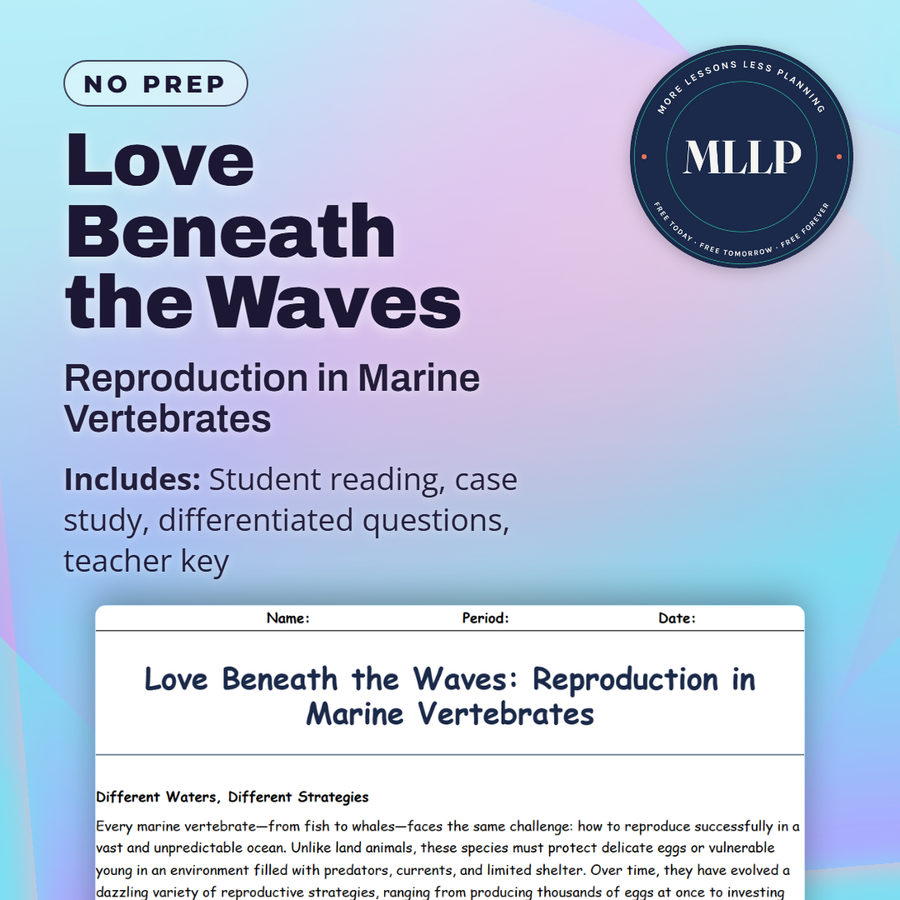
Love Beneath the Waves: Reproduction in Marine Vertebrates
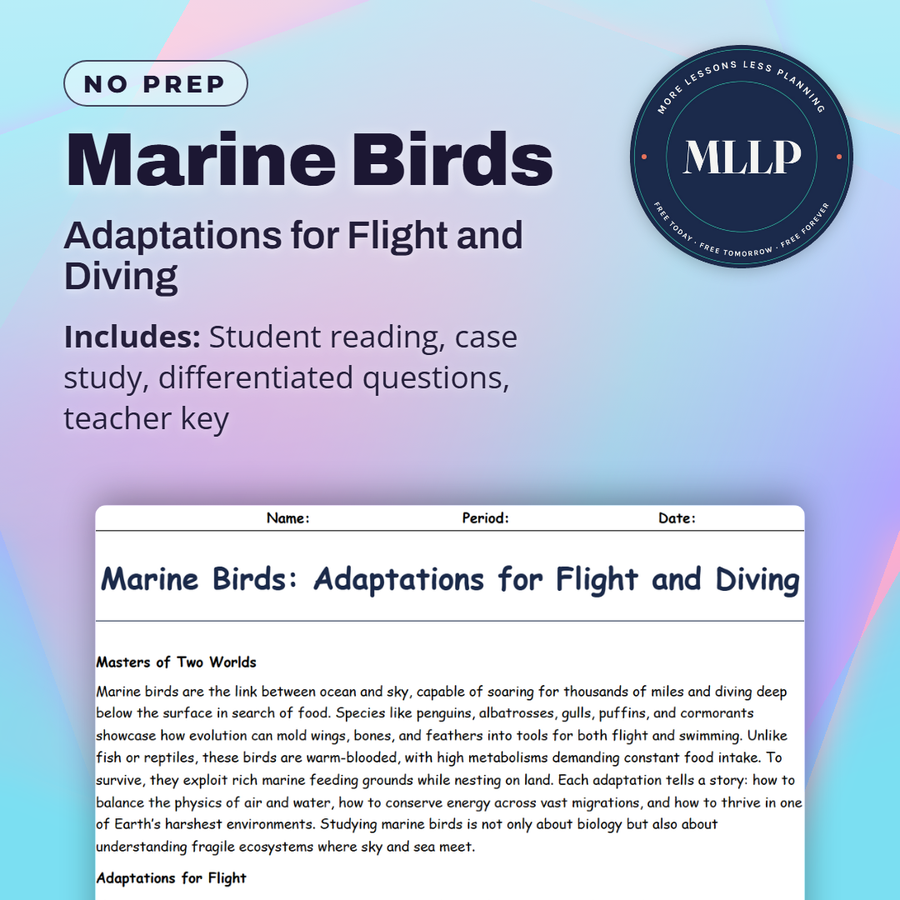
Marine Birds: Adaptations for Flight and Diving
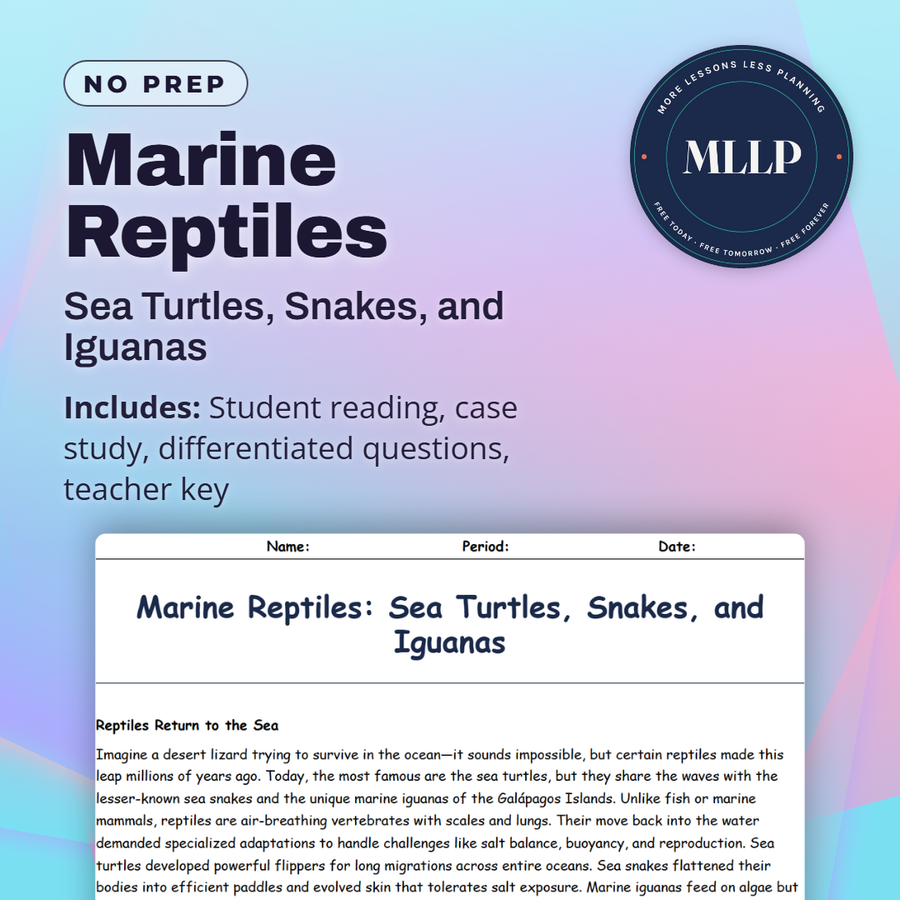
Marine Reptiles: Sea Turtles, Snakes, and Iguanas
Every lesson on this site is free to download and use. If one of them saved you a prep period, you can chip in a few bucks toward my three kids' daycare fund. That's genuinely where tips go.