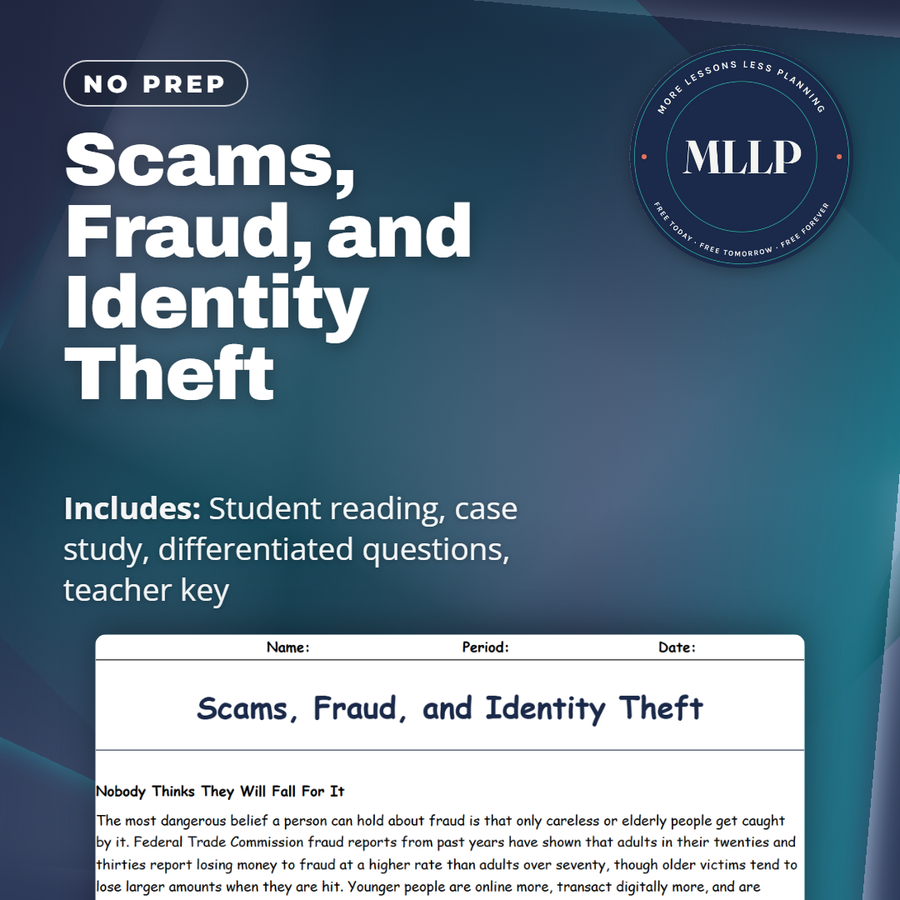
Scams, Fraud, and Identity Theft
Quality reviewed September 2026
Facts verified September 23, 2026
- Subject
- Career & Life Skills
- Grades
- Grades 9-12
- Length
- 9-page student worksheet
- Time
- About one 50-minute class period
- Great for
- Sub plans and independent work
- Includes
- Reading passage, comprehension questions + full answer key
- Format
- Print-and-go PDF
What students do
- Identify the three part pattern, unexpected contact, urgency, and unusual payment, in a sample scam
- Tyler's job offer gets checked against the reading's own warning signs of a fake check scam
- Explain why a one time verification code should never be read aloud to a caller
- The correct order of steps after identity theft gets put back in sequence
What it covers
- The three part pattern shared by nearly every scam, from unexpected contact to unusual payment
- Phishing, one time codes, and the account hygiene habits that defeat most of it
- Tyler's fake job offer case study and the fake check scam behind it
Start reading this worksheet
Nobody Thinks They Will Fall For It
The most dangerous belief a person can hold about fraud is that only careless or elderly people get caught by it. Federal Trade Commission fraud reports from past years have shown that adults in their twenties and thirties report losing money to fraud at a higher rate than adults over seventy, though older victims tend to lose larger amounts when they are hit. Younger people are online more, transact digitally more, and are targeted with scams built specifically for the platforms they use. Confidence is not protection. It is the condition scammers count on. Fraud is deception carried out for financial gain, and modern fraud is not the work of a lone stranger improvising. It is an industry with scripts, call centers, quality control, and specialization, and the people running it test their approaches on thousands of targets and keep whatever converts best. That is why the messages feel professional now, with correct logos, real company phone numbers spoofed onto caller identification, and websites cloned pixel for pixel. The old advice to watch for bad spelling is largely obsolete, and where errors still appear they are frequently deliberate, filtering out skeptical readers so the operators only spend time on people likely to comply. The reliable defense is not spotting a typo. It is recognizing the structure of the request itself, because the underlying pattern has barely changed in fifty years even as the packaging has become flawless.
The Shape Every Scam Shares
Almost every scam, regardless of story, combines the same three ingredients, and learning that pattern is worth more than memorizing any list of specific frauds. First, an unexpected contact. The message arrives without you initiating anything, whether by text, email, phone call, direct message, or a pop-up. Second, manufactured urgency paired with a strong emotion, usually fear or excitement. Your account will be closed today, a warrant has been issued, your package cannot be delivered, you have won something that expires in an hour. The purpose of urgency is uniform across all of them, which is to prevent you from stopping to verify, because verification kills every scam that exists. Third, an unusual method of payment or an unusual request for information. Legitimate organizations do not require gift cards, wire transfers, cryptocurrency, payment applications sent to strangers, or a code read aloud from your phone. Gift cards in particular are the single loudest alarm in consumer fraud. No government agency, utility, employer, bank, or court has ever accepted a gift card as payment, and any request for one is fraud without exception. When those three ingredients appear together, the story wrapped around them does not matter. The correct response is always the same and always simple: stop, do not use any contact information contained in the message, and independently verify through a number or website you locate yourself.
The Ones Aimed at Students
Several scams target high school and college-age people specifically, and they are worth naming because recognition is nearly instant once you have heard them. The fake check or overpayment scam is the most common. Someone hires you for a remote job, sends a check for more than the agreed amount, and asks you to deposit it and send back the difference or buy equipment from their vendor. Your bank makes the funds available in a day or two, which people mistake for the check clearing, and when it bounces a week later you owe the bank the full amount you sent. Banks make funds available before verification, and that gap is the entire scam. The job scam is close behind, advertising unusually high pay for vague work, requiring no interview, and eventually requesting a fee, personal financial information, or the use of your bank account to process payments, which is money laundering and is a crime even if you did not know. Rental scams post apartments below market with a landlord conveniently out of the country who needs a deposit before a showing. Concert and event ticket scams sell tickets that do not exist or are sold to several people at once. Romance and social engineering scams build trust over weeks before any money is mentioned. Scholarship scams charge for applications and guarantee awards, and legitimate scholarships never charge a fee. The thread running through every one of them is that the target is asked to send money or information first and receive the promised thing afterward, which is the exact reverse of how a legitimate transaction is structured.
Like what you read? The full reading, the case study, and every question set are in the free download below, along with the answer key.
Why this matters
Job scams, fake check offers, and phishing texts are aimed specifically at people with a thin financial history and a real need for extra money, which describes most teenagers looking for weekend or summer work. The reading's warning that adults in their twenties report losing money to fraud at a higher rate than adults over seventy cuts directly against the assumption that only older or careless people get caught, which is exactly the confidence scammers count on. Recognizing the three part pattern before a wire transfer or a shared verification code, rather than after, is the difference between Tyler's story ending with a question from his sister and ending with a debt he cannot recover.
From one teacher to another
Tyler posts on a job board looking for weekend work, and four days later a stranger offers him a remote job, no interview required, along with a check for two thousand one hundred dollars he is told to deposit and partly wire back. The reading names the three part pattern behind almost every scam, unexpected contact, manufactured urgency, and an unusual payment request, and shows why gift cards are the loudest warning sign of all. Students learn how a fake check clears just enough to look real before it bounces, why a one time verification code is a key rather than a confirmation, and the correct order for reporting identity theft once it happens. Tyler's sister stops him with a single question before he sends the wire, asking who he actually interviewed with.
What you get
Download
Where should I send the next one?
Everything here is free and it stays that way. Leave your email and I'll send you the new lessons as they go up. You can unsubscribe from any one of them.
Related resources
Advertising Tactics: How You Get Persuaded
Building a Household Budget
Comparison Shopping and Unit Pricing
Consumer Rights and Responsibilities
Grocery Shopping on a Budget
Making a Major Purchase
Every lesson on this site is free to download and use. If one of them saved you a prep period, you can chip in a few bucks toward my three kids' daycare fund. That's genuinely where tips go.