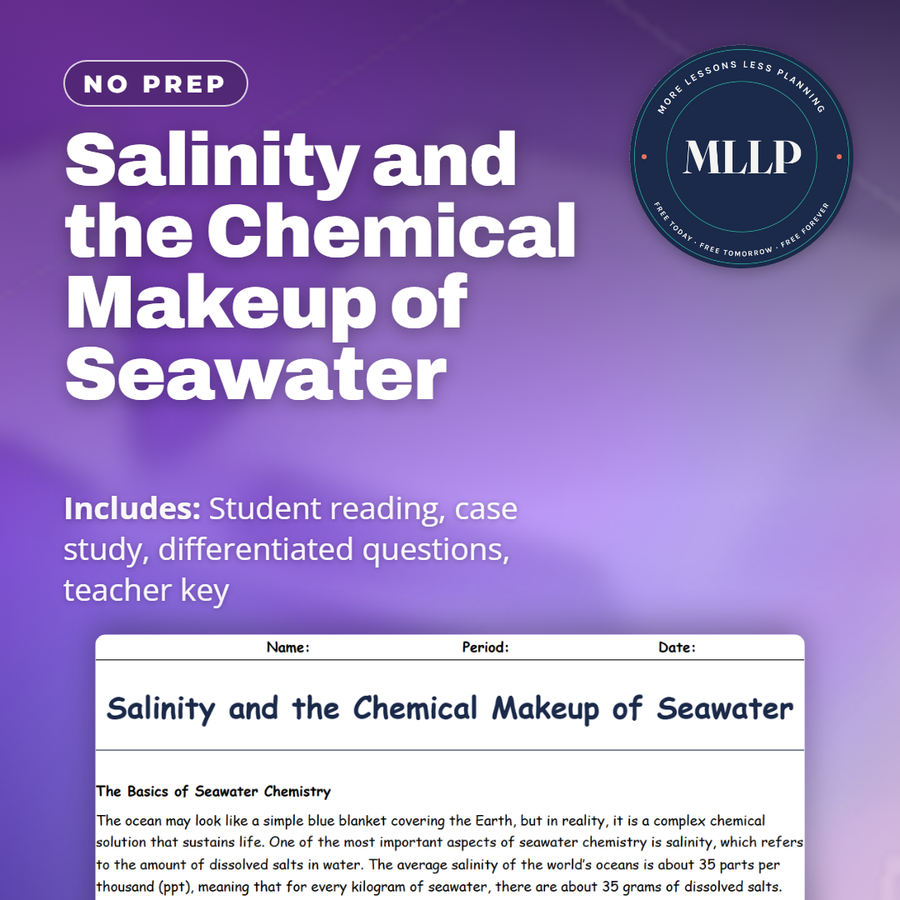
Salinity and the Chemical Makeup of Seawater
Quality reviewed September 2026
Facts verified September 14, 2026
- Subject
- Science
- Grades
- Grades 9-12
- Length
- 7-page student worksheet
- Time
- About one 50-minute class period
- Great for
- Sub plans and independent work
- Includes
- Reading passage, comprehension questions + full answer key
- Format
- Print-and-go PDF
What students do
- Match terms like chloride, the Rule of Constant Proportions, euryhaline organisms, steady state, and residence time to their correct definitions
- Fill in the blank sentences on rock weathering, how salty the Dead Sea is compared to the ocean, and what drives thermohaline circulation
- Answer multiple choice questions on the average salinity of seawater, what adds salts through hydrothermal vents, and which organisms tolerate only narrow salinity ranges
- Write short answers and case study questions on why salinity varies between seas like the Baltic and the Red Sea, how salinity drives the global conveyor belt, and why the Dead Sea became so salty
What it covers
- How salinity, the major ions like chloride and sodium, and the Rule of Constant Proportions define the chemical makeup of seawater
- How weathering, rivers, and hydrothermal vents add salts to the ocean while evaporites and marine organisms remove them, keeping salinity in steady state
- A case study on the Dead Sea, where a lack of any outlet has concentrated salts to nearly ten times the ocean's average
Start reading this worksheet
The Basics of Seawater Chemistry
The ocean may look like a simple blue blanket covering the Earth, but in reality, it is a complex chemical solution that sustains life. One of the most important aspects of seawater chemistry is salinity, which refers to the amount of dissolved salts in water. The average salinity of the world’s oceans is about 35 parts per thousand (ppt), meaning that for every kilogram of seawater, there are about 35 grams of dissolved salts. While this may seem like a small amount, it is enough to create a unique chemical environment that shapes marine ecosystems. The salts in seawater are mostly made up of major ions—including sodium (Na⁺), chloride (Cl⁻), magnesium (Mg²⁺), sulfate (SO₄²⁻), and calcium (Ca²⁺). These ions are remarkably consistent in their relative proportions no matter where you sample seawater. For example, if sodium makes up about 30% of the ions in one region of the ocean, it will also make up about 30% in another. This principle is called the “Rule of Constant Proportions.” It allows scientists to determine salinity by measuring just one ion and then calculating the rest. Salinity is not uniform across the ocean. Some regions, such as the Mediterranean Sea or the Red Sea, have much higher salinity due to strong evaporation and limited freshwater input. In contrast, places like the Baltic Sea or areas near the mouths of large rivers have lower salinity because of high freshwater inflow. These variations in salinity affect density, circulation, and ultimately, the distribution of marine life.
Sources of Salts in the Ocean
Where do these salts come from? Most of the ions in seawater originate from weathering of rocks on land. Rainwater, slightly acidic due to dissolved carbon dioxide, breaks down rocks and minerals. Rivers carry the released ions into the ocean. Another important source is hydrothermal vents, located along mid-ocean ridges. These vents release dissolved minerals and gases from Earth’s crust into seawater. Despite these constant inputs, salinity has remained relatively stable for millions of years. This stability is explained by the concept of a steady state, where the input of salts is balanced by their removal. Salts are removed from the ocean through processes like the formation of evaporite deposits, where salt crystals form in shallow, evaporating basins, or through the incorporation of ions into the shells and skeletons of marine organisms. To understand this balance, scientists compare the residence time of different elements in seawater, or how long they remain before being removed. For instance, sodium has a very long residence time, meaning its concentration in seawater stays steady over geological timescales. In contrast, elements like iron or aluminum have much shorter residence times and can vary significantly.
Like what you read? The full reading, the case study, and every question set are in the free download below, along with the answer key.
Why this matters
The Dead Sea holds nearly ten times the salt of the open ocean because it has no outlet: water leaves only by evaporating while every mineral rivers carried in stays behind and concentrates. The open ocean avoids that fate because its ions arrive from weathering and vents and leave through evaporites and marine life, keeping salinity steady for millions of years.
Students guess that saltier seas simply have more salt, so the Rule of Constant Proportions surprises them: the ratio between the major ions stays fixed everywhere, from the Baltic to the Red Sea, even as total salinity swings widely. Explaining why the Dead Sea broke that balance beats memorizing the number.
From one teacher to another
Seawater's saltiness isn't random. This worksheet walks through where ocean salts come from, why the same ions show up in the same proportions no matter where you sample the water, and how that steady state has held for millions of years. The case study on the Dead Sea shows what happens when the normal balance breaks down and water can only leave through evaporation.
What you get
Download
Where should I send the next one?
Everything here is free and it stays that way. Leave your email and I'll send you the new lessons as they go up. You can unsubscribe from any one of them.
Related resources
Chemical Tracers and Ocean Circulation
Dissolved Gases in Seawater: Oxygen, CO₂, and Nitrogen
Gas Solubility in the Ocean: Temperature and Salinity Effects
Nitrogen and Phosphorus in the Ocean: Vital Nutrient Cycles
Nutrient Limitation Across Ocean Zones
Ocean Acidification: Threats to Marine Life
Every lesson on this site is free to download and use. If one of them saved you a prep period, you can chip in a few bucks toward my three kids' daycare fund. That's genuinely where tips go.