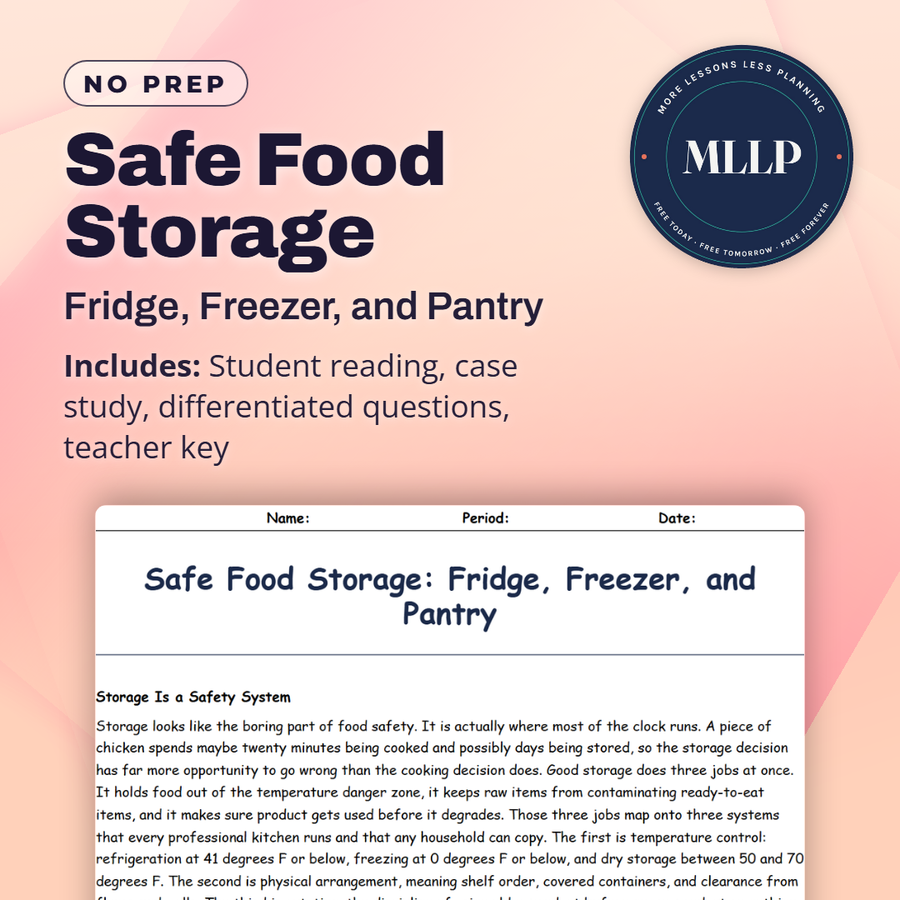
Safe Food Storage: Fridge, Freezer, and Pantry
Quality reviewed September 2026
Facts verified September 23, 2026
- Subject
- Career & Life Skills
- Grades
- Grades 9-12
- Length
- 9-page student worksheet
- Time
- About one 50-minute class period
- Great for
- Sub plans and independent work
- Includes
- Reading passage, comprehension questions + full answer key
- Format
- Print-and-go PDF
What students do
- The three storage systems, temperature, arrangement, and rotation, get separated so students see what each one protects against
- Fill in the blank on the exact fridge and freezer temperatures the reading requires
- Explain why a freezer preserves safety but not quality forever
- Elena's cooler reading gets compared to what the probe thermometer found in the back corner
What it covers
- The correct fridge, freezer, and dry storage temperatures
- Why refrigeration slows bacteria instead of killing them
- The FIFO rule and why every stored item needs a date
Start reading this worksheet
Storage Is a Safety System
Storage looks like the boring part of food safety. It is actually where most of the clock runs. A piece of chicken spends maybe twenty minutes being cooked and possibly days being stored, so the storage decision has far more opportunity to go wrong than the cooking decision does. Good storage does three jobs at once. It holds food out of the temperature danger zone, it keeps raw items from contaminating ready-to-eat items, and it makes sure product gets used before it degrades. Those three jobs map onto three systems that every professional kitchen runs and that any household can copy. The first is temperature control: refrigeration at 41 degrees F or below, freezing at 0 degrees F or below, and dry storage between 50 and 70 degrees F. The second is physical arrangement, meaning shelf order, covered containers, and clearance from floors and walls. The third is rotation, the discipline of using older product before newer product so nothing gets buried and forgotten. A kitchen can nail two of the three and still make somebody sick. A perfectly cold cooler with raw chicken on the top shelf is a hazard, and a beautifully organized cooler running at 48 degrees F is a hazard. The systems only work together. Storage is also where money lives. A household that stores food well throws away noticeably less of it, and a restaurant that stores food well protects a food cost percentage that decides whether the business survives the year. Safety and thrift point in the same direction here, which is not true of every food safety rule.
Refrigeration Is Slowing, Not Stopping
The most common misunderstanding about refrigeration is that cold kills bacteria. It does not. Cold slows bacterial reproduction dramatically, which buys time, but the population is still growing and some species are barely inconvenienced. Listeria monocytogenes actively multiplies at refrigerator temperatures, which is why deli meats and soft cheeses carry warnings for pregnant patients. A refrigerator should hold at 41 degrees F or below, verified by a thermometer inside the unit rather than by the dial on the front, because dials indicate a setting and not an actual measured temperature. Air circulation matters as much as the setting. Overpacking a cooler blocks airflow and creates warm pockets, so a refrigerator that reads 40 degrees F at the sensor may be running 48 in a crowded corner. Leave space between containers, keep food off the floor and away from the walls, and open the door as briefly as possible. Store food in covered containers or wrapped, both to prevent drips and to keep food from absorbing odors and drying out. Cooked leftovers should be refrigerated within two hours, cooled properly rather than dumped in hot, and used within three to four days. Raw ground meat and poultry hold one to two days, whole cuts three to five, and eggs in the shell three to five weeks. Placement inside the unit follows the same logic as temperature. The door is the warmest spot and swings through the widest temperature range every time somebody opens it, which makes it the wrong home for milk and eggs and the right home for condiments that are shelf-stable anyway.
The Freezer Preserves Quality, Not Safety Forever
Freezing at 0 degrees F or below stops bacterial growth entirely, which makes the freezer the most forgiving storage space in the kitchen. Food held continuously at 0 degrees F is safe indefinitely from a pathogen standpoint. What degrades is quality, and it degrades in specific, predictable ways. Freezer burn is the most familiar. It happens when moisture sublimates out of the food's surface and refreezes elsewhere in the package, leaving dry, grayish, leathery patches. Freezer burn is unappetizing but not dangerous, and the affected portion can simply be trimmed off. It is prevented by airtight packaging that excludes air: heavy freezer wrap, freezer bags with the air pressed out, or vacuum sealing. Quality windows are worth knowing. Ground meat holds three to four months, whole cuts of beef and pork four to twelve, poultry pieces nine months, whole poultry a year, and soups and casseroles two to three months. The rules that matter most are about movement. Label everything with contents and the date it went in, because unlabeled frozen items become archaeology. Never refreeze food that has thawed to above 41 degrees F. And do not freeze in a container so large that the center takes a full day to freeze, since everything at the center is sitting in the danger zone while it waits. One exception is worth knowing. Food thawed in the refrigerator that never rose above 41 degrees F may be refrozen safely, though the quality will suffer because ice crystals rupture cell walls a second time. Food thawed on a counter or in warm water may not.
Like what you read? The full reading, the case study, and every question set are in the free download below, along with the answer key.
Why this matters
A cluttered fridge is something almost every one of my students has lived with, and this reading gives them language for why that clutter is more than messy, it is a hazard. Elena's case study is the one that sticks, a deli cooler with a door display reading a safe forty degrees while a packed corner sat seven degrees warmer, because nobody could see the airflow getting blocked. The reading also reframes something families deal with weekly, spoiled food that gets thrown out because nobody tracked how long it had been sitting, against food that gets used because it was rotated to the front. Good storage is the boring half of food safety, and the reading makes the case that boring is where the actual risk lives.
From one teacher to another
Storage looks boring compared to cooking, but the reading opens by pointing out that food spends far more time being stored than it ever spends on a stove, which is exactly why storage mistakes cause so much illness. Students work through the three systems every kitchen runs at once, temperature control, physical arrangement, and rotation, and learn the specific numbers behind each: forty-one degrees F for the fridge, zero for the freezer, and the FIFO rule that puts older stock in front of newer stock. The reading corrects a common myth directly, since refrigeration slows bacteria rather than killing them, and Listeria keeps multiplying at fridge temperature regardless. The case study follows Elena, a deli manager whose cooler read forty degrees on the door while a packed back corner quietly sat at forty-seven.
What you get
Download
Where should I send the next one?
Everything here is free and it stays that way. Leave your email and I'll send you the new lessons as they go up. You can unsubscribe from any one of them.
Related resources
Cleaning vs. Sanitizing: They Are Not the Same Thing
Cross-Contamination and How to Stop It
Date Labels, Spoilage, and When to Throw It Out
Food Handler Hygiene: Gloves, Hair, and When to Stay Home
Foodborne Illness: The Pathogens That Make People Sick
HACCP: How Professionals Keep Food Safe
Every lesson on this site is free to download and use. If one of them saved you a prep period, you can chip in a few bucks toward my three kids' daycare fund. That's genuinely where tips go.