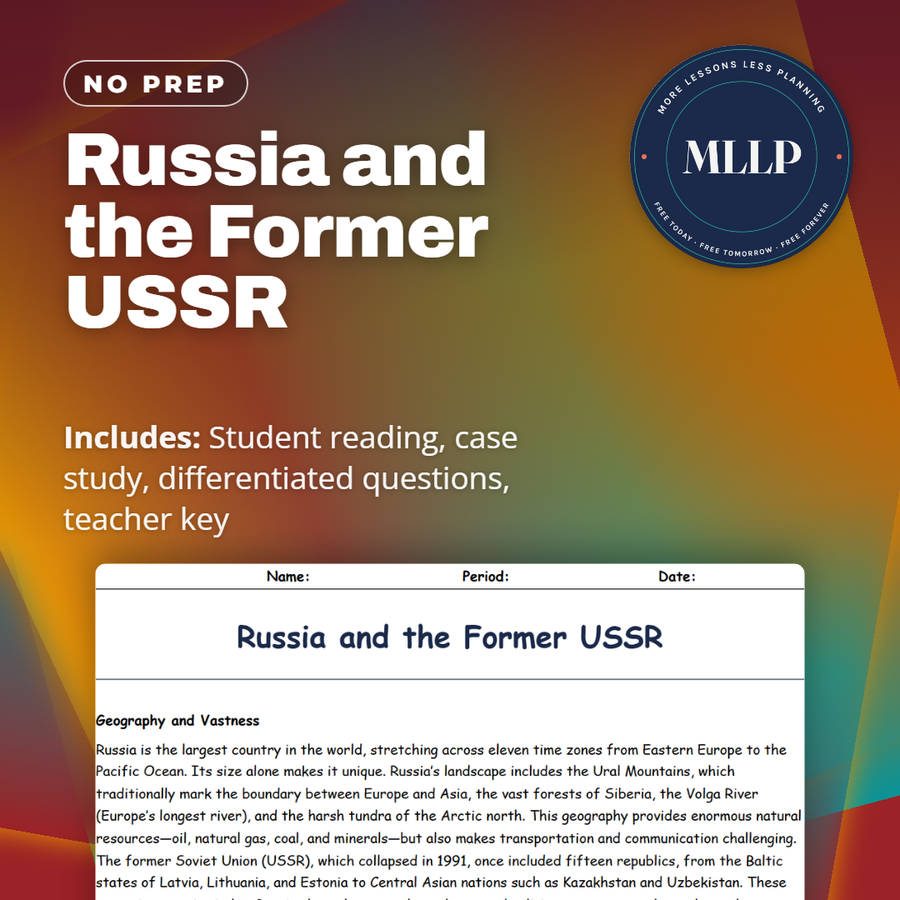
Russia and the Former USSR
Quality reviewed September 2026
Facts verified September 14, 2026
- Subject
- Social Studies
- Grades
- Grades 9-12
- Length
- 7-page student worksheet
- Time
- About one 50-minute class period
- Great for
- Sub plans and independent work
- Includes
- Reading passage, comprehension questions + full answer key
- Format
- Print-and-go PDF
What students do
- Match terms like the Ural Mountains, the Volga River, and Glasnost and Perestroika to their correct definitions
- Fill in the blank sentences on the Ural Mountains, the year the Soviet Union dissolved, and Russia's energy exports
- Answer multiple choice questions on what marked the end of the Soviet Union, Gorbachev's reforms, and which former republics joined the European Union
- Write short answers on how geography shapes Russia's power, why some former Soviet states lean toward Russia while others lean West, and what the USSR's collapse teaches about reform
What it covers
- Russia's vast geography, including the Ural Mountains, the Volga River, and the resource wealth of Siberia
- The political history of the Soviet Union, from the 1917 revolution through Gorbachev's glasnost and perestroika reforms
- A case study on the fall of the Soviet Union in 1991 and the fifteen independent states it created
Start reading this worksheet
Geography and Vastness
Russia is the largest country in the world, stretching across eleven time zones from Eastern Europe to the Pacific Ocean. Its size alone makes it unique. Russia’s landscape includes the Ural Mountains, which traditionally mark the boundary between Europe and Asia, the vast forests of Siberia, the Volga River (Europe’s longest river), and the harsh tundra of the Arctic north. This geography provides enormous natural resources—oil, natural gas, coal, and minerals—but also makes transportation and communication challenging. The former Soviet Union (USSR), which collapsed in 1991, once included fifteen republics, from the Baltic states of Latvia, Lithuania, and Estonia to Central Asian nations such as Kazakhstan and Uzbekistan. These countries remain tied to Russia through geography, culture, and politics, even as many have charted independent paths. Russia’s vast size and location mean it serves as both a European and Asian power, shaping its identity and global role.
History and Political Legacy
The Soviet Union was one of the most powerful states of the 20th century. After the Russian Revolution of 1917, the Bolsheviks established a communist state led by the Communist Party. Under leaders like Joseph Stalin, the USSR became a superpower, rivaling the United States during the Cold War. The government controlled the economy, society, and political life, leading to industrial growth but also widespread repression and shortages. By the late 1980s, economic stagnation and demands for reform weakened the USSR. Mikhail Gorbachev introduced glasnost (openness) and perestroika (restructuring), but these changes accelerated the system’s collapse. In 1991, the Soviet Union dissolved, creating fifteen independent states. Russia emerged as the largest, inheriting much of the Soviet military and economic power, but also facing massive challenges. Today, Russia maintains a strong central government, with Vladimir Putin playing a central role in politics since 2000. While some former Soviet states have joined Western organizations like the European Union or NATO, others remain closely tied to Russia through trade, military alliances, or cultural ties. The legacy of the USSR still shapes the region’s identity and geopolitics.
Economy and Global Influence
Russia’s economy relies heavily on oil and natural gas exports, making it one of the world’s top energy producers. Energy wealth has allowed Russia to remain a major global power, especially in Europe, where many countries depend on Russian gas. However, this dependence has also created vulnerability when energy prices fall or sanctions are imposed. The former Soviet republics vary greatly in their economic paths. The Baltic states have become integrated into the European Union, developing technology and service industries. Central Asia remains resource-rich, with Kazakhstan and Turkmenistan relying on oil and gas. Ukraine, once part of the Soviet Union, has become a focal point of tensions between Russia and the West, especially after Russia’s annexation of Crimea in 2014 and its full-scale invasion of Ukraine in 2022. Despite challenges, Russia maintains influence through its military, energy resources, and diplomacy. Its geography ensures it will always play a role in both Europe and Asia. The former Soviet republics continue to balance independence with the realities of Russian influence.
Like what you read? The full reading, the case study, and every question set are in the free download below, along with the answer key.
Why this matters
In 1991, one country became fifteen. Students who picture the Soviet Union only as a name on an old map are surprised its breakup left new states still choosing sides, some toward Russia's energy exports, some toward the European Union. The Ural Mountains and Volga River explain why Russia's resource wealth in Siberia outlasted the political system built on top of it.
I bring this in right after a lecture on communism, since Gorbachev's reforms are what students misread. Glasnost and perestroika sound like fixes, and my students assume they worked, until they read how those same reforms exposed the weaknesses that ended the Soviet Union instead of solving them.
From one teacher to another
This reading covers Russia's massive geography alongside the political history of the Soviet Union. I like that it walks students straight through the causes of the USSR's collapse, from economic stagnation to Gorbachev's glasnost and perestroika reforms. The case study on the Soviet Union's fall shows how those same reforms exposed weaknesses instead of fixing them, ending in fifteen new independent states. This pairs well with a unit on the Cold War or global government systems.
What you get
Download
Where should I send the next one?
Everything here is free and it stays that way. Leave your email and I'll send you the new lessons as they go up. You can unsubscribe from any one of them.
Related resources
Every lesson on this site is free to download and use. If one of them saved you a prep period, you can chip in a few bucks toward my three kids' daycare fund. That's genuinely where tips go.