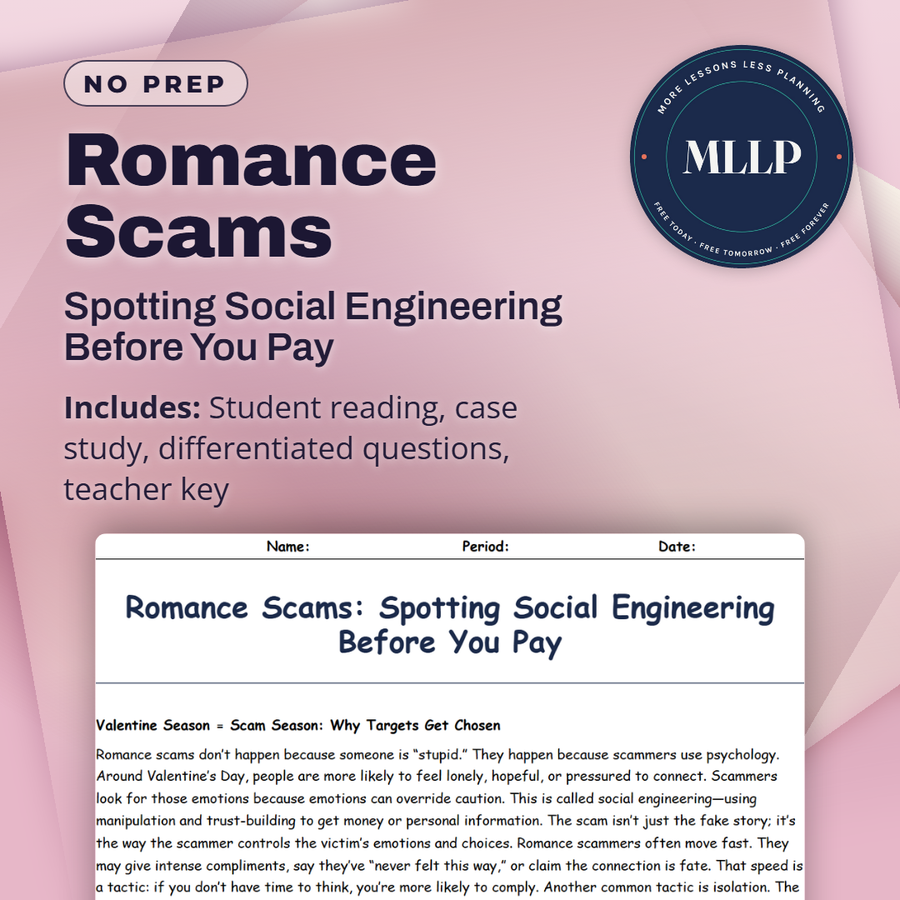
Romance Scams: Spotting Social Engineering Before You Pay
Quality reviewed September 2026
Facts verified September 9, 2026
- Subject
- Career & Life Skills
- Grades
- Grades 9-12
- Length
- 7-page student worksheet
- Time
- About one 50-minute class period
- Great for
- Sub plans and independent work
- Includes
- Reading passage, comprehension questions + full answer key
- Format
- Print-and-go PDF
What students do
- Identify red flags in romance scam patterns and manipulative tactics
- Apply firm boundaries when faced with urgency, isolation, or money requests
- Analyze a case study to distinguish healthy connection from engineered bonding
- Explain how commitment and escalation pressure victims into compliance
What it covers
- Romance scams and social engineering psychology
- Red flags: urgency, isolation, verification avoidance
- Personal boundaries and safe digital practices
Start reading this worksheet
Valentine Season = Scam Season: Why Targets Get Chosen
Romance scams don’t happen because someone is “stupid.” They happen because scammers use psychology. Around Valentine’s Day, people are more likely to feel lonely, hopeful, or pressured to connect. Scammers look for those emotions because emotions can override caution. This is called social engineering—using manipulation and trust-building to get money or personal information. The scam isn’t just the fake story; it’s the way the scammer controls the victim’s emotions and choices. Romance scammers often move fast. They may give intense compliments, say they’ve “never felt this way,” or claim the connection is fate. That speed is a tactic: if you don’t have time to think, you’re more likely to comply. Another common tactic is isolation. The scammer may discourage you from talking to friends or family, claiming “They don’t understand us,” or “Keep this private.” Isolation prevents reality checks. Students should also know that scams don’t only target older adults. Teens and young adults can be targeted through social media DMs, gaming chats, or “friend” requests. Sometimes the scam isn’t romance—it’s a fake friendship that turns into a request for gift cards or account access. The best defense is learning the patterns, recognizing the red flags early, and having a clear rule: no money, no codes, no passwords, no secrecy.
Red Flags That Matter: What Scammers Do on Purpose
A good rule is to look for patterns, not one-off weird moments. Red flags include: refusing video calls, avoiding specific details, repeating dramatic stories, and making excuses for why they can’t meet. Another major red flag is urgency: “I need help right now,” “I’ll lose my job,” “I’m stuck and can’t get home.” Urgency is used to shut down careful thinking. Scammers also use flattery as a tool. Compliments feel good, and the brain wants to believe people who make us feel valued. They may mirror your interests (“I love the same music!”), agree with everything you say, and create a fantasy of perfect compatibility. This isn’t real connection; it’s engineered bonding. Money requests usually start small. “Can you help me with gas?” becomes “Can you send me a gift card?” becomes “Can you wire money?” Gift cards and money transfers are popular because they’re harder to reverse. Another common request is for “verification codes.” A scammer might say, “I need the code you received” to “prove you’re real,” but those codes can be used to break into accounts. Students should also watch for off-platform pressure: scammers push victims to move the chat to private apps where reporting is harder. When someone tries to rush you off the original platform and into secrecy, treat it as a danger sign.
Protecting Yourself: Verification, Boundaries, and Smart Next Steps
Smart online behavior is not paranoia—it’s basic safety. Verification starts with a simple question: does the person’s story match evidence? If someone claims they’re local, do they know local details? If they claim a job, does their story stay consistent? Most importantly, do they agree to a video call? A real person with honest intentions usually understands safety and can verify identity in reasonable ways. Another protection is your own boundary rule: never send money, gift cards, account codes, or passwords to someone you haven’t met and verified. If someone reacts angrily to that boundary, that’s useful information. Healthy people respect boundaries; scammers punish them. Students should also understand digital footprints. Scammers often reuse photos, copy bios, and run multiple conversations at once. If a profile seems too perfect, has few real-life connections, or uses professional-model photos with little personal context, be cautious. If you suspect a scam, the safest move is to stop responding, save evidence (screenshots), report the account, and tell a trusted adult. This is not “being dramatic.” It’s being safe. Finally, remember that embarrassment keeps scams alive. Scammers rely on victims staying silent. A strong safety culture says: talk early, ask for help, and treat it as a learning experience—not a shame moment.
Like what you read? The full reading, the case study, and every question set are in the free download below, along with the answer key.
Why this matters
The messages that work best on romance scam victims are never the obviously fake ones. Scammers are skilled at reading exactly which emotions override caution, and Valentine's Day is when that skill pays off best for them.
The case study is not about someone gullible. Students watch the tactics stack in order instead: isolation first, small money requests that escalate, a refusal to ever video call. What lands hardest is the commitment piece. Once you feel invested, backing out feels like the bigger loss, and that feeling is the exact lever scammers pull. Recognizing the pattern in real time replaces the instinct to feel embarrassed with the instinct to check a fact.
From one teacher to another
Romance scammers aren't stupid. They're skilled psychologists who know that emotions override caution, especially around Valentine's Day. I've watched students connect the dots: isolation ("don't tell anyone") is a tactic, small money requests escalate fast, and video call refusals are a giant red flag. What gets them is the commitment piece. Students realize that feeling invested is exactly what scammers exploit, they make you complicit in your own manipulation. By the case study, they see the pattern in real time and recognize it's not about being dumb; it's about how psychology works.
What you get
Download
Where should I send the next one?
Everything here is free and it stays that way. Leave your email and I'll send you the new lessons as they go up. You can unsubscribe from any one of them.
Related resources
Animal Courtship Biology: Sexual Selection in the Wild
Famous Relationship Cases in Forensics: Evidence vs. Emotion in the Public Eye
Forensic Science and Domestic Violence
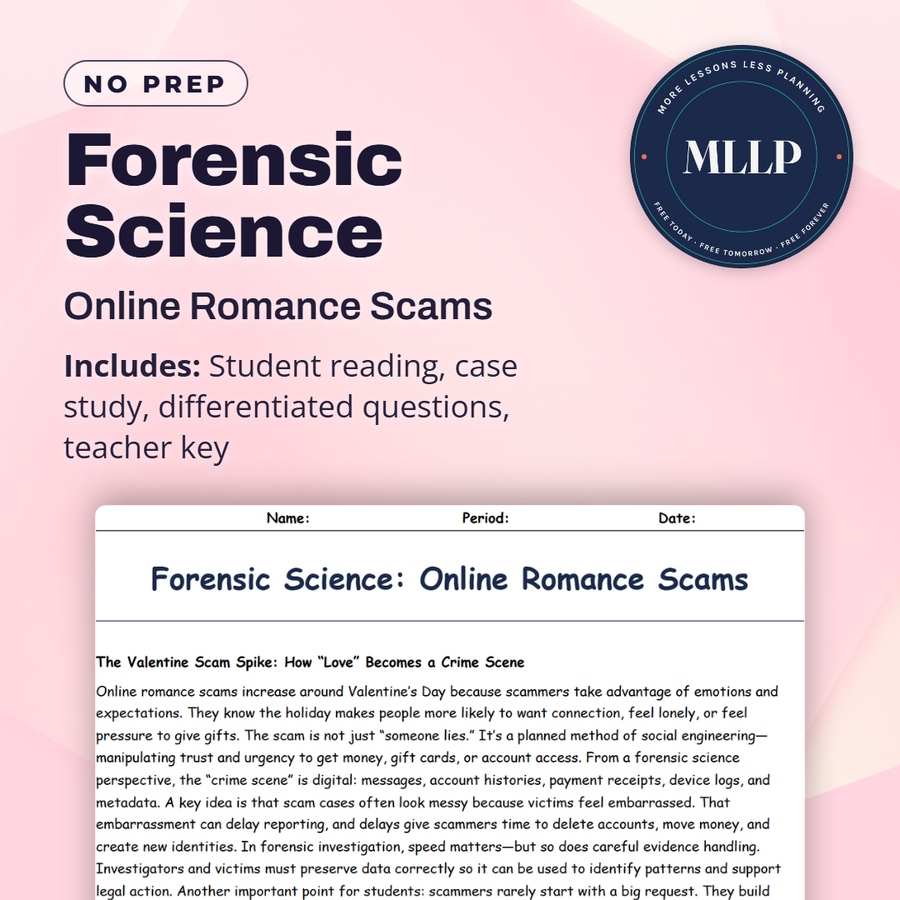
Forensic Science: Online Romance Scams
Government and Relationships: How Laws Have Shaped “Love” in U.S. History
Love Hormones: Oxytocin, Dopamine, and the Brain
Every lesson on this site is free to download and use. If one of them saved you a prep period, you can chip in a few bucks toward my three kids' daycare fund. That's genuinely where tips go.