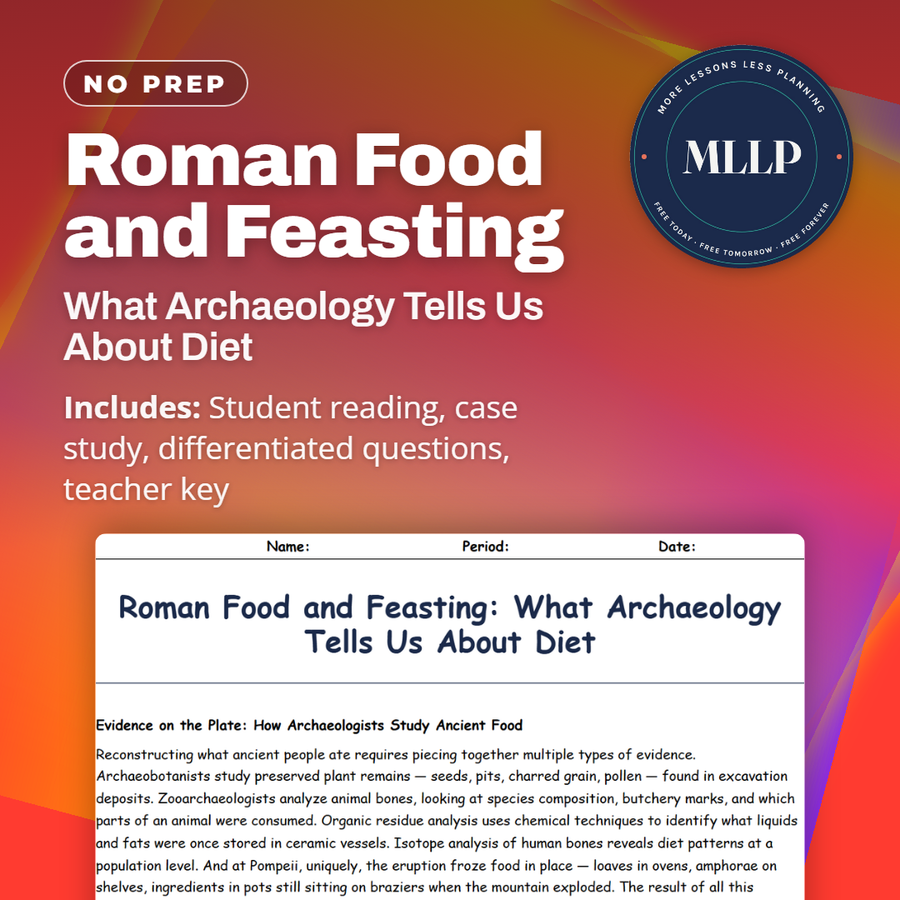
Roman Food and Feasting: What Archaeology Tells Us About Diet
Quality reviewed September 2026
Facts verified September 21, 2026
- Subject
- Social Studies
- Grades
- Grades 9-12
- Length
- 8-page student worksheet
- Time
- About one 50-minute class period
- Great for
- Sub plans and independent work
- Includes
- Reading passage, comprehension questions + full answer key
- Format
- Print-and-go PDF
What students do
- Sextus stirs vats of fermenting fish bound for senators' tables, a product he has never once tasted
- Explain what isotope analysis of Roman skeletons reveals about the gap between rich and poor diets
- Garum's production, grading, and trade routes from Morocco to Britain get traced through the reading's own evidence
- Match food-related vocabulary like thermopolium, triclinium, and annona to what each actually describes
What it covers
- How archaeologists use plant remains, animal bones, and isotope analysis to reconstruct ancient diet
- Garum production and how stamped amphorae reveal its trade routes across the empire
- The gap between elite triclinium feasts and the grain-based diet of most ordinary Romans
Start reading this worksheet
Evidence on the Plate: How Archaeologists Study Ancient Food
Reconstructing what ancient people ate requires piecing together multiple types of evidence. Archaeobotanists study preserved plant remains (seeds, pits, charred grain, pollen) found in excavation deposits. Zooarchaeologists analyze animal bones, looking at species composition, butchery marks, and which parts of an animal were consumed. Organic residue analysis uses chemical techniques to identify what liquids and fats were once stored in ceramic vessels. Isotope analysis of human bones reveals diet patterns at a population level. And at Pompeii, uniquely, the eruption froze food in place: loaves in ovens, amphorae on shelves, ingredients in pots still sitting on braziers when the mountain exploded. The result of all this evidence is a picture of Roman diet that is both familiar and surprising. The Mediterranean triad of grain, olive oil, and wine formed the base of almost everyone's diet, rich or poor. But the range of what Romans ate was broader than many people assume, and the inequality between the diets of the rich and poor was greater than the shared staples suggest.
The Roman Street: Fast Food and Food Shops
Most Romans did not cook at home. Apartment buildings (insulae) typically had no kitchens; fire was too dangerous in densely packed multi-story structures, and fuel for private cooking was expensive. The solution was a dense network of food stalls and thermopolia (fast-food counters) that lined Roman streets. At Pompeii, archaeologists have identified at least 150 thermopolia, roughly one for every 75 residents, a density comparable to modern fast-food districts in busy cities. Thermopolia were simple structures: a counter faced with marble or stone, with circular holes cut to hold large ceramic vessels (dolia) containing hot food and drink. Recent excavation in Regio V at Pompeii uncovered a thermopolium with vivid painted decorations on the counter front and, inside the dolia, the preserved remains of food: fragments of duck bone, pig and goat bone, fish, snails, and eggs. A D-shaped drinking cup was still on the counter. This single food stand tells us more about what ordinary Romans actually ate daily than most ancient cookbooks, which were written for elite audiences and describe elaborate dishes that most people would never encounter.
Garum: The Condiment That Ran an Empire
No Roman food ingredient appears more frequently in ancient sources (and more confusingly to modern readers) than garum. This was a fermented fish sauce made by layering fish (often small fish like anchovies or mackerel) with salt and allowing them to liquefy over months in large vats in the sun. The resulting liquid was filtered off and used as a universal condiment and flavoring agent, added to dishes ranging from vegetables to desserts. Ancient sources describe dozens of varieties: some cheap, some extraordinarily expensive. The finest garum could cost as much per volume as perfume. Garum was not just a condiment but the basis of a massive industry. Amphorae (large ceramic transport vessels) stamped with the producer's name and origin have been found across the Roman world, from Britain to the Black Sea, allowing archaeologists to trace the garum trade routes and identify major production centers. The largest known garum factory in the Roman world was at Lixus in modern Morocco. Archaeological analysis of the trade amphora distribution maps shows garum moving from production centers in Spain, Portugal, North Africa, and the Black Sea into the heart of the empire through a sophisticated commercial distribution system.
Like what you read? The full reading, the case study, and every question set are in the free download below, along with the answer key.
Why this matters
Sextus never tastes the premium garum he spends his days stirring, and that detail says something true about most supply chains, ancient or modern: the people doing the physical work are rarely the ones consuming the finished luxury product. The isotope evidence showing wealthier Romans ate more meat while poorer Romans lived mostly on grain and legumes is also a pattern that shows up in food history far beyond Rome. Students reading about a fermented fish sauce that cost more than perfume are really reading about how status gets built into what people eat, a question that has stuck around long after garum disappeared from anyone's kitchen.
From one teacher to another
Most Romans never cooked at home, which is why the reading spends real time on thermopolia, the street food counters that Pompeii alone had at least 150 of, one for roughly every 75 residents. Students trace how archaeologists reconstruct ancient diet through preserved plant remains, animal bones, and isotope analysis of human skeletons, then meet garum, the fermented fish sauce that ranged from cheap to more expensive than perfume and shows up in trade routes from Britain to the Black Sea. A passage on the wealthy triclinium contrasts stuffed dormice and boiled flamingo with what isotope analysis shows most Romans actually ate: grain, legumes, and cheap wine. Sextus, a seventeen-year-old stirring vats of fermenting fish bound for senators' tables, is the case study's subject.
What you get
Download
Where should I send the next one?
Everything here is free and it stays that way. Leave your email and I'll send you the new lessons as they go up. You can unsubscribe from any one of them.
Related resources


Every lesson on this site is free to download and use. If one of them saved you a prep period, you can chip in a few bucks toward my three kids' daycare fund. That's genuinely where tips go.